Setxu Xirau Roig (Canet de Mar, 1968) is a visual artist who looks more like a walking artwork. Like his extensive experience in set design, it can be detected in his impeccable staging: precise discourse, kind tone, thin face with a good son of Satan beard. The Museu Nacional d'Arte de Catalunya is, in turn, a public cultural institution that tries by all means to overcome bureaucratic obstacles and budgetary limitations to propose projects that are more fun, more original, and more universal than simple exhibition and conservation activity (I was going to say conservative, but Pepe Serra is the opposite of a conservative). This eagerness to step out of the framework of the work, but also out of the administrative framework, has led to two fallen angels converging in an initiative as seductive as it is elegant: L'Ull del Cabirol, it's called. At the Museu Nacional until February 26. Something else.
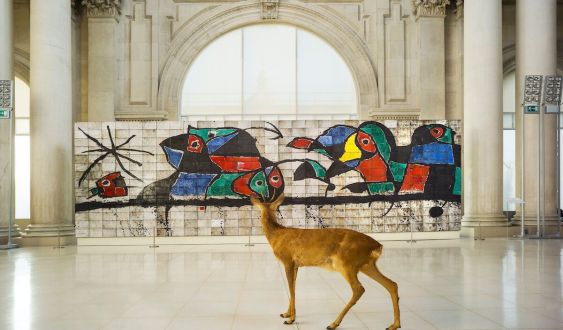
What does it mean to put a roe deer to wander among the works of Catalan art? It means taking off our corset and wig, being a little more daring and making a gesture towards that (not at all negligible, today) number of visitors who will end up saturated with Gothic, Romanesque, Modernism and avant-garde. Not Baroque, all the Baroque is in Madrid, with all due respect for the efforts of the Cambó legacy. The fact is that, when we reach the height of Miró's Mural for IBM in the upper lobby (mural created for the IBM company headquarters on Via Augusta, a building designed by Coderch, later the Departament d'Ensenyament de la Generalitat), we will see that the mural no longer only dialogues with the disconsolate marbles of the Llimonas but that, before, a small stuffed roe deer brings its snout towards the mural as if saying not so much "what is this?" but "what's wrong with you?". "What's wrong, Joan"? "What's wrong with you, humans?". "What are you doing?".
Setxu Xirau Roig has a specialization in Sculpture from the Faculty of Fine Arts Sant Jordi of the University of Barcelona (UB), but also a strong relationship with Paris and with the École Supérieur des Beaux-Arts: in fact, this intervention will travel to Paris during the spring of 2023, specifically to the Sorbonne, in collaboration with the Institut d'Estudis Catalans (IEC). When we discuss it, Setxu, whose work I came to know through the butterflies and large chromatic paintings of the Reial Cercle Artístic some four or five years ago, emphasizes the difference between Paris and Barcelona to me: it's no myth, it's not that we're returning to the topic of Dalí or Miró, of Picasso, it's truly the attitude of the city. "In Paris there is respect," he tells me. I believe him. In Barcelona, it seems that a talented Catalan artist has to grovel, begging for the favor of being able to exist, but there, whether you are more recognized or not so much, whether you manage to exhibit or not, you are respected as an artist. Red carpet, facilities, a minimum of curiosity, a minimum of admiration. When he tells me this, I think that perhaps what we have lost is not so much curiosity (which too) but respect. A roe deer, yes. Naivety, delicacy, vulnerability in front of the work. An attitude that does not forgive your life, but moves you and makes you feel in the same space. On the same planet, at the same moment. And to see it for what it is: a luxury.
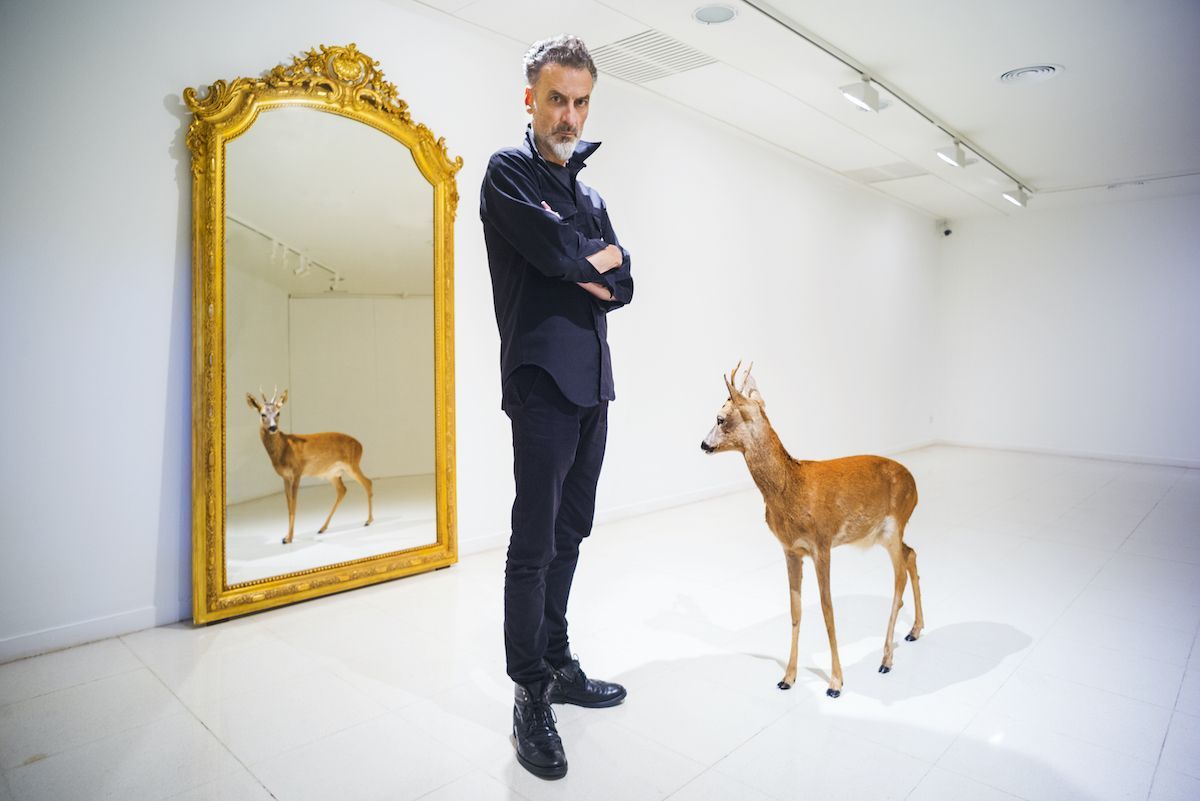
Apart from Miró's mural, you will see another roe deer in the educArt room under the museum's dome: in this case, the roe deer does not bring its snout close but rather raises its head and looks at itself in a mirror. We cannot be in the room; we only act as voyeurs of a scene where the animal explores its own image. As if we were spying on a diva's dressing room. Xirau Roig wanted to bring all the innocence of nature and "liminal" animals (those that live on the border between the city and the forest, like the invasion Barcelona suffered from wild boars during the pandemic) to the highest exponent of civilization, which is an art museum. Observing the observing animal brings us back to the attitude of "looking slowly," starting from scratch and without preconceptions, and above all without haste, quite the opposite of Godard's young people running through the Louvre's corridors in Bande à part. Going back to the other side of the Altamira caves, recapitulating, what has happened during all these millennia in which humans painted roe deer and bison until now, in which nature questions us and our inhuman haste. What have you done, meanwhile. What do you tell me. As if the animal kingdom woke up from a long slumber and had missed both Romanesque and Gothic and Modernism and the avant-garde and now, before a Miró and before a mirror, tried to understand the relationship between a mirror and a Miró.
There is a type of museum that exhibits, conserves, and disseminates: there are others that, in addition, aim to animate. Animals, cartoons, souls, are for Xirau Roig the purest part of expressiveness. Going back to Disney, that is to say to Aesop, that is to say to beasts with human properties that put us in front of the mirror and paralyze us as in taxidermy. A kind of Sagarra's "soul of things," but from mammal to mammal: before the roe deer's eye, we are the black man of Banyoles, the creature of the zoo, the "humanimals." This author, who before going to Paris will exhibit an important installation in the Artur Ramon gallery in Barcelona (eager to see the relics of "nameless saints," which promises to be a tribute to spiritual fetishism), not only asks for respect like the one they have in Paris, but also presents an intervention full of respect for us. A roe deer is a remedy against our cynicism, an invitation to accept fragility and to embrace the immense luxury of having life. That is, having a soul.
Add The New Barcelona Post as your preferred Google source for free
Stay informed with the latest news.
