A couple of grandparents have sat on a bench at the top of the Jardinets de Gràcia. One would say it's a gesture they make every afternoon. The lady retains a hint of elegance in the way she wears her clothes – which now crouch over a somewhat bony body – and in the styling of her white hair, pulled back. The gentleman walks a little straighter than her and seems to maintain some strength that allows him to carry a bag with their snack. From this bag will come a sandwich and a fruit, which they will eat under the shade of the plane trees, amidst the noise of the traffic going up and down. Behind them is Casa Fuster, that kind of enchanted – and enchanting – castle where the poet Salvador Espriu lived, now a hotel with a watchful doorman outside (top hat on his head and upright demeanor) and the warm, orange lights inside, which seduce the passerby, like an advertisement telling him: "Inside here, it's like being in a mother's womb."
If you sit for a while on the benches of the Jardinets de Gràcia, you realize that many buses and motorcycles circulate in Barcelona at the same time. Like an unstoppable waltz. A continuous, incessant current, only crossed by honks. According to the street directory, this place is properly called Jardinets Salvador Espriu. This is a place to find shelter, to stop and rest for a while, as a book of poems might do. The Jardinets are the entrance to Gran de Gràcia street, to the historically working-class and popular Gràcia, coming from the stately and bourgeois Paseo de Gràcia. On both sides, there are now bank branches, jewelers, opticians, real estate agencies, departments of the Generalitat government, and plastic surgery clinics about to open. What would Espriu say about this row of shops and new services? It makes one smile, just thinking about it.
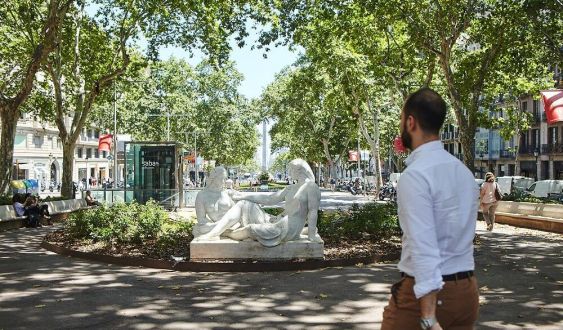
The elderly couple looks like a lifelong Gràcia marriage doing what they have done every afternoon since they retired and their children grew up and their obligations also lightened. When she finishes taking the last bite of a cookie, the lady starts reading a magazine. Very close to the bench where they are sitting, one of the three sculptures that cross the Jardinets remains. It is L'Empordà. Oda nova a Barcelona (1903-1991), a work by Ernest Maragall i Noble, son of the poet Joan Maragall. A naked girl and another in fine clothes appear, looking at each other. The sculpture was created to commemorate the centenary of Maragall's birth (1960) but for years it was installed in Cervantes Park. The poet's grandson and mayor of Barcelona, Pasqual Maragall, ordered it to be moved to the Jardinets de Gràcia. The serene gaze of the two female figures seems to be more in keeping with the contemplative spirit of the green space, a boulevard of modest dimensions – if we compare it with the Parisian ones – designed as a result of the 1929 Barcelona International Exposition.
The grandparents get up, shake off the crumbs and go step by step down the Jardinets. A pigeon –from the enormous community of pigeons that populate them– quickly passed in front of them. Another hops until it takes flight. And a little further on, to the right, three friends try to pair something similar to a song. They carry a piano that is blown, a guitar and the slightly out of tune voice of a girl. On the other side, there are two men with faces of hard work waiting for another to finish the task. OBELISK-BOX ON THE GROUND The grandparents laugh when they see a dog dive into the fountain under the two figures of ladies with an ode-like gesture. The dog shakes off the water with joy and without letting go of the ball it has caught with its mouth. It is young and has also gotten used to spending the afternoon in the Jardinets, chasing the ball, knowing all the hidden holes and nooks in this green bubble. When it comes out of the water, its owner takes the ball out of its mouth and the dog is already far away, behind him, running with its tongue out as if its life depended on it. Now it has ended up in the Solc, Frederic Amat's work dedicated to Espriu, the last of the works installed in the Jardinets (in 2014). It is a box excavated in the ground, in the shape of an obelisk, measuring 17 meters in length. And it casts a shadow on the monument to Francesc Pi i Margall, in Cinc d'Oros square, the confluence of Diagonal and Paseo de Gràcia. The dog slides through this box, once it has caught the ball again, trying to slow down the impulse. It has overlooked the marble plaque, with relief (La lectura, by Josep Clarà), which pays homage to Pompeu Fabra.
The dog happily returns to its owner, as if telling him: I beat you again. The couple of grandparents continue to advance, step by step, imperturbable to the box and the general speed, towards the lower part of the Jardinets. They are greeted by the inscription in Frederic Amat's Espriu-like furrow: "Shine, within the sole knowledge of black, the gold of my dream." The inscription greets the dog and the couple, youth and old age, the passage of time and vain hopes. The grandmother suddenly stops, as if to rest. And in a poetic, coquettish gesture, she smooths her skirt and runs her hand through her hair, backwards.
Add The New Barcelona Post as your preferred Google source for free
Stay informed with the latest news.