Large cities are the heart and brain of countries, and it is in cities where one must auscultate the pulsations of a nation to corroborate whether it enjoys health or has succumbed to decadence. After months of a suffering pandemic, it is logical that Barcelona residents have a fatigued heart, because Covid-19 has taken many lives, has dramatically affected the economy and commerce, and it seems that it will still determine our free activity for months.
In parallel, the pandemic has intensely affected the cultural universe, altering the programming of our auditoriums, museums, and theaters, punishing the life of our athenaeums and our very important civic centers.
[subscribe_newsletter_esp]
But when the heart suffers, one must reactivate the brain to remember that, despite the incidence of the pandemic, Barcelona has not suffered an armed siege or a climatic hecatomb. Faced with the temptation to fall into pessimism, one must resort to work and realism, and this leads us to see that the city's assets and treasures remain practically intact.
Let's repeat it as many times as necessary: when the effects of the pandemic belong to the past, Barcelona will still have the engines that have made it a pioneering and attractive city in the eyes of the whole world.
Let's talk about facts, not conjectures. Last year, our airport hosted 52.7 million passengers and is the headquarters for 212 international destinations to 63 countries on the planet. Fira plays in the Champions League of Europe's major exhibition venues. The last fiscal year closed with a record figure of 215 million euros after successfully organizing more than 150 events.
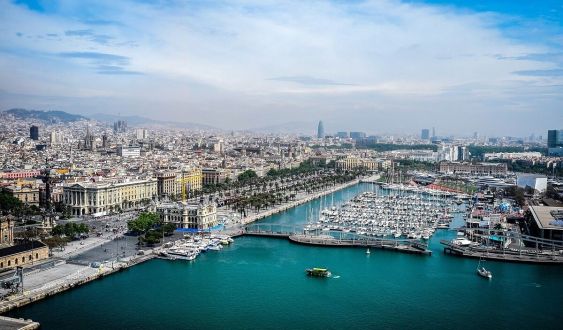
When Barcelona has resisted the onslaught of Covid-19, just as it already overcame many even worse crises strongly and gallantly throughout its millennial history, it will continue to enjoy one of the most important port infrastructures in the world, with 7 terminals where more than 3 million passengers circulated last year. Barcelona has the main cruise port with base and destination in the Mediterranean and is among the first in freight transport.
As in any leading city in the world, in Barcelona economic activity has always gone hand in hand with scientific research. Recently, the European Union has chosen our city to locate the MareNostrum 5, one of the most pioneering and powerful supercomputers on the planet, whose features are already enjoyed by mathematicians, physicists, architects, and geographers of our country in their research and teaching work.
When the heart suffers, one must reactivate the brain to remember that, despite the impact of the pandemic, Barcelona has not suffered an armed siege nor a climate catastrophe.The Centres de Recerca de Catalunya (CERCA) have ranked among the top European research institutions in receiving open and competitive funds from the H2020 program (they have obtained 70% of the funds allocated to all centers in the State), and have become a scientific and research reference point in southern Europe.
Moreover, our city is one of the most beautiful in the world, and that is why last year it was visited by 12 million tourists, recording a total of 33 million overnight stays in hotels and apartments in our neighborhoods, with an average expenditure of 200 euros per person, thus forming an essential industry for the lives of thousands of SMEs and families in Barcelona.
It is not surprising that, year after year, the most visited museum is that of Fútbol Club Barcelona. Barça, we know, is more than a club. But, in addition, it generates an annual economic impact of 2,040 million euros for the city, making up 1.5% of its GDP. Due to its international dimension, the club is today our "conselleria" of foreign affairs, and it is difficult to think of a better reference for the city in terms of projection and notoriety in the world.
To maintain the unbeatable strength of all our assets, it is now necessary for the administrations to show themselves more united than ever and speak with a single voice.There are millions of people who choose Barcelona to enjoy it as visitors, but there are also many people who do so to study. This is certified by data such as the Financial Times having ranked the IESE school for six consecutive years as the best school in the world in the field of executive education and that the "full time" MBA of ESADE is among the 10 best in Europe.
The same publication, none other than the FT, states that Barcelona is one of the main poles of investment attraction in Southern Europe, which demonstrates that our city is still a privileged place to live and do business.
All this information does not arise from the excessive pride of an adopted Barcelonian. These are not opinions. They are facts. All of them are drivers of the city that are often better valued in the rest of the world than in Barcelona itself.
But there is still a more essential and determining factor. Aristotle said that "a city is made up of different kinds of men: people who are alike cannot ever make a city exist." Indeed, Barcelona's most important engine is the difference between its men and women, its diversity, a plural, tolerant, creative citizenry, with initiative and a particular lifestyle that combines the obsession for a job well done with cultural enjoyment.
Barcelona is diverse in its political ideas, beliefs, and culture, and all this strength will also survive the pandemic. Maintaining and optimizing these realities must be a priority for the different administrations, and citizens must legitimately pressure and encourage them to do so.
To maintain the unbeatable strength of all our assets, it is now necessary for administrations to be more united than ever and speak with one voice.
From The New Barcelona Post, we want to ask for a global pact among all public administrations, and especially between the City Council and the Generalitat, so that, when it comes to Barcelona, they set aside their (legitimate!) differences and ensure the necessary resources for the city's engines to remain intact or with more revolutions than ever. In these momentous times, let the interests of the city prevail over political interests.
Let us now foster an agreement to boost everything that works, so that when the winds are favorable to us, starting next spring, Barcelona is truly prepared and is even stronger and more pioneering.
Thus, when this nightmare has passed, the city will be ready to be at the forefront of development and well-being in Southern Europe again. Doing so is in our hands. Barcelona has always resisted, and will resist. I am convinced of it.
Add The New Barcelona Post as your preferred Google source for free
Stay informed with the latest news.