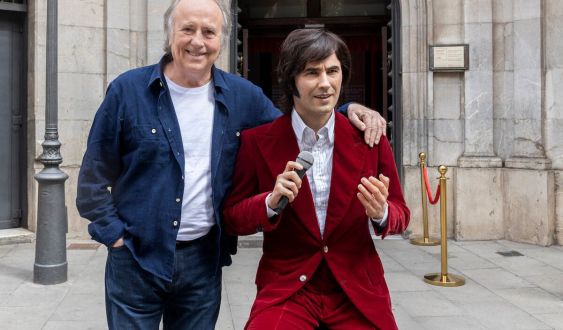
Joan Manuel Serrat is a casteller of the Colla Jove Xiquets de Tarragona. Specifically, a tercio, one of those who barely protrude from the folre and the soca, the thing is that he doesn't know it yet. Nor does he know that he shares this task with Che Guevara, who stares at him and grabs him by the shoulders, as if saying "you've been recycled too, haven't you?". And the wax figure of Serrat has existed for many years, since the museum's beginnings in '73, and yours truly (who goes at least once a year since he was little) remembers that back then Serrat was in a dining room with views of Montserrat and represented the corner of Catalan culture along with Núria Feliu, Jacint Verdaguer, Prat de la Riba and a "pastoret dels remences". Now, the Barcelona Wax Museum has changed from top to bottom and has decided to relegate the old Noi del Poble Sec as a casteller while, today, the singer in person presents his new figure.
The object in question is covered with a kind of large maroon burqa, in the middle of the Banca passage, it almost looks like someone has been kidnapped if it weren't for Serrat talking on the phone in a corner and guests (friends) arriving, like Xavier and Fede Sardà, real brothers, and Toni Cruz and Tatxo Benet, who, although many people confuse them and they have decided to dress in blue and white (precisely the same as Serrat), are not brothers. The singer confirms to me that he had never been to the museum, that he didn't know he had a figure since 1973, and that the idea of having a wax replica is like having a twin brother but without having to fight.
When the sheet is uncovered, a Serrat appears who is by no means a twin but in any case a much younger brother: like the figure from '73, but more stylized and above all better dressed (the singer confesses that it is wardrobe clothes, from pieces that were given to a charity auction and have now been recovered by the museum). They wanted to immortalize him in his Mediterráneo era, just when he was about to conquer the Atlantic and the Pacific. That's why the photo seems strange, because for many years we have had in our minds the image of a Serrat with nostalgia on his skin and a tremor in his gaze. The singer plays with his youthful self and hides behind it, as if delegating all the work. But, even if he says that the museum will especially please his grandchildren, he will always manage to put on a smile of a marveling child. He has many years of experience and is a true professional.
He explains to me that retiring in December is, "for now, a firm decision" and "within what one can be sure of." Okay, but I'm told on the other side that he's not entirely convinced because he's having too much fun. In any case, what he emphasizes to me is that it's a personal decision and that it hasn't come from any external circumstance. Agreed. As we make our way (greeting the casteller Serrat and then Copito de Nieve, Neruda, Franco, Picasso, or the pirates on a ship where I see that the old figure of Serrallonga is now a nameless buccaneer), he tells me that he wouldn't know whether to call himself a musician or a poet, but rather he is someone who makes songs, that he has never considered writing a book of poetry, or a great musical work, but that the song gives him the exact size of his expressiveness. Over the years, he explains, his technique has developed in this direction and it is his form of expression: there are already people who know how to paint (we pass in front of Dalí), or cook (we happen to be in front of the Rocas, Adrià, and Ruscalleda), and when he thinks of a theme, even if it could be made into a literary or musical narrative, he doesn't take long to always derive it towards the form of a song. And here we finally have him, magically placed in the main hall next to an Elton John who waves from the stage, with his back to the Beatles and sitting with a microphone singing for Adele, Rosalía, and Michael Jackson: Joan Manuel Serrat.
While Sardà (Xavier) immobilizes himself pretending to be made of wax, and Sardà (Fede) makes jokes from the back seats of the bus, I throw him the reflection on the fact that even in 2022 there is no way for Spain to present a song in Catalan at Eurovision. Perhaps the problem was not (nor is) Franco, don't you think? He replies that he also finds it hard to understand, although last year they almost put some singers in Galician, right? Right. He tells me that, after the Eurovision gap from '68 to '80-something, it was decided to designate the candidate songs by popular vote. But then Chiquilicuatre came out (he laughs)! And after that scare, and modulating the selection criteria without submitting it 100% to popular vote, it has never resulted in a song in Catalan being designated either. Neither one way nor the other. Perhaps there's no way, I tell him. Perhaps so, he admits. And perhaps even, I add, that TVE director who had to veto his Lalalà had a point when he told him he had to decide if he would be a universal or provincial singer. But no, I don't catch him here either: we read Japanese and Polish literature, no language prevents anything, not even winning a Nobel. Not even being part of a small and unfortunate land (he tells me, evoking Espriu) prevents anything. As I am talking to a singer who became great especially by expanding into Hispanic America, and in Spanish, I am left with the doubt. What can we do if this province has such a difficult escape. What can I do, if I was born in the Mediterranean.
Finally, he takes some last photos with Toni Cruz, artistic director of the museum, and we end up talking about Barcelona. Mil cares té Barcelona, he sang, but I ask him if today's Barcelona is the one that turns its back or the one that lends a hand. He gives a speech about the thousand facets that Barcelona has, its plurality, its constant evolution, which makes you suddenly find it a little strange. This is not bad, he tells me: it means it is alive. But the risk is that the world of money and speculation, he laments, will spoil its personality. Reality, he tells me already behind a table and a beer, always keeps a great distance from dreams, and then his voice tremor almost infects my soul. He ends by clarifying that there are initiatives by true entrepreneurs, like the new Wax Museum, which in his opinion show the best face of the city. Barcelona does these things, he tells me. Of those small things, I think looking at the flesh and blood figure that smiles at me, that are great even if you think time and absence killed them.
Add The New Barcelona Post as your preferred Google source for free
Stay informed with the latest news.
