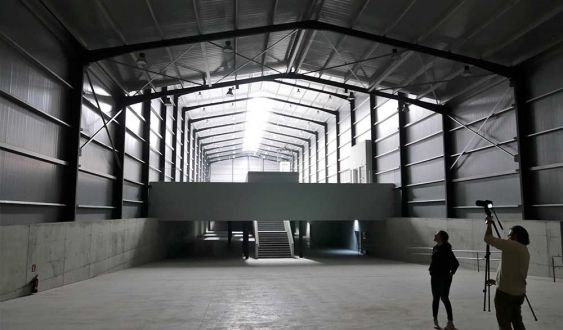
"PLANTA is an innovative project. An innovative project in art, an innovative project also in the business world. It arises from the intersection of the two worlds: from the Sorigué group, the business world, and from the Sorigué Foundation, art." This is how Ana Vallés, president of Sorigué and director of the foundation, expresses herself. In PLANTA, these elements are integrated: it is an industrial production platform that seeks to be environmentally friendly, in turn converted into a center for contemporary creation. There, relevant names such as Antonio López, Bill Viola, Anselm Kiefer, Anish Kapoor, or Juan Muñoz meet, whose work Double Bind -formerly in the turbine hall of the Tate Modern- has been perfectly adapted to the space of the Balaguer plant (Lleida).
"We are interested, above all, in visitors leaving with questions," emphasizes Ana Vallés. More than lecturing or entertaining, contemporary art plays a role that is sometimes uncomfortable, but fundamental for stirring up prejudices and promoting critical thinking.
The Foundation, inaugurated in 1985 by Julio Sorigué and Josefina Blasco, emphasizes the need to make effective the "return to society" through support programs for some vulnerable sectors, as well as through educational and cultural activities aimed at the general public. Among them, it is worth mentioning the art collection, a collection started with works of Catalan Noucentisme -from the Sorigué family collection- which was expanded from 2000 with the incorporation of works by contemporary creators until reaching a figure of more than 450, selected by a commission of experts, among whom are José Guirao, Rafa Doctor, Miguel Zugaza, Paloma Esteban, Julio Vaquero, or José Miguel Ullán.
The selection criteria for the works in the collection are perfectly aligned with the exhibition program, which features creators of utmost relevance in the art scene, as well as others less known, though with proven potential. All of them address problems inherent to the human condition, especially stimulating in their artistic expression. "We are interested, above all, in visitors leaving with questions," highlights Ana Vallés. More than educating or entertaining, contemporary art stands out for its involvement, for playing a role that is sometimes uncomfortable, but fundamental for stirring prejudices and promoting critical thinking through emotional experiences.
DES/MATERIALIZATIONS OF A HASSELBLAD AWARD
Art has long ceased to illustrate exemplary actions, memorable subjects, or singular manifestations of nature, with the aesthetic experience -in itself- being the protagonist. By incorporating technologies that allow transcending traditional boundaries between genres, contemporary creations elicit a more intense participation from the viewer. The exhibition that can currently be visited at the Fundació Sorigué in Lleida (until December 30) is a clear example of this. It is an exhibition focused on the work of Óscar Muñoz, who recently -coinciding with the exhibition, in fact- received the prestigious Hasselblad award (important names such as Nan Goldin, Boris Mikhaïlov, Cindy Sherman, or Henry Cartier-Bresson were honored in the past).
Without being a photographer, Muñoz uses photography to reflect on the ephemeral nature of the human being. Therefore, the awarding of the prize (offered by the camera brand used by the first men to step on the moon, almost 50 years ago) should not be surprising, as what his work transmits, through moving images, is the intrinsic transience of reality that seeks to be fixed and reproduced. Precisely the pretension of stopping time -which photography seems to satisfy- reveals a deeply rooted need inherent to the nature of the human being: a being who knows himself to be alive as long as he lasts, being also aware of (from) his natural tendency to cease to be.
That Óscar Muñoz's exhibition is titled Des/materializaciones only emphasizes the need for that trace that, in a more or less artistic way, human beings tend to project in their lifetime, as if to transcend it.The exhibition consists of a series of video art installations that pose a dialectic as old as photography itself, although -in reality- it is already implicit in every art form. The primitive gesture of marking and leaving a trace in the prehistoric cave -perhaps to exorcise nature, tame the elements and make hunting more propitious- implies a significant activity, which brings together being and ceasing to be. That Óscar Muñoz's exhibition is titled De/materializationsit only emphasizes the need for that trace that, in a more or less artistic way -not infrequently hysterical, as social networks show- the human being tends to project in his lifetime, as if to transcend it. One of his installations,Sedimentations, illustrates the topic of the flow of lives, sordidly presented by portraits that deform and seep down the drain, in an agonizing spiral, worthy of the filmVertigo(which not in vain has been known by the name of the novel that inspires it,From Among the Dead).
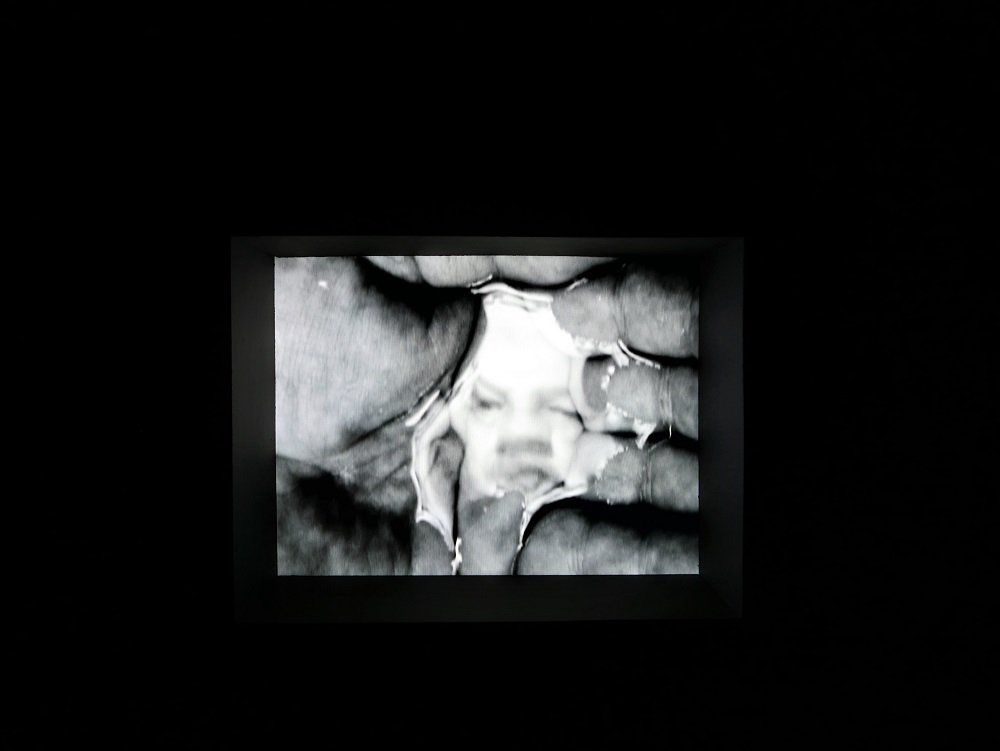
They are images of deceased people that are shown naturally -beings that, at first, we would believe to be as alive as us- which are then lost, irremediably, until they are nothing more than a stain that represents nothing. Because, in fact, those images have never been alive. Gemma Avinyó, head of visits at the Sorigué Foundation, alludes to those "longings to be permanent" following another of Óscar Muñoz's works, specifically the one titled Línea del destino: in the bowl formed by the hand, a volume of water reflects the changing face of whoever looks into it, alternating recognition and disfiguration. Being-represented and ceasing-to-be correlate with alarming eloquence: can we be that which we do not seem to be? Questions are imposed through an aesthetic experience that awakens emotions, and that encourages the search for answers. As neuroscientists have shown, this emotional imprint constitutes the most efficient way to receive and fix knowledge.
Gemma Avinyó recalls the importance of mediation in the case of contemporary art. She refers to the series of explanations -offered by the Foundation to visitors or groups of students who wish it- that do not sentence or obstruct questions, but rather suggest personal interpretations. Many schools benefit from this service, which also works with the teachers themselves, so that they can later develop activities in which those ideas come to life, having been internalized through their own experiences. The exhibition viewers become co-participants, by composing works themselves in which the question of identity is raised. Within the framework of the omnipresence of the digital image -shared by all, in our time- Óscar Muñoz's work Juego de las probabilidades reveals a phantasmagorical unreality, in an unpredictable mosaic, that invites personal continuation.
DOUBLE BIND: THE OTHER FACE OF THE GAZE
The question of self-knowledge is the fundamental theme of humanism, both Renaissance humanism and that of the artists gathered by the Sorigué foundation in its museum in Lleida and in the different sites of the Balaguer production plant. The most spectacular, currently (awaiting others already programmed) is the aforementioned Double Bind, a work by Juan Muñoz. The term that titles the installation comes from psychology, and refers to the discoordination that occurs in some individuals, in those situations where verbal communication is accompanied by non-verbal attitudes or manifestations that seem to contradict what is expressed.
Double Bind displays its best virtues in its current location, also functioning as representative of the values and faith in art -an educational medium- of the Fundació Sorigué. In that industrial enclave, we find an apparently empty nave, divided into two levels. After descending a gently sloping ramp, stairs invite us to go up to the upper floor and contemplate the work. But there is nothing there, except for a series of scattered skylights. The openings are square, seem to be traversed by light, even if some are perceived as false. This trompe l'oeil effect is complemented by the incessant rattling of an elevator that connects the spaces. When we walk back, and in semi-darkness, we descend to the ground floor -to the cavernous underworld- we discover the truth of an unthinkable connection.
Juan Muñoz's classic and anti-academic figures inhabit a liminal space. Their grimaces inquire for answers and trigger uncertainty. What these human beings -so similar and different from us- do and why they are there is something we cannot grasp.The installation does not propose a mere return to ascensional Platonism - contrasting the falsity of appearance with the essential immutability of pure forms that shine in the light of intelligence - nor an inverted Platonism - as recreation in confused vision - but rather a kind of invitation to wander along unexpected paths, through chiaroscuro interstices inhabited by new and strange beings, without certainty of what will happen despite expectations (or because of them, which are confirmed as erroneous). Juan Muñoz's classic and anti-academic figures inhabit the liminal space, with grimaces or attitudes that demand answers and trigger uncertainty. What these human beings - so similar and different from us - are doing, and why they are there, specifically, and not somewhere else, is something we cannot grasp. It is something that awakens admiration and unease, because it challenges, it stirs up questions without simple answers.
SYNERGIES OF CONTEMPORARY ART
All of this takes place within the framework of a factory, a markedly industrial site that, as they explain to us, is orchestrated according to parameters of energy efficiency and the use of the earth's resources (from the raw material for construction itself, to the fruit of the surrounding olive trees, with even the fruit pits being reused). One of the challenges of the 21st century, perhaps the most pressing and complex, is precisely that which concerns the management of natural resources, intimately connected with the production and sustainable use of energy.
"PLANTA articulates our way of understanding return through art, in its confluence with architecture, landscape, science, knowledge, and business," explain the Sorigué Foundation.The industrial landscape, which more than a century ago made possible a change in living conditions, is still in the process of transformation, not only in the context of cities, where -as is known- factories have become public spaces. We can cite well-known cases such as the Tate Modern, the former Bankside Power Station in London or -even more familiar, for many- the Caixaforum space, in the modernist Casaramona Factory. Also in Barcelona, it is pertinent to mention the Fabra i Coats space, converted into a contemporary creation center. Without a doubt, it is a happy coincidence that turns the place of efficient production into a showcase for the exhibition of cutting-edge creativity, an idea that the Foundation emphasizes with its flagship project: "PLANTA articulates our way of understanding return through art, in its confluence with architecture, landscape, science, knowledge and business."
The new millennium demands a new twist in the paradigm shift, more sensitive to the need to care for the planet. And the Sorigué group of companies has not only received different awards that accredit the efficiency of its model, but also bets on carrying out tasks, through its Foundation, that deal with awareness about sustainability, the improvement of living conditions of some of the least favored sectors of the population, and the possibility of educating through art -specifically, contemporary art- contributing with the promotion of a valuable intangible: the configuration of a self-aware and critical gaze.
Add The New Barcelona Post as your preferred Google source for free
Stay informed with the latest news.
