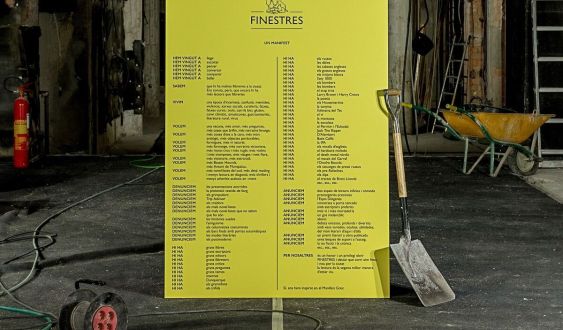
"A book is a window through which we escape," said American writer Julien Green. This is the origin of the name of the future Llibreria Finestres, proposed by its founding partner, businessman Sergi Ferrer-Salat. The project will be led by Àurea Perelló and Mireya Valencia, who will be the booksellers, and Camila Enrich, Marina Espasa, and Kiko Amat, who will be in charge of cultural programming. Together with Ferrer-Salat, all of them reflected and discussed Green's idea and expanded the concept, understanding the books that Finestres will host not only as a means of escape but also as a way to learn, to acquire new knowledge.
[subscribe_newsletter_esp]
The origin of Finestres also lies in another idea, that of silence. "The beginning is this space where silence reigns to bring you closer to the book and meet it in a conscious way," explains Àurea Perelló, with a long career in the cultural world and a bookseller for years. "We have defined the space in such a way that it invites this silence. So that when you enter the bookstore there is a fracture between what happens outside and what happens inside," she illustrates.
"We have defined the space in such a way that it invites silence," illustrates Perelló, one of the booksellers.The bookstore will be a very warm place, with a lot of wood, armchairs, and space to read, without background music and, naturally, full of books. It will be requested that mobile phones be looked at little, reclaiming what is analog and is lost among so many screens. "Not so much out of antipathy but because we want that when one enters the bookstore there is this experience of tranquility, silence, and contemplation." A bookstore with a British touch, adds writer and journalist Kiko Amat. "Only the slippers will be missing," jokes Amat.And all this silence will serve to invite reading, because, aren't armchairs one of the best places to read?
Seeking silence, those responsible for Finestres have remembered Sherlock Holmes to create one of the spaces in the bookstore. More specifically, his older brother, Mycroft Holmes, who founded the Diogenes Club, a place reserved for those gentlemen who wanted to read the newspaper quietly, without distractions, taking into account that the main rule was silence. "No talking is permitted under any circumstances, and three breaches in this regard, if they reach the ears of the committee, expose the speaker to the penalty of expulsion. My brother was one of the founders and I myself have found a very relaxing atmosphere there," Sherlock explained in The Greek Interpreter by Arthur Conan Doyle. In fact, Mycroft only left his house to go to the Diogenes Club, where he spent most of his time ---there were also comfortable armchairs---. And, from there, back home.
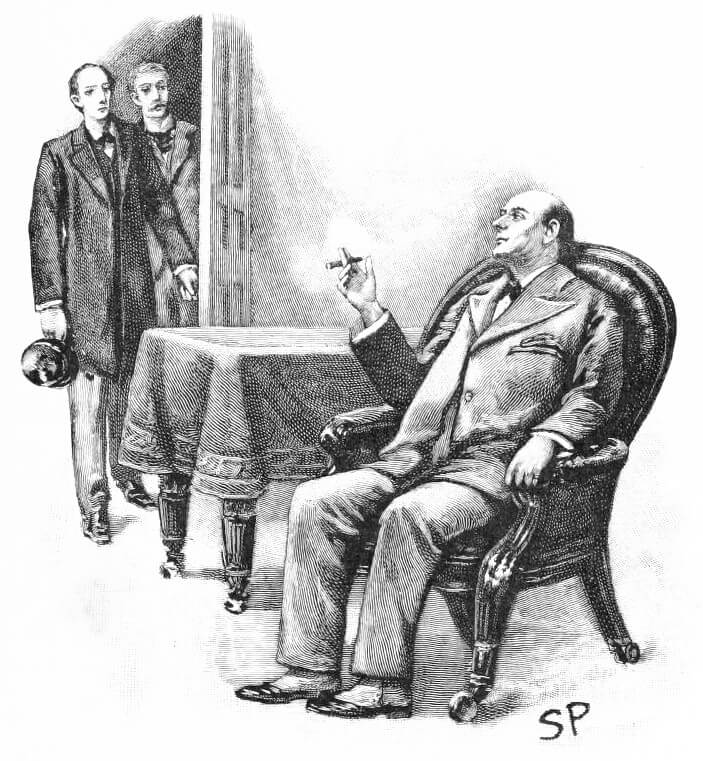
It remains to be seen what Finestres' Diogenes Club will be like ---and if it finds readers as faithful as Mycroft---, but, to pique curiosity, it will be the space where some of the bookstore's cultural activities will take place, such as book presentations. However, these will not be typical book presentations. "We were very clear about how we wanted them to be and how we didn't want them to be," emphasizes Amat, who has been bored at too many presentations to repeat it again. Amat imagines "evenings" with writers, in more intimate and passionate settings. And, returning to the United Kingdom, they want the authors who visit Finestres to read their works and not explain the four facts that publishers constantly repeat. And, above all, they will shy away from current events, opting for books that perhaps have gone unnoticed or that, simply, they fancy.
Where Monvínic was
All this will happen at Llibreria Finestres, on Diputació street, between Balmes and Rambla Catalunya, where until recently Monvínic, a wine restaurant ---or temple---, was located. Also promoted by Ferrer-Salat, it announced its closure at the end of September, after twelve years. Now, nothing remains of what was Monvínic, beyond cables and its old blind, and Finestres is slowly making space, with construction work progressing, although it is still not possible to discern what it will look like if one passes by.
However, Finestres will have two premises, totaling 800 square meters. Where Monvínic was, the largest space, one will be able to find literature, essay, young adult, and comic books, with over 40,000 references. Just opposite, across the street, in a smaller space, there will be the second bookstore, which will have about 14,000 references and will be dedicated to the arts, that is, to architecture, cinema, photography, music, dance, design...
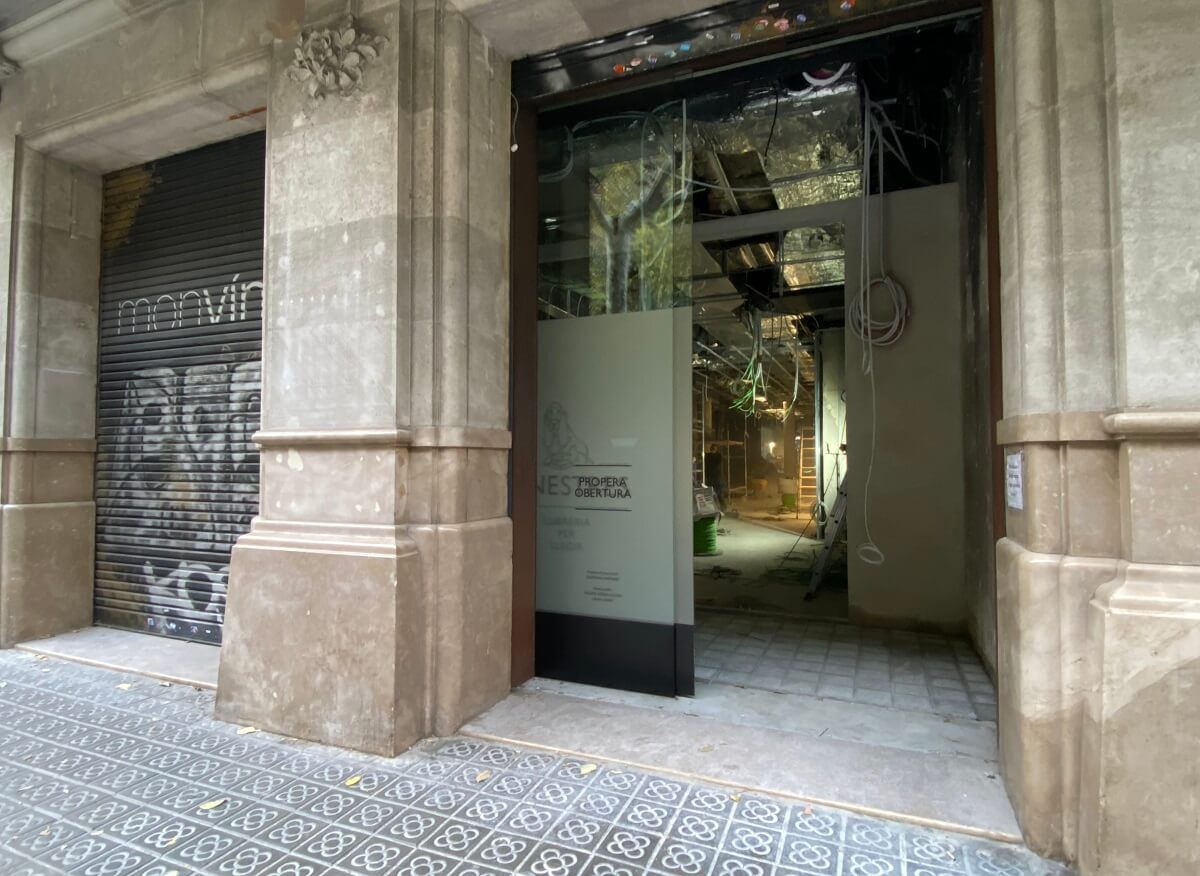
The first is expected to open between late March and early April next year, while for the second, one will have to wait a bit, still without a date. If the large Finestres bookstore aims to be like a club, with much British comfort, the small bookstore will be more industrial and rebellious, "with more cement and dirty," Amat indicates, although both will be in concordance and communicate with each other.
Likewise, the books will not be organized in a conventional way, by genres, themes, or authors' origin. The aim will be to design a narrative and encourage the discovery of stories and authors. "We want to transcend the way of arranging books exclusively thematically and generate proposals of knowledge, surprise, and discovery," Perelló details. And books in different languages will also be integrated among them, representing a good part of the collection, inviting reading in English, Italian, French, or German.
More than a bookstore
"Finestres is not just a bookstore, it's a cultural project," Perelló remarks. One of its pillars, obviously, is the bookstore, but it will also have awards and scholarships. The Finestres Narrative Award will reward the best books written in Catalan and Spanish published throughout the year, giving a second chance to works that perhaps did not capture the attention they deserved, with a prize of 25,000 euros per language. On the other hand, the Finestres Essay Scholarship will serve to promote writing in Catalan and Spanish of essays and humanistic chronicles, of scientific, historical, political, musical, literary, and artistic dissemination, with the aim of strengthening both modalities, with a prize of 20,000 euros per language.
"Finestres is not just a bookstore, it's a cultural project," Perelló remarks.In addition to the awards and scholarships, there will be unconventional book presentations and the norm will also be broken with reading clubs and cycles, always detached from current editorial news.For example, Amat points out that there will be a reading club about books that make you hungry or a philosophy series that will feature a figure similar to that of the reader's advocate in newspapers to ask for clarifications on anything that might not be clear. In total, Finestres will organize six series and four reading clubs during 2021, once it is open. All this to demonstrate, as they defend in their manifesto, that reading is the second best way to be alive.
Add The New Barcelona Post as your preferred Google source for free
Stay informed with the latest news.
