
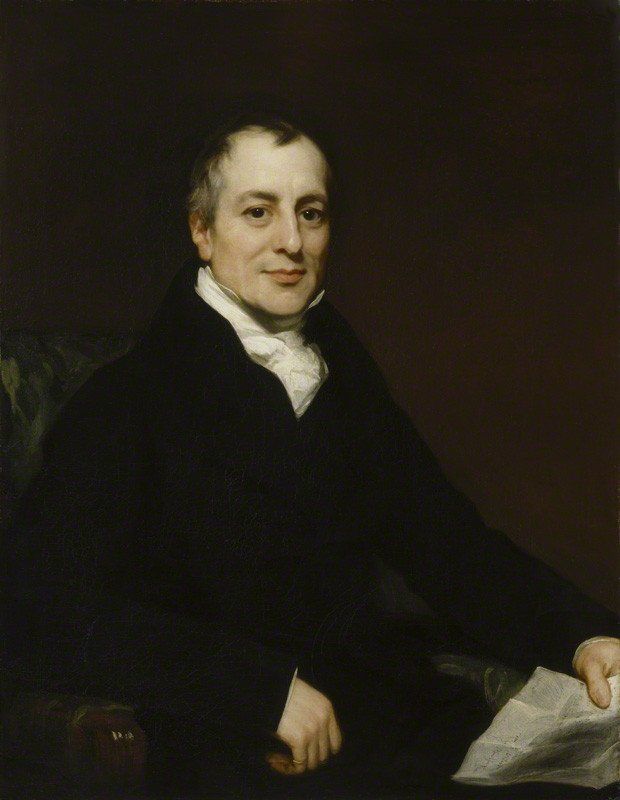
In 1817, one of the most classic works—which usually means it is much more cited than read—in economics was published: David Ricardo's Principles of Political Economy and Taxation. Chapter seven contains the first formulation of the argument of comparative advantages as an explanation of the benefits of international trade, which, two centuries later, continues to be explained in all economics faculties around the world. In this era of globalization, proponents of efficiency gains derived from open markets often take this two-century-old explanation as an initial reference. Another message from Ricardo is, as highlighted from the first paragraphs of the book's prologue, the primary role that the question of how the wealth generated by the cooperation of production factors among themselves is distributed has among the objects of study of political economy. Trade and distribution thus constitute two dimensions that are as central as they are linked. In a world like today's, where the frictions generated by inequality problems are commonplace and even serve as a breeding ground for approaches contrary to trade and globalization, it is fully relevant to recall the messages of the British financier, economist, and parliamentarian David Ricardo.
PRODUCTION AND DISTRIBUTION
One of the successes of Ricardo's Principles, which at first glance might seem doubtful but implies exceptional recognition, is that they became the reference point in political economy against which alternative approaches were launched. This was done by the marginalists from 1870 and also notably by John M. Keynes: Ricardo is the first author mentioned in the General Theory (1936), in which he formulates Keynesian approaches as opposed to the "theory that culminated in Ricardo" and which, following Marx, he calls "classical economics." But even with this —too frequent— tendency to simplify the adversary to revalue one's own positions, Keynes recognizes that one must distinguish between the "Ricardian tradition" and Ricardo's original formulations, with special emphasis on the central point of the inseparability between the aspects of production and distribution. Keynes refers to a letter from Ricardo to Malthus —an epistolary exchange that still deserves to be read today— from October 1820 in which Ricardo insists that "the true object of [economic] science" is that of "relative proportions."
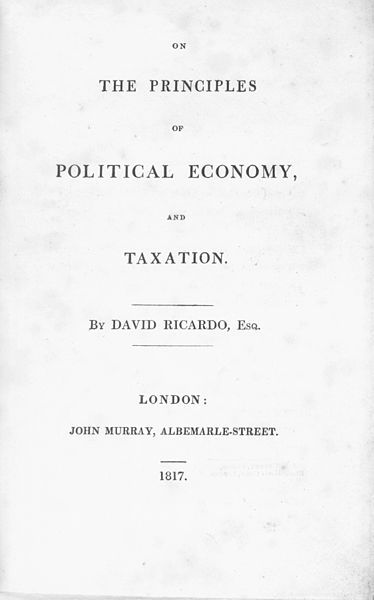
In fact, the Principles published in 1817 had as its main instigator James Mill—father of John Stuart Mill—who urged Ricardo to expand a pamphlet published in 1815 and commonly known as Essay on Profit, with a full title that referred to the effects of a low price of cereals on profits and, in general, on the distribution of income among landowners, wage earners, and industrialists. In 1815, the discussion and approval of the corn laws—corn laws—which introduced a significant degree of protectionism and penalized imports of cheaper cereals that competed with those produced in Great Britain, became the trigger for many controversies. The debates showed that behind the opposing positions between defenders of free trade and supporters of protectionism there were not only economic but also sociopolitical interests and "model of society" interests. In the 1815 text, Ricardo vehemently criticized a protectionism that benefited British landowners: "I deeply regret that the interests of a particular class of society are allowed to impede the progress of the wealth and population of the country." Ricardo advocated for the engine of progress that technological innovation of the Industrial Revolution represented, and highlighted the importance of having sufficient resources to finance this new dynamic, which could be achieved more easily with unrestricted imports of cheap cereals that, by lowering food costs, which then represented a much more substantial part of the "shopping basket" than now, would contain wage costs and allow industrial profits that, adequately reinvested, would advance the modernization of the economy and society. In the background of the debates on free trade or protectionism, there was, therefore, a sociopolitical struggle between the traditional landowning aristocracy and the emerging industrial bourgeoisie.
UNIVERSAL TRADE SYSTEM
Ricardo's argumentation in favor of trade openness contained aspects of general formulations and others more specific. Among the more bombastic declarations is an application of Adam Smith's "invisible hand" principles to trade: "Under a system of perfectly free trade," each country seeks its own interest; "it is admirably connected with the universal good of the whole...", it spreads general benefit and links "the universal society of nations throughout the civilized world," as we read in the seventh chapter of the Principles. At a more concrete level, Ricardo's texts abound with comparisons between the positive effects of technological progress and international trade. In fact, these are the two mechanisms presented as the most powerful to overcome the famous and feared tendency to diminishing returns, especially in the exploitation of land for the cultivation of food products.
Less known is Ricardo's idea that the most notable benefits of international trade are related to the possibility of lowering the prices of products consumed mainly by the most modest sectors of society, principally wage earners, since in this way they contribute to maintaining the purchasing power of wages—real wages—with modest variations in nominal wages, and the consequent positive effect on industrial profits. In a world like that of recent decades, in which modest wage evolution—and even the stagnation of some indicators—has been a subject of controversy, and in which the role of "cheap imports" often from Asian economies has allowed some standards of purchasing power to be maintained, Ricardo's argument from two centuries ago maintains renewed relevance. Precisely, one of the controversies of recent times is whether the effects of international trade have been pro-poor—increasing the purchasing power of lower-income segments—or whether the effects desired by Ricardo have not occurred, with analyses showing conflicting results. In any case, a notable aspect of Ricardian formulations is that the gains from international trade are initially sought through cheap imports, and not so much—or at least not principally or exclusively—through facilities for exporting. In fact, some recent formulations that often highlight that cheap and efficient imports facilitate subsequent exports, by becoming more competitive in industries, would already fit with Ricardo's approaches. The role of "imports as an engine for exports" helps to dispel some Manichaean opposition between exports and imports that we often hear and that threatens to lead to outbreaks of mercantilist or protectionist temptations.
COMPARATIVE ADVANTAGES
The famous theory of comparative advantages as an explanation of why it is more convenient for countries to specialize and trade than to try to be self-sufficient or autarkic has a delicate point, where it comes into play in situations where there is not one country more efficient than the other in each good, but rather one country can have greater productivity in a wide group of sectors. In the early 19th century, the asymmetry between an England that was undergoing the Industrial Revolution and other countries that had not yet reached it made it more efficient to produce almost any product in England. Did this close the door to the possibility of international trade in which all participants would benefit? Ricardo's great analytical contribution was to demonstrate that even in this case, it was worthwhile for all participants—and for the international economy as a whole—for the more productive country to specialize in the product with which it had a superior margin of advantage—comparative advantage—and leave the more backward country to specialize in another product in which the difference in technological level was not so important. From this argument arises the classic example that formulates the recommendation that England dedicate itself to textiles and leave Portugal to produce wines. An implication of this formulation is its "politically correct" nature: even countries with the lowest technological level have a place in the patterns of international division of labor. The presentation of international trade as a "positive-sum game" in which all participants can win—despite their asymmetries—has become one of the powerful arguments in favor of an open trading system, in clear contrast to formulations that see international trade as a mechanism of exploitation or "unequal exchange." But it must be remembered that distributive aspects are—in addition to efficiency gains—central to Ricardo's approaches. Beyond the issues of trade and distribution, in the third edition of the Principles, in 1821, Ricardo introduced a new chapter on "the question of machinery": he expressed some doubts about whether the benefits of the growing implementation of machines would reach all segments of society. A topic that, almost two centuries later, also regains notable relevance.
Add The New Barcelona Post as your preferred Google source for free
Stay informed with the latest news.