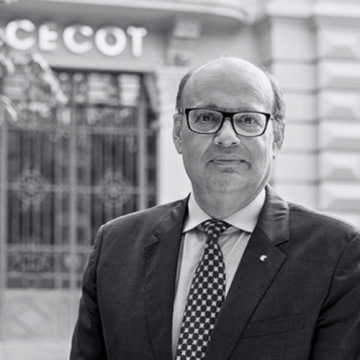
"More housing, more affordable and faster". It could be one of the slogans printed on a banner of the 11-N mobilizations, but in this case it is the common thread of the 20 proposals that the employers' association Cecot presented this Tuesday, led by the economist Josep Maria Raya, professor of Applied Economics at TecnoCampus, a center affiliated with Pompeu Fabra University. The housing emergency has not only reached the streets and the ballot boxes, but it also worries the business sector. "Housing is a social issue, but also an economic and competitiveness one," said Xavier Panés, president of Cecot, who claimed that "companies are not the problem, but must be part of the solution."
Given this scenario, the employers' association has put forward a set of measures that aim to be "concrete, effective and well executed". However, Panés warned that, beyond the proposals, "time, continuity and stability" are needed to address a structural problem that cannot be solved "in just two or four years" and that has been built up over decades.
The data accompanying the diagnosis highlight the difficulties in expanding the residential supply in Spain and, especially, the slowness with which projects are executed. According to Raya during the presentation, there are approximately seven million potential homes on land that is already planned in Spain. But, of these, in large cities only between 28% and 47% of the planned homes are actually built. Added to this difficulty is the slowness of urban planning processes: between the time a home begins to be planned and a family moves in, between nine and eighteen years can pass. A period that, according to the economist, highlights the need to review the functioning of the system and to unblock projects that could contribute to increasing the supply.
In addition, the deficit of social housing is also a cause for concern. Spain is between five and six times below the European average, depending on whether the entire residential park or specifically rental is taken as a reference.
Given these data, Raya summarized the two main axes on which housing policies should pivot: "Build more and faster, and increase the social housing stock." Any policy that deviates from these two objectives, he warned, runs the risk of straying from the main problem: the lack of supply.

However, the battery of 20 proposals is structured around four principles. The first, that private initiative is part of the solution: Raya recalled that between 60% and 70% of current social housing is promoted with the participation of private companies and that, therefore, "if we want social housing, we need the private route." He also defended the role of landlords in the rental market: "For a housing market to function, we need landlords to put flats up for rent. Renting is not speculating."
60% and 70% of current social housing is promoted with the participation of private companies
The second, that legal certainty must be for everyone, both for tenants and for landlords and developers, and that the protection of vulnerable groups must be the responsibility of the Administration. The third, that taxation must be linked to the use of housing and not so much to who buys it, to favor first residences, residential rentals, and social housing. And the last, that the housing challenge "goes far beyond housing" and that, therefore, factors such as salaries, productivity, and transport infrastructures must be taken into account.
The 20 measures to unlock residential supply
The report groups the 20 proposals into seven major areas of action, ranging from land mobilization and urban densification to the simplification of administrative procedures, the strengthening of social and affordable housing, legal certainty, taxation linked to residential use, and the promotion of industrialized construction. A set of measures that, according to Cecot, should allow unlocking residential supply, accelerating construction times, and expanding the affordable housing stock.
More land and facilitating construction
1. Execute already planned land within reasonable deadlines, make urbanization processes more flexible, and allow urbanization and building to advance simultaneously when possible.
2. Promote supramunicipal urban planning to prevent local interests and blockages from paralyzing large residential developments.
3. Mobilize public land, which represents approximately half of the available land, through transparent and competitive awards.

Densify where possible
4. Allow more density, height, and buildability in sectors where possible, to make better use of the land and reduce the cost per dwelling.
5. Facilitate changes of use and increase buildability by up to 20% in multi-family buildings, as well as dividing large dwellings and converting commercial premises, offices, and warehouses into dwellings.
6. Review urban and technical standards that may be disproportionate, such as minimum parking requirements or certain construction requirements, without sacrificing services and urban quality.
Simplify administrative processes
7. Develop urban plans in two layers: one strategic and stable, and another operational that can be modified more agilely.
8. Ensure that license concession periods do not exceed 1 or two months, through digitalization, artificial intelligence, a single window, and positive administrative silence.
9. Establish maximum deadlines for electricity, gas, and telecommunications supply companies.
10. Expedite the approval of the law on the simplification of urban procedures through faster parliamentary processing.

Grow the social and affordable housing stock
11. Facilitate access to social housing for social infrastructure funds, with long-term financing mechanisms. Raya has also called for a review of the financing difficulties faced by small developers.
12. Guarantee a permanent public housing stock, with indefinite qualification and mostly intended for rent.
13. Buy housing use rights for periods of 20 or 25 years to incorporate them into the social housing stock, following examples such as Dublin, and mobilize empty homes.
Guarantee legal certainty
14. Prevent formal defects from leading to the annulment of entire urban plans and unblock the reform of the Land Law. Currently, according to the data presented, there are 94 Spanish municipalities with their planning annulled since 2023.
15. Guarantee the protection of vulnerable tenants without transferring the cost to owners, for example, through a public default insurance assumed by the State.
Reasonable taxation according to use
16. Apply progressive taxation that facilitates access to the first habitual residence, at 0% rate, with a reduction in VAT and property transfer tax.
17. Minimize taxation on social housing, including VAT, construction tax, and license fees.
18. Make taxation reward the residential use of housing, whether it is intended as the owner's primary residence or placed on the residential rental market, instead of being based exclusively on the buyer's profile.
Promote industrialized construction
19. Establish multi-year public programs, ICO financing lines adapted to industrialized construction schedules, and more agile approval processes.
20. Promote generational replacement and dual vocational training in construction to address the aging workforce and the lack of professionals in the sector.
A State pact with annual objectives
Beyond specific measures, Raya has argued that "housing should become a State pact, with annual residential production targets and a stable public budget" to boost social housing.
Raya: "Housing should become a State pact, with annual residential production targets and a stable public budget"
The economist cited Vienna as an example, which has developed its housing policy over a century, with public investment and continuity over time. "We cannot achieve in one year what Vienna has achieved in a century, but the sooner we start, the sooner we will be closer," he noted.
Add The New Barcelona Post as your preferred Google source for free
Stay informed with the latest news.