Catalonia is a country with "collaborative DNA", in the words of the Minister of Health, Olga Pané. Alliances between companies have always been among the priorities of the public administration, but also of companies. Sharing is not only a way to streamline and facilitate resources, but it opens up a new space for thought, with more people to solve a single problem. In this case, collaboration arrives in a sector completely connected with the improvement of people's lives: health. Specifically, the Consorci de la Zona Franca (CZFB), the Hospital del Mar and the Hospital Clínic, with the support of the Department of Health, are joining forces. Three very powerful institutions in their respective sectors, but also pioneers in innovation in this country. The Consorci signs an agreement with the two hospital centers to cede them the space and machinery of its 3D incubator, facilities of almost 1,000 square meters with printing tools and cutting-edge technology to solve real problems of hospital patients. With this new signing, the centers will be able to use this space for complicated cases or even to test research. The project begins with these two centers, but Pané recognizes that the idea is that, as the initiative progresses, more centers will join this new alliance.
"It's an innovation that doesn't make much sense to do alone," explains Jaume Raventós, managing director of Hospital del Mar. In this way, the executive recalls that within hospitals, innovative treatments are already being sought and personalized pieces are requested for different cases, but with this new alliance, all these processes can be done more quickly and centrally. In addition, the use of the facilities will be shared, which may indicate that there will also be synergies between the professionals of the two hospitals. Thus, an even larger space for conversation and reflection will be created from which more innovative ideas can emerge. At the same time, thanks to the technology provided by the Consorci, they can be put into practice. "We are a small country where we all know each other, so we have to collaborate," says Josep Maria Campistol, general director of Hospital Clínic.
This new alliance opens a new line of action for hospitals, but also helps the CZFB to reactivate facilities that host some start-ups, but which can do much more. "It is the first 3D incubator in Europe and we must take advantage of it," says Pere Navarro, executive president of the Consorci de la Zona Franca de Barcelona. The reality, then, is that hospitals will give a second life to the space and from there great innovative ideas could emerge that —it is hoped— can help improve patient treatments. "Innovation in health is the service with the strongest impact for people," recalls Blanca Sorigué, general director of the Consorci de la Zona Franca de Barcelona.
An incubator at the service of patients
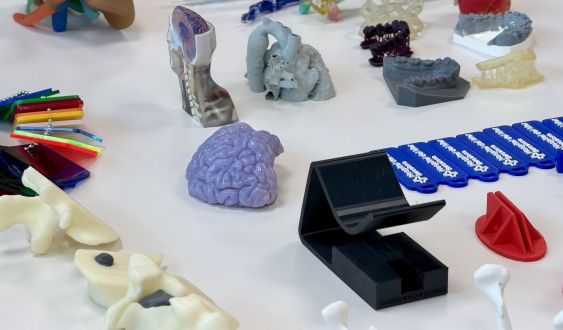
The 3D incubator can seem a very imposing concept and sometimes it is difficult to bring it down to earth with use cases. In fact, both Hospital del Mar and Hospital Clínic have an innovation head who have exemplified this alliance with concrete use cases that can be carried out in the facilities. Hospital del Mar has Antoni Gilabert (Director of Innovation and Digital Strategy) and Hospital Clínic has Jorge Fernández (Director of Innovation). In this way, the laboratory provides service in three areas (healthcare, teaching, R+D/innovation) and applies to many specialties: cardiovascular, neurosurgery, urology, ophthalmology, ENT, traumatology, maxillofacial surgery, neonatology/NICU, occupational therapy and electromedicine, among others. Specific uses range from digital surgical planning and the manufacture of biomodels, surgical guides and custom implants, to simulators for clinical training and spare parts for discontinued equipment. In other words, everything an researcher, doctor or teacher needs to innovate.
While it is true that each hospital has its human team and some spaces in the centers themselves for research and investigation, with these facilities they will also be able to create models, see their usefulness, or even practice. Some of the planned uses are the creation of simulated babies to improve clinical training when dealing with critical situations in newborns or the development of objects that facilitate the daily lives of people with dependency or mobility difficulties. Work is also being done on printing elements to optimize electromedicine. That is, to create parts that are easily replaceable when something breaks in a medical device.
In short, as Fernández concludes, it is "a historic step" and this alliance will help find solutions more quickly and effectively for patients. In addition, there is a clear vocation for it to become a reference space for research and investigation with a wide range of machinery that will allow all possible products to be tested safely. Thus, after being the first of its kind in Europe in 2019, with this signing, the 3D Incubator is once again at the center of the scene.
Add The New Barcelona Post as your preferred Google source for free
Stay informed with the latest news.