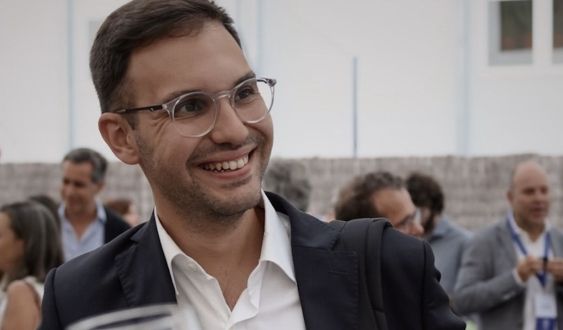
The New Barcelona Post converses this month with Albert Chamorro, one of the young people participating in the leadership and city program taught by Barcelona Global, Barcelona 2040. Chamorro is the CEO of V2 Group, a company dedicated to large-format additive manufacturing for the nautical and naval sector, offering innovative 3D printing services and prototype development for luxury yacht builders.
The objective of this series of interviews is for this new generation of leaders to share their vision for the Barcelona of the future they aspire to, as well as their impact proposals for the improvement of the city.
--- What do you expect from Barcelona in the year 2040?
--- I expect a Barcelona that maintains its globally recognizable attractiveness and dynamism without losing its cultural identity. I also trust that it will continue to position itself as a benchmark in its capacity for innovation, talent attraction, sustainability, and quality of life, prioritizing public transport that connects it better with its metropolitan area and frees up public spaces for citizens.
--- Which city would you compare Barcelona to?
--- Barcelona is, above all, a Mediterranean city with a strong identity in each of its neighborhoods and municipalities in the metropolitan area. This makes it not easy to compare it directly with other cities. However, it shares traits with cities like Amsterdam, for its commitment to sustainable mobility, or with Copenhagen for its urban planning designed for people.
"One of the biggest challenges facing Barcelona is the need to harmonize the expectations of its different actors: the lifelong Barcelonians, those who, without being so, have chosen our city, and tourists"--- What city model do you think Barcelona should resemble?
--- Barcelona must follow its own path, adapting its growth to its Mediterranean identity and its social and economic reality. It should not copy other models, but rather develop urban planning that prioritizes sustainability, accessibility, and quality of life. It can be inspired by Vienna for its balance between affordable housing and public space, by Copenhagen for its sustainable mobility, by Sydney for its integration between port, city, and nature, or by London for its ability to become a pole of attraction for economic activity.
--- What is the main challenge Barcelona must solve in the coming years?
--- Barcelona must reassert itself as a global reference city, consolidating a shared direction that integrates its historical identity with its role as a driver of innovation, culture, and sustainability. To do this, it is essential that the city defines a strategic vision that not only projects it into the future but also respects and values its legacy, fostering balanced and sustainable development. One of the biggest challenges Barcelona faces is the need to harmonize the expectations and aspirations of its different actors: long-time Barcelonans, those who, without being so, have chosen our city, and tourists. Avoiding fragmentation that generates tensions or hinders progress is key to ensuring a cohesive and resilient city. In this sense, the coexistence of these diverse approaches should not be seen as an obstacle, but as an opportunity to evolve inclusively. Only through balanced management of urban growth, improvement of the quality of life, and strengthening of the social fabric will it be possible to maintain the essence of Barcelona without renouncing its capacity for transformation and leadership on the international stage.
"Through dialogue, civic participation, and the promotion of creative initiatives, Barcelona can move forward with a shared vision that balances modernity and tradition"--- What do you think should be the role of new generations and their involvement in the development of the city?
--- Cities are, in their essence, the people who inhabit them. Therefore, young people must be clear about which direction to take to ensure that Barcelona continues to evolve and leaves a better legacy for those who come after. Their participation is key to driving changes that improve the quality of life and guarantee a balanced future for all. From involvement in decision-making to the defense of public space and the exploration of new economic and urban models, young people can play a fundamental role in the transformation of Barcelona. Betting on technological innovation, social entrepreneurship, and new forms of collaboration will allow facing the challenges of the future without losing the essence of the city. Through dialogue, civic participation, and the promotion of creative initiatives, Barcelona can advance with a shared vision that balances modernity and tradition, growth and sustainability, consolidating itself as a benchmark for an innovative city committed to its citizens.
"Sea transport is the most sustainable on a large scale, and Barcelona can become a key hub for innovation in this field"--- What do you think should be the role of the new generations and their involvement in the development of the city?
--- Barcelona must boost the digital economy, sustainable mobility, and biotechnology, in addition to consolidating its position in the creative and cultural sector. But, above all, it must look to the sea. As a leading port city, it has the opportunity to lead the development of sustainable maritime technologies, betting on port electrification, green fuels for naval transport, and advanced maritime logistics. Sea transport is the most sustainable on a large scale, and Barcelona can become a key hub for innovation in this field.
Add The New Barcelona Post as your preferred Google source for free
Stay informed with the latest news.
