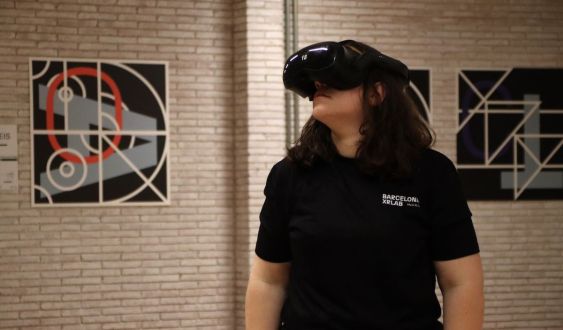
Barcelona's commitment to the audiovisual sector is evident, with the Tres Xemeneies del Besòs project at the forefront, and now it takes a step further. In the Palo Alto complex in Poblenou, the city inaugurates the new XRLAB, which aims to promote the growth and competitiveness of the audiovisual field, boost new economic activity, attract investment, and generate quality talent and employment.
Driven by the City Council through Barcelona Activa and the companies Lavinia, Magma Cultura, and ArtsMediatech, the center is the first to open in the city designed as an Economic Activity Hub. The intention is for facilities of this type to emerge in the city, focused on different key sectors, with one objective: to draw the economic map of the Barcelona of the future, accelerating its growth and positioning, supporting entrepreneurial initiative, and promoting investments and new economic activity.
The XRLAB is the first of this planned network of facilities, which arise from public-private collaboration. The space has started by appealing to technology companies working in the audiovisual and augmented reality sector, and aims to become the epicenter of experimentation and innovation in this field.
To this end, the 2,000 square meters of the building's four floors have a laboratory, multipurpose rooms, and coworking areas with the latest technologies so that companies can develop and test their proposals, whether immersive reality, 3D, projections, or any technological format. In this sense, it also has a 240-square-meter metaverse room, designed to host virtual experiences, as well as an immersive room with the possibility of projection on all four walls, and a room for 3D scanning.
Thus, the building has been conceived seeking the "versatility" and multifunctionality of the spaces, as highlighted by the center's director, Esther Rovira. Her forecasts are that the center's 80-seat coworking space will be fully occupied by the end of the year: at its opening, it is already at 60% of its capacity. Some of the companies that will operate in the new XRLAB are Layers of Reality, Barspin Studios, Alma Digital, and Estudio Gurugú.
The objective is to put the center's technologies at the service of all companies in the sector, where until now "some infrastructure of this type was missing," according to the general director of Lavinia and the Audiovisual Cluster, Miquel Rutllant. In addition, the center will offer a training program and collaborate with institutions to provide academic programs, courses, and internships for students.
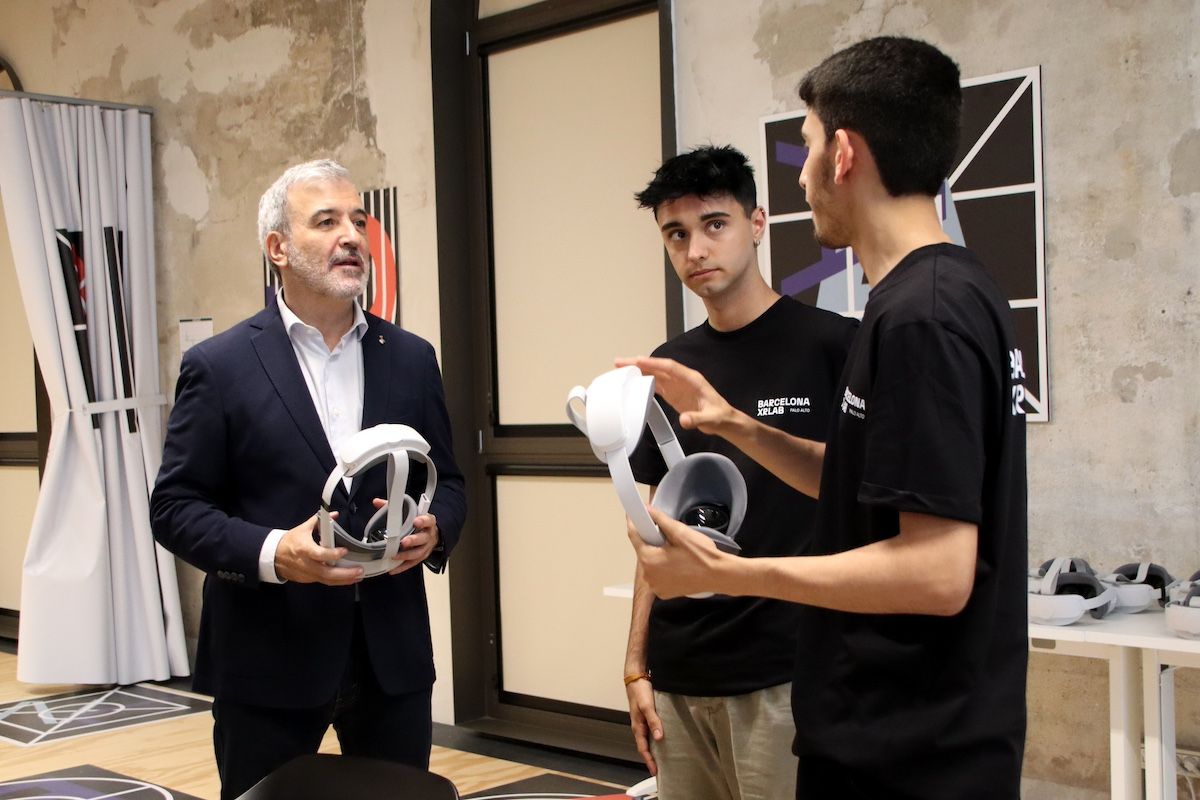
In this way, the center aims to touch all aspects of the ecosystem and close the circle between companies, talent, and investors, with the desire to act as a "catalyst for innovation in the audiovisual field in Barcelona and Catalonia," highlighted the mayor, Jaume Collboni. After emphasizing the business fabric of the sector, he advocated for initiatives promoted from the facility to transcend the audiovisual, and "radiate new sectors of the city." All so that Barcelona continues to "be a leader" in innovation, generating spaces where "creativity and entrepreneurship" can be felt.
Thus, the aim is for the space to become a "nerve center specialized in new technologies applied to audiovisual," according to the CEO of XRLAB and president of Magmacultura, Artur Duart: "In Barcelona there is a lot of talent and small initiatives; we intend to centralize them and, above all, consolidate them as a hub in Southern Europe with a desire for international projection."
Add The New Barcelona Post as your preferred Google source for free
Stay informed with the latest news.
