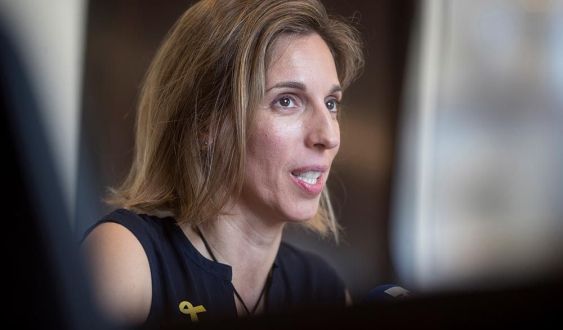
"Women must be in leadership positions and also in intermediate positions, both in more conventional jobs and in technological fields". The Minister of Business and Knowledge, Àngels Chacón, has a particularly highlighted issue on her agenda: women must achieve the same presence as men in the business field, but especially in the scientific and technological sphere. In an era where no one can doubt that they can play all the keys, the time has come for their hands to reach the keyboard.
Her objective aligns with that of the United Nations General Assembly in the resolution "Transforming our world: the 2030 Agenda for Sustainable Development". Among the 17 objectives and 169 global targets to be achieved by 2030 present in this document, one of the highlighted points is the challenge of ensuring the full and effective participation of women. This means achieving equal opportunities for leadership at all levels of decision-making in political, economic, and public life.
The Department of Business and Knowledge, led by Minister Àngels Chacón, the first woman to hold the position, joins this objective and is already working to achieve it. In this sense, female presence in a sector such as science and technology is relevant to reverse a too pronounced gap, as is also the case in the industrial sector.
WOMEN, UNDERREPRESENTED
The figures do not contradict the feelings: there is still a long way to go, especially in some of the sectors with the most weight in the Catalan economy, such as the industrial sector. According to the report "Women in the industrial sector in Catalonia", promoted within the framework of the National Pact for Industry and prepared by Carmen Poveda from the Women, Business and Economy Observatory of the Barcelona Chamber of Commerce, there is a strong masculinization of the industrial sector in Catalonia. Only 28% of jobs in this area are occupied by women and the gender pay gap is higher than that of the economy as a whole, 17.3% against 15.3%.
The Minister of Business and Knowledge believes that "overqualification and the problems they have in being promoted and reaching positions of responsibility, due to difficulties in work-life balance but also due to the glass ceiling, hinder their internal promotion and have significant economic effects".
Another significant fact concluded by the study is that the average educational level of women in the industry is higher than that of men, but this does not translate into a greater female presence in decision-making positions, which stands at 22.4%.
"There is a fundamental problem, which is the lack of industrial vocations, especially in technical profiles, among both men and women, because when we talk about this sector, we still draw chimneys with smoke when it is the branch that innovates the most", explains Chacón. But in the case of women, the situation is even more complicated due to the masculinization of the work environment and the lack of female role models. This circumstance also forces women to strive harder to be recognized, to be overqualified, to have a greater dose of self-confidence, and greater family support. Many times, the female presence in industry is explained by family ties or acquaintances. An example: 75% of women engineers are daughters of engineer fathers. Most women who work or want to work in an industry do so because they have relatives who work or have worked there.
The study also highlights that one of the main reasons for the scarce female presence in the industrial sector is the lack of professional guidance from childhood, as it has been shown that from the age of six, girls already reject technological options because they believe they are more difficult studies and "it's a man's thing."
MAKING FEMALE ROLE MODELS IN SCIENCE AND TECHNOLOGY VISIBLE
Given this situation and with the aim of achieving the 50-50 challenge by 2030, the Department of Business and Knowledge has already begun to work on promoting an action plan. This must be transversal, starting from primary school to develop female competencies, make visible female role models in fields such as science and technology, implement mandatory technology subjects in schools, explain the environmental change that industry has undergone, and also the job opportunities it offers. "Visits to companies are already being made, but sometimes it's just a simple excursion; pedagogical material needs to be prepared that addresses all these concepts", Chacón points out.
One of the challenges society faces is retaining and empowering female talent, and for this reason, the strategic lines to follow focus on achieving true flexible working hours and adaptation to the life cycle; promoting work-life balance between women and men; opting for work by objectives instead of presenteeism; and fostering the internal promotion of female talent.
To achieve effective equality, women's access to higher levels of responsibility must be promoted. In this regard, the Minister of Business and Knowledge explains that it is necessary to promote "mentoring programs, women's groups, and promote their participation in external training".
Add The New Barcelona Post as your preferred Google source for free
Stay informed with the latest news.
