[dropcap letter="E"]
nric Juliana wrote a couple of weeks ago in La Vanguardia that the title of Jordi Amat's short pamphlet La confabulación de los irresponsables (The Conspiracy of the Irresponsible) will define the era —for optimists, the last five years— of the Kafkaesque Der Prozess that you and I have had to live through, especially in Barcelona. Without the reflection having a hint of criticism of the essayist's work in question, I beg to differ and you will soon understand why.
Since the first massive demonstrations began on Paseo de Gracia back in 2012 and, as the secessionist proposal consolidated and advanced towards the disconnection process —which ultimately did not happen—, journalists, essayists, and columnists have widely used the diary Abans del sis d'octubre (Before October 6th), published in 2008, by lawyer Amadeu Hurtado to reinforce their respective arguments. Normally, of course, against independence sentiments.
The diary, unpublished until then, certainly did not mark any era, nor did it have any influence among its contemporaries. Other texts did, now completely forgotten. Such was the case of Crítica del 6 d'octubre (Critique of October 6th) by propagandist Jaume Miravitlles (1935), which was written with the purpose of exempting Companys from the failed 'Events of October 1934' and to blame the then Minister of Governance, Josep Dencàs, and the independence faction he led within ERC, Estat Català.
Hurtado's diary, on the other hand, has had a strong impact among current essayists. And it is that among writers, there persists the desire to make their perspective endure, in the style of journalist John Reed's report, Ten Days That Shook the World (1919) about what happened in the Russian October Revolution. To transcend, rather than to analyze or explain, is the objective of these works.
In the Catalan case, for example, in a mix of Reed and contemporary —confessed— translation of Hurtado, Enric Ucelay-Da Cal, Arnau Gonzàlez Vilalta and Plàcid Garcia-Planas have written in intertwined urgent notes some meditations on the Catalan October, Tumulto. Undoubtedly, future researchers will browse it to get a feel for more perspectives. Although it will hardly be the Abans del sis…
Undoubtedly, these and many other essays that have appeared, whether more or less accurate in their analyses, are interesting and complement each other. It will be necessary to read them all, or perhaps wait for a synthesis, to have a multicolored fresco of what happened. Despite this, none will define the days we lived dangerously. Future perception will not depend on how much the media aligned with their theses have, relentlessly, extolled them. No. If at some point reality mattered and it could be considered that something similar to it could be objectified, today it is trading low. It is not that reality, past or present, does not exist —which could be debated—, it is simply that it does not matter.
In the Catalan cultural sphere, this was already the case before the advent of the digital world and liquid modernity. More and more people reading a historical novel believe they are reading History. It has reached such an absurdity that the reading public prefers 'the truth' of Victus, of Soldados de Salamina or of Yo, Claudio rather than the studies of Joaquim Albareda, Joan Maria Thomas, Mary Beard or the annotations of the Hurtados of the moment.
It will therefore be he who, with his talent, creates a Vida privada, a Plaza del diamante, a Ciudad de los prodigios, a Diario de un ladrón or for its outskirts a trilogy like that of Julià de Jodar, L'Atzar i les ombres, who manages to crystallize the vision of the separatist process in the popular imagination. Just as Fallada did with the years of the Weimar Republic and the Hitlerian regime or Dickens with those of Victorian England, however paradoxical it may seem, who will fix the image of our revolutionary Barcelona decade will not be the essay on reality, but directly fiction. After all, who cares about John Ferling's analysis of the life of the second president of the United States, if the series John Adams dispatches it in seven entertaining (and biased) episodes?
Featured image
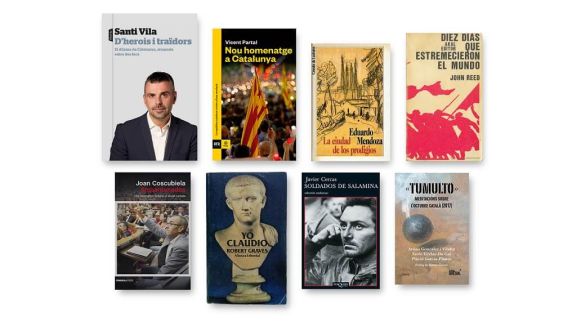
From top to bottom and from left to right: D'herois i traïdors, Santi Vila / Nou homenatge a Catalunya, Vicent Partal / La ciudad de los prodigios, Eduardo Mendoza / Diez dias que estremecieron el mundo, John Reed / Empantanados, Joan Coscubiela / Yo Claudio, Robert Graves / Soldados de salamina, Javier Cercas / Tumulto, Arnau Gonzàlez i Vila, Enric Ucelay-Da Cal, Plàcid Garcia-Planas.
Add The New Barcelona Post as your preferred Google source for free
Stay informed with the latest news.