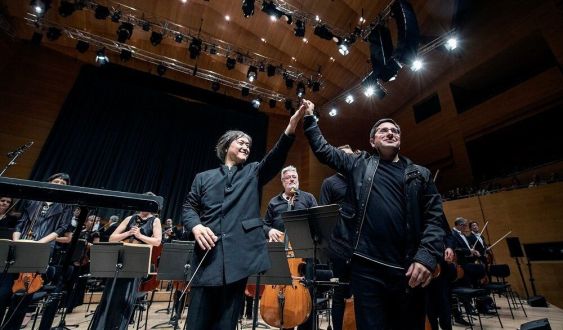
After the dress rehearsal, on Friday (May 18) morning, Héctor Parra attends to the press with commendable generosity and a smile that shows satisfaction for the work done. He seems to anticipate what the next day will be a success, as rarely has been experienced on the occasion of the premiere of a work, in the main hall of the Auditori. The creator of Inscape, a commission that the OBC premieres together with soloists from the renowned Ensemble Intercontemporain -an orchestra founded by Pierre Boulez, as such a specialist in experimental music- expresses himself with captivating, very pedagogical ease.
Born in Barcelona in 1976, son of a physicist, the composer passionately transmits the ideas that structure his work, to make it more accessible to most listeners. An obligation that weighs on many contemporary creators -not always artists had to fulfill such a demand- but which in his case is lived, on the contrary, as an optimal occasion to foster the appreciation of his work. Although Inscape shies away from the programmatic character of the symphonic poem, the truth is that it narrates a cosmic journey. A "transport" through the acoustic experience, which will bring the listener to the limits of the audible.
BEYOND THE CONFINES OF SENSIBLE REALITY
The French astrophysicist Jean-Pierre Luminet, who accompanied Héctor Parra in the conception of the project, is equally accessible in his talk with the press. He provides images, visual examples or reminiscences of ancient wisdom (Thales, Heraclitus, Pythagoras…) in order to illustrate the notion of order that characterizes the cosmos, up to the limits of what is rationally knowable. The reality of antimatter, the possibility that black holes connect different universes, or the very (inaudible) sound of the universe are questions that ordinary mortals can hardly develop. Parra's challenge is enormous, in this sense. And, nevertheless, in his effort to materialize the immaterial -to verbalize the inaudible and achieve the propagation of sound waves that suggest that other reality of physics- what the listener discovers is a prodigious work, from an entirely musical perspective.
The complicity of conductor Kazushi Ono, who during various interruptions of the rehearsal listens attentively to Parra's instructions, score in hand, is fundamental for the integration of the particular efforts of the notably challenged staff musicians. The way of extracting unusual sounds from classical instruments -the beginnings of this praxis can be found in Mahler, whose symphony is precisely programmed in the second part of the concert- is fascinating in its interaction with digital technology, which takes advantage of Stockhausen's electroacoustic revolution, and allows it to transport the listener beyond the confines of sensible reality, which they believe they know.
"In the effort to materialize the immaterial -to verbalize the inaudible and achieve the propagation of sound waves that suggest that other reality of physics- what the listener discovers is a prodigious work, from an entirely musical perspective"Film buffs will perhaps remember the unusual lucidity of Stanley Kubrick, largely responsible for the soundtrack of his 2001. A Space Odyssey: to the feat of achieving that the Blue Danube could reliably illustrate the rotation of the space station, one must add the effective use he made of the Atmosphères of Ligeti, pieces in which one can guess the impossible sound (inaudible, in principle) in a vacuum. The possibility of wave propagation is the reality before which Parra also plunges, with an ambitious orchestral proposal, which partly de-localizes the focus of meaning.
Sounds reverberate everywhere, the volume of the auditorium is colonized by waves, even to declaim in whispers close to silence. In addition to the large orchestra, led by the soloists of the Ensemble Intercontemporain, the composer chooses to distribute various percussion and wind ensembles in the amphitheater boxes, which produce an immersive sound at specific moments, giving rise to a completely new experience that is nevertheless lived with a strange naturalness. It is enjoyed with a mixture of astonishment and familiarity, due to the organic and overwhelming character of a creation that delineates the physical reality of silence and also very joyfully tortures the eardrums, in what seems like a celebration of the order opposite to the cosmos, which at the same time constitutes: chaos.
THE INCOMPREHENSIBLE NATURE
The sensation of being subjected to a rhythmic and yet unpredictable influence is difficult to convey in words during the audition of Inscape. And yet, it unequivocally conveys, through a very striking timbral richness -through the confluence and contraposition of instruments from disparate families- the reality of physis that other celebrated artists had already explored. It is impossible not to think of the Rite of Spring due to the eventual prominence of the bassoon and the way percussion and brass instruments imprint agonizing rhythms, of clear Dionysian inspiration. But even if we believe we detect some quotation -to Ligeti and Stravinsky, perhaps we could add Takemitsu- Parra's creation is absolutely original. It relies on number, as it could not be otherwise when dealing with a cosmic question, but it is open to the influence of the unforeseen, that dialectic -absolutely musical- being what generates addiction, and makes it an enormous work.
The reality of the void is mysterious, incomprehensible, but no more so than the reality of being, and the propagation of waves that lead us to positively experience what there is. That "physis -Heraclitus expressed, referring to the most immediate and obvious reality, which cannot not be- likes to hide itself". It is not that true reality resides in the hidden, or shows itself superior to the sensible, as philosophical and religious Platonism has insisted on emphasizing. Much more suggestive is the possibility -disturbing for some, plausible for others- that the difference between physics and metaphysics, between material and immaterial reality, is only a difference of degree.
"The reality of the void is mysterious, incomprehensible, but no more so than the reality of being, and the propagation of waves that lead us to positively experience what there is."Some mythical conceptions, in the origins of those first forms of wisdom that Jean-Pierre Luminet alluded to (when mentioning Heraclitus, for example), insinuate in a non-discursive way the co-belonging of being and non-being, understood no longer in terms of exclusion, but as a mutual condition of possibility. Héctor Parra's journey, vertiginous and subtle depending on the region through which it passes, represents a brutal update of the excursion that Gustav Mahler undertook a century earlier with his Fourth Symphony, the work scheduled for the second part of the concert. From an implacable gaze -common to both composers- we find, however, the real contemplation of nature, both of beauty without reason and of its thundering power, which would seem meaningless (destruction tends to seem less comprehensible to human interests).
Inscape, a work that will soon be performed in Paris, Lille, and Cologne, stands as an inspired sublimation of the longing for transcendence that confirms, however, that we are immersed in the flow of a changing, visible and invisible reality (physis), understood in an unfruitful and always provisional way. The role of some solo instruments, specifically the flute, embodies this attempt. But it is not the only voice that builds the fabric and confronts the most radical void. There are many attempts at colonization, and the merit of Parra's work is the global, ambitious, and sensitive effort to make audible the order of the cosmos, even in the vicinity of what has been called a "black hole," a maximally dense reality that impenitently swallows any beam of matter.
Add The New Barcelona Post as your preferred Google source for free
Stay informed with the latest news.
