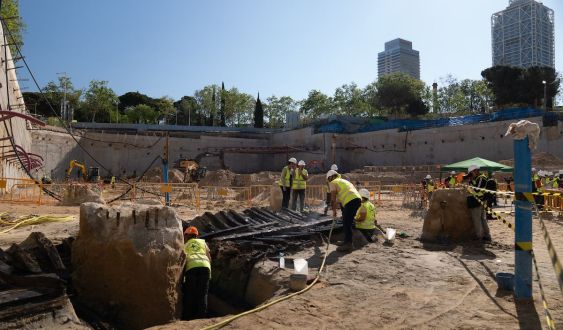
Barcelona looks to the future with initiatives such as the Ciutadella del Coneixement, the cutting-edge scientific research complex in Europe that will host some 2,000 researchers. A commitment to the future that, however, is sustained and built on the pillars of a city with thousands of years of history. Beneath the buildings that will constitute this city of the future, a millennial Barcelona is hidden, which, from time to time, allows itself to be discovered through works that build the city, such as the medieval houses recently located in the works on Via Laietana. The works for the future scientific center of the Ciutadella del Coneixement, which are expected to last until 2028, have also unearthed a part of this historical past, from which the remains of a medieval ship have emerged that will allow expanding knowledge about the intense maritime activity in the city.
Specifically, the remains found correspond to a wreck, a term used in underwater archaeology to refer to a ship that has sunk or been abandoned and covered by sediments over time. Centuries later, the works for the future research center, five meters below sea level, have brought to light the remains of this ancient ship, dating from the 15th or 16th centuries, which had been buried under the sand of the Barcelona coast.
The unearthed fragment, which corresponds to the stern and port side ---the rear-left part of the vessel---, measures more than 10 meters in length and 3.5 meters in width, which confirms that it is a large vessel. Specifically, the remains of the ship consist of a structure of thirty frames ---the curved timbers that form the skeleton of the ship---, as well as two vertical pieces, fixed with iron nails. The conditions in which the vessel was found suggest that it probably did not sink in this location, but rather arrived as a result of storms.
"We don't find a ship of these dimensions every day," highlighted Santiago Palacios, the archaeologist leading the excavation, who described the find as "exceptional." In fact, in the city of Barcelona, only one other vessel of similar conditions had been found, the Barceloneta I, located in 2008 during excavations near the França station, and which is currently exhibited at the Barcelona History Museum. These remains date from the 15th century — a chronology similar to that of the vessel now found in the future Ciutadella del Coneixement — and with a probably Basque type of construction.
In contrast, the remains of the ship discovered on the site of the old Mercat del Peix reflect a type of construction typical of the medieval Mediterranean, known as skeleton, which spread throughout Europe from the mid-15th century. These two ships, therefore, allow documenting and studying the differences between the two constructive typologies that coexisted in the city in the 15th century, and offer "a more complete vision of the diversity and complexity of the intense maritime activity during medieval Barcelona," according to Palacios.
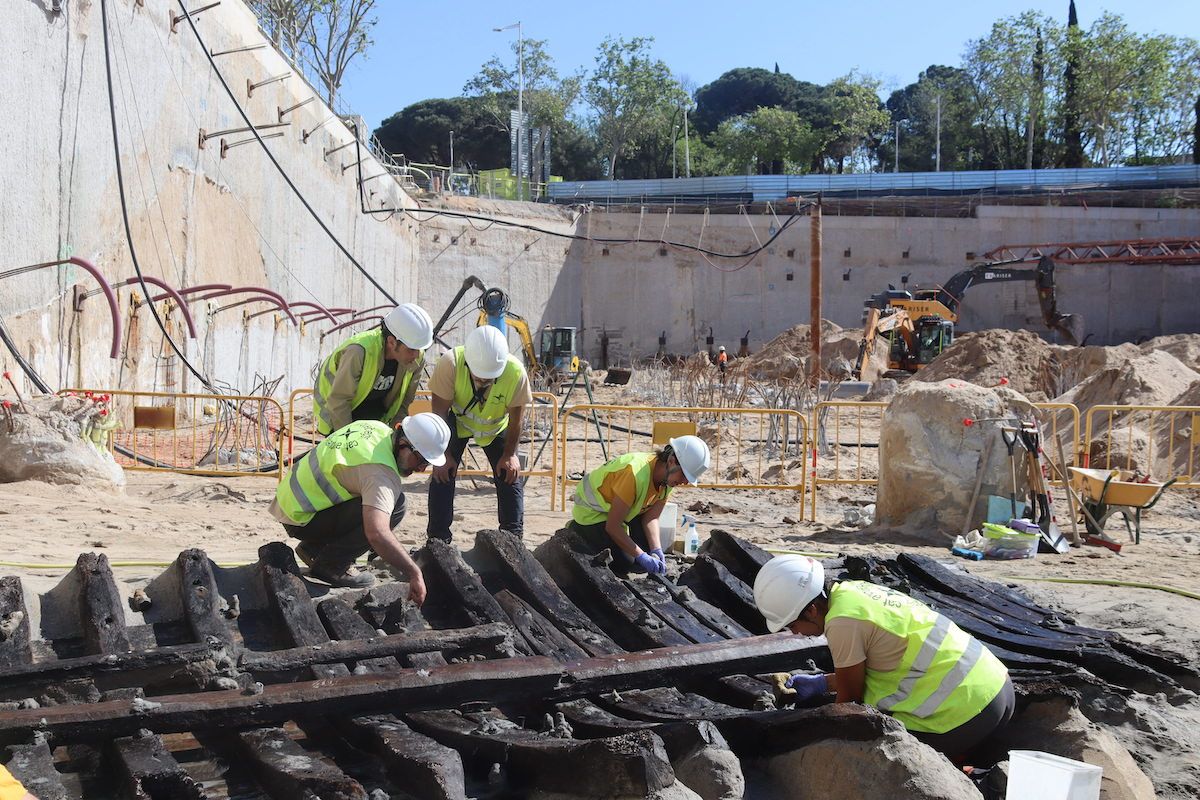
Despite being an exceptional find, when the team of archaeologists began working on this plot, it was already suspected that they might locate such an ancient vessel, due to the depth at which they are working, more than five meters below sea level, and its proximity to the coast. In fact, in the 15th century, the sea covered the site now being excavated, and it was not until 1439, with the construction of the first artificial docks, that the coastline began to change and the beach gained space from the coast. For this reason, archaeologists do not rule out unearthing some other surprise in the area they have not yet excavated out of the total 7,000 meters that the works occupy.
For now, archaeologists have not been able to determine the exact chronology of the vessel, information that can be obtained in the coming months, with the analysis of pollen found in the boat and carbon 14, which will allow detailing the origin, chronology and even the utility of this vessel. For now, the Servei d'Arqueologia de Barcelona, with the advice of the Museu d'Arqueologia de Catalunya - Centre d'Arqueologia Subaquàtica de Catalunya (CASC), is focusing on the conservation of the remains found.
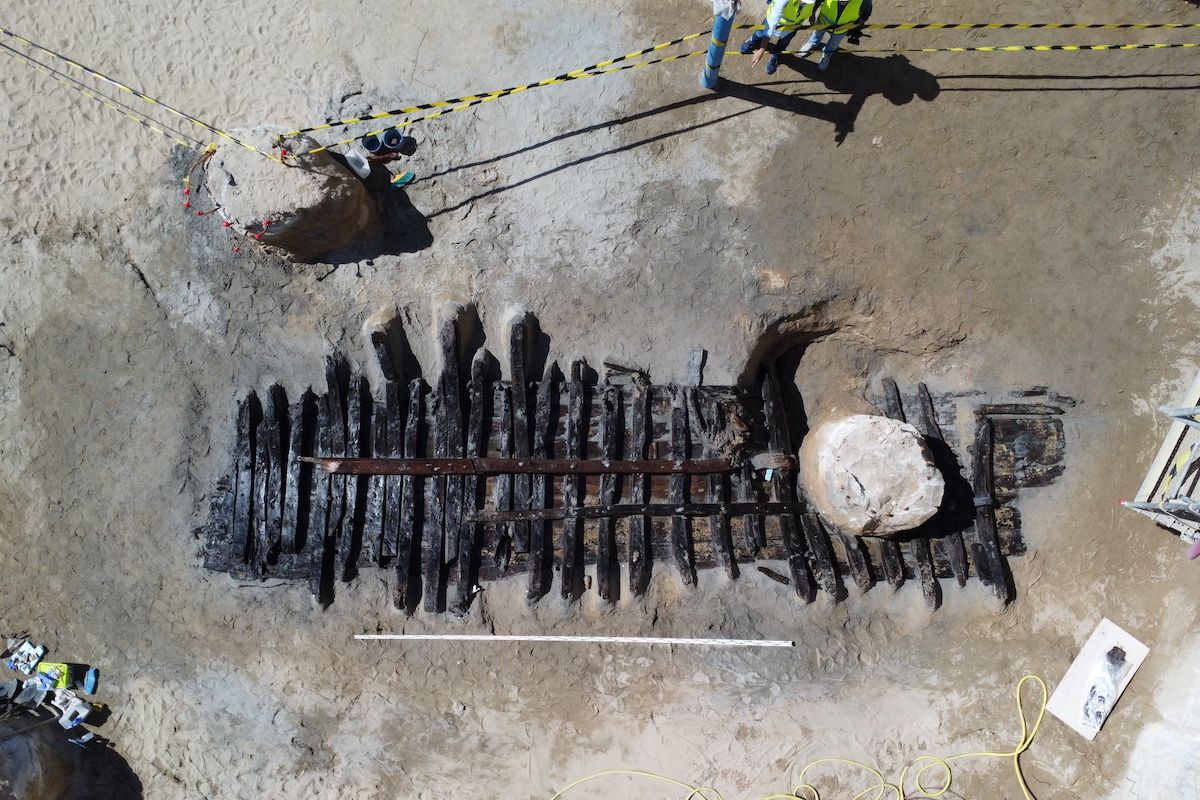
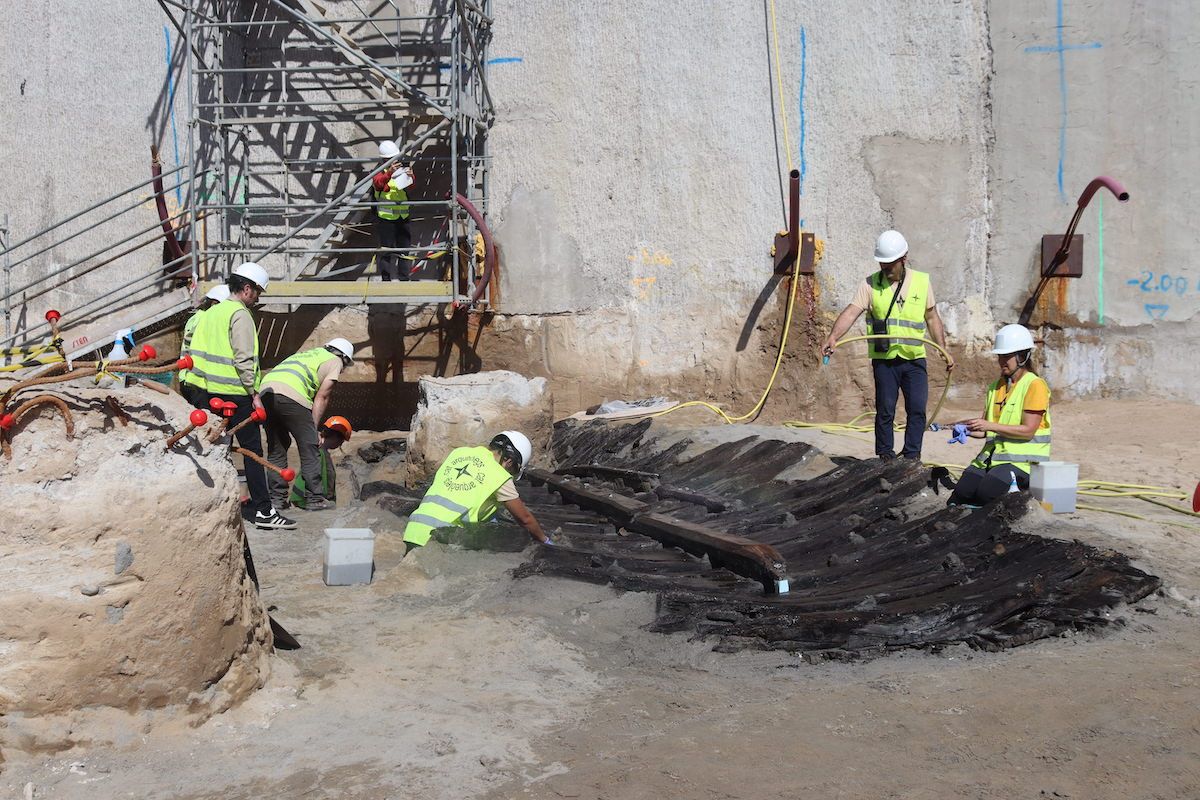
A "delicate" conservation, as detailed by restorer Delia Eguiluz, since wood, despite being a common material in shipbuilding throughout history, is only preserved in environments with very specific characteristics, such as aquatic environments, and deteriorates rapidly when it comes into contact with air. For this reason, when these remains were discovered in mid-April, it was decided not to unearth them completely, but to keep them partially covered with the original sand that surrounded them. In addition, an irrigation system ensures that, day and night, the wood does not dry out or degrade.
At this time, direct manipulation of the remains is being avoided, and archaeologists are working by applying high-precision three-dimensional marks and photographs to obtain more information about the pieces. Subsequently, the fragments will be transferred "piece by piece, after an exhaustive cleaning of each of the woods, in containers full of water," as Eguiluz explained. Once transferred, a desalting process and resin application will be carried out to ensure the long-term conservation of these materials. A conservation and restoration process that can last for more than four or five years, before it can be exhibited in a museum, although it is still too early to establish the possible destination of these remains.
In addition to the boat, organic remains have also been found in the works, such as a pinecone or roots of nuts, like hazelnuts or almonds, elements that are currently being studied but it is not ruled out that they could date from a similar chronology to that of the vessel, or even have some direct relation to it. Xavier Maese, from the Servei d'Arqueologia de Barcelona, has assured that it is a large quantity of remains to have arrived casually, but rather it is probable that these elements may be related to the vessel. Likewise, the works have also allowed to recover up to 40,000 meters of sand, which is already being used to regenerate the Sant Sebastià beach, where about 25,000 meters of sand have already been moved.
The archaeological excavation, carried out by the company Arqueòlegs.cat, began at the same time as the works, at the beginning of 2023, and these findings should not delay the works. With a calendar that has been extended over the years, the completion of the Ciutadella del Coneixement is initially planned between 2027 and 2028, when it will become a leading research center, with professionals from the Parc de Recerca Biomèdica de Barcelona (PRBB), the Consejo Superior de Investigaciones Científicas (CSIC), the Barcelona Institute of Science and Technology (BIST) and the Universitat Pompeu Fabra (UPF).
Specifically, the works are now focused on the base of the complex, where the future underground parking of BSM will be located, a public company that already managed the old parking that for years had occupied this space, where historically the city's Mercat del Peix could be found. The forecast is that the parking lot, with a total investment of 22.2 million euros, can come into operation during the first quarter of 2026, to later erect the three buildings that will make up the future research center.
Add The New Barcelona Post as your preferred Google source for free
Stay informed with the latest news.
