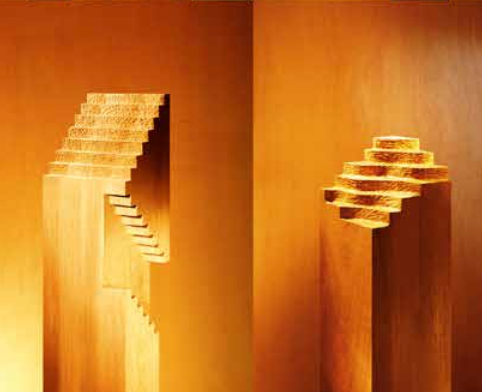
[dropcap letter="L"]
a ramp is a reinterpretation of nature; the staircase, an invention. If the perfectly horizontal plane is something artificial—a creation—, the succession of horizontal planes of equal depth and staggered at a uniform height—the staircase—is a remarkable invention. An invention that, unlike, for example, the wheel, is found or spread throughout the globe, an ecumenical architectural protagonist since time immemorial. From the first Egyptian monuments, the staircase is an architectural piece that several millennia have not managed to improve. And, also from the beginning, the staircase is a construction full of symbolisms of all kinds: of power, of hierarchy, mystical or erotic. The staircase as a symbolic way to ascend to heaven or to descend to hell is lost in time and is present in practically all cultures. The recognition of the staircase as a symbol of phallic erection and as an ideal setting for representations of high erotic charge is also general. I am not referring only to the vedette descending, quite lightly dressed, with sensual slowness the long staircase of the Folies Bergère, I am referring to Claudia Cardinale wrapped in a white bathrobe, descending, majestic and dazzling, down the staircase of The Girl with a Suitcase.
Almost all memorable historical staircases share two characteristics. The first is the horror of the railing. It doesn't matter if artists represent staircases in drawing or painting, if set designers build them for a film, or if architects design them for everyday use. Creators have always preferred staircases without balustrades or railings, without any protection, without the presence of this annoying diagonal of the handrail, with the steps showing in all their purity. The risk and discomfort for users is evident, but the insistence of designers in obviating this nuisance is no less so. In painted staircases, from Leonardo's Adoration of the Magi to Duchamp's Nude Descending a Staircase, the absence of a balustrade is the general rule. In cinematic settings, almost the same thing happens: how many duels between swordsmen do we see on staircases with railings? How many staircases with railings in German expressionism? How many railings in the set designs of Busby Berkeley or Robert Leonard musicals?
The second trait common to almost all staircases that have made history, if we adhere to the regulations currently in force in, let's say, advanced countries, is their illegality. Both safety regulations and fire regulations would make these staircases impossible today. It seems that the regulation drafter does not share architects' love for staircases. It is undeniable that, in the event of a fire, the stairwell can act as a chimney, rendering it unusable as an evacuation route. However, this undisputed risk has led to regulations that grossly penalize the staircase. The staircase cannot open into any habitable space; it must be totally independent and accessible only through self-closing doors that require titanic force to overcome and are usually held open by wedges that owners have logically but illegally inserted. But what's more, for many uses, curved paths, progressively dimensioned steps, cantilevered steps, etc., are proscribed in staircase design. In other words, according to legislators, a staircase like the prodigious imperial staircase of the Garnier Opera in Paris, which violates almost all regulations, is highly dangerous and, in the event of evacuation, would lead to multiple and tragic falls, although the exact number of deaths caused by this public enemy in almost a century and a half is unknown.
It is not strange that, faced with this increasing pressure, exhausted in a sterile struggle in defense of alternative projects, architects become demoralized and adapt to solutions that deserve all blessings and entail no legal risk: the enclosed staircase, with a rectilinear layout, with equal and orthogonal steps; the hackneyed and universal standard staircase, economical and safe. We have gone from considering it the center of the building to designing it as an equipment room. If today we intend to design a staircase of the interest of those that have made history, it will surely not be legally considered an evacuation route, which means we will have to convince the client to finance it as a decorative sculpture.
This is the main reason why I believe this protagonist of great architecture of all time is in danger of extinction. In danger of extinction because nowadays the staircase has ceased to be a pezzo di bravura of the architect to become a service space, purely functional, marginal, isolated, and almost standardized. I am pessimistic about the future of the staircase as a noble architectural theme, and this prediction saddens me because throughout my career I have had a great time designing some, and throughout my life I have greatly enjoyed walking through others, so much so that I am thinking of writing a travel guide focused on these pleasure generators.
Add The New Barcelona Post as your preferred Google source for free
Stay informed with the latest news.