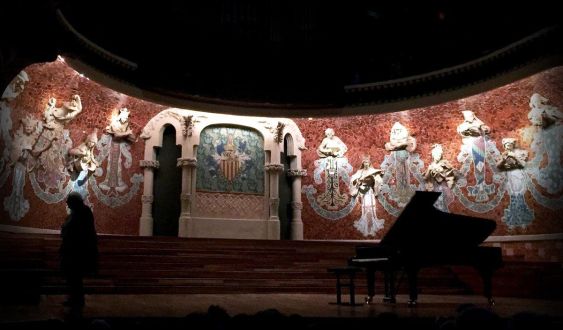
[dropcap letter="U"]
nother year, Russian pianist Grigory Sokolov has gathered a crowd of faithful followers at the Palau de la Música Catalana, practically filling the Concert Hall. And this marks eleven consecutive seasons. It matters little that he doesn't announce, until a few weeks before the concert, what the definitive program will be, that is, the pieces he will perform (with the usual and relatively predictable range between the baroque of Bach or Rameau and the mature and balanced romanticism of Brahms). For, as happens in the best concerts, the audience comes for the interpreter, whom one can consider from a romantic conception, as a decanter of essences or an alchemist. And yet, these qualifiers are little or not at all suited to the strange case of Sokolov.
By default, given the recurring success of his convocatoria, one is tempted to think that behind this mass phenomenon (within the world of classical music, of course, which is in itself reduced compared to pop) we find an immense marketing effort. A company that takes care of its image and invests in communication, counting on the complicity of the main involved party (the promoted artist) who would sell himself as a prodigy, a type with a diva-like presence on stage and charming off it. Another disappointment, Sokolov is not a technical prodigy, nor does he exude charm in public events, which, by the way, are minimal, saving the concerts. His person and manners suggest an artist from another era or, rather, from no specific era.
His person and manners suggest an artist from another era or, rather, from no specific era.Sokolov is a musician who, above all, delights (he, in the first person) in the pleasure of interpretation, without even looking in the mirror of tradition. There is no trace of historicist criteria in his way of playing. And just as when he appears on stage he immediately sits down at the piano, barely looking (and therefore not greeting) the audience, his reading of the chosen pieces does not get distracted by inter-epochal dialogues or winks, nor does it pretend to rescue the lost essence of the score, supposedly akin to the true spirit of the composer. A very evident fact, without going any further, in his three Haydn sonatas, in the first part of this year's recital at the Palau. Nor does he indulge in a form of virtuosity as spectacular as it is vacuous, that circus exercise that has aroused admiration in all eras, and, as could not be otherwise, also in ours.
On the contrary, Sokolov prioritizes the declamation of the phrase, building a coherence that is not merely subjective (capricious, motivated by chance or by the circumstances of his personality) nor results from an objectification, in search of that musical quintessence. Where his modus operandi is best and most evident is in Schubert's series of Impromptus, already in the second part. The flow of these false improvisations, with an easy melody and an extremely intricate and powerful texture, allows the interpreter temporal fluctuation. The voluntary alteration of tempi and intensities. And with it, the generous modulation of emotional states, which he dispenses to the piano with an imperturbable pose, without any kind of affectation.
The flow of these false improvisations, with an easy melody and an extremely intricate and powerful texture, allows the interpreter temporal fluctuation.Ignasi Cambra, a young talent to whom we will soon dedicate an audiovisual piece and who usually attends Sokolov's recitals (he is not the only musician who attends), explained to us that in his way of playing, some type of activity is always appreciated, a product of a deep study of the score. A complete immersion, which makes the interpretation original and worth listening to. Sokolov resolves the most intricate passages with apparent ease, but, above all, he enjoys making most of the nuances audible, regarding the relationship between notes and the very sonority of some of them, in which he seems to test the piano, amplifying the beautiful vibration it produces. That is why, perhaps, he is not content with fulfilling what is stipulated in the program, and almost habitually offers a series of encores.
The third part of the program, not entirely secret at this point (although it is never warned a priori) usually, in effect, consists of a substantial series of encores, where the pleasure of interpretation is rediscovered, in the foreground. Generally, it is a series of six short pieces (he reappears on stage about ten times, between greetings and the concession of each extra piece) in which he alternates the danzabile elegance of a Rameau, a harpsichord composer whose pianistic version requires precise fingering, with the magnificent palette of colors and affects that characterizes Chopin's production, one of the composers most invoked in this third act of the program. Sokolov satisfies the audience's demands, but with enigmatic indifference.
The following and admiration that some young interpreters profess for him suggests that, precisely he (an infrequent specimen in our times) can become a reference.It does not seem to be arrogance, vanity or contempt that leads him to appear cold. It is as if he reserves every communicative nuance, any form of complicity, for the occasion of his musical interpretation. This is not the only, nor the least fascinating of the paradoxes posed by his personality as an artist. For the following and admiration that some young interpreters profess for him suggests that, precisely he (an infrequent specimen in our times) can become a reference for the future. Never before had technical training been so outstanding, in such a high number of musicians. Interpretive exceptionality, on the other hand, is more difficult to train. In this sense, there is no doubt that it is also worth noting his effort to read the works from within.
The counter-discourse that Sokolov embodies (without intending to indoctrinate, of course, something alien to his personality) not only proves to be genuine, but also successful: it moves and therefore attracts many listeners to concert halls. Perhaps the best proof that music transcends mere entertainment is provided by the artists themselves, those who (like Grigory Sokolov) live it on stage with a particular intensity, enabling the emanation of that inexplicable magnetism. Unapproachable in origin, it provides aesthetic experiences that build much more loyalty than other promises of immediate happiness.
Add The New Barcelona Post as your preferred Google source for free
Stay informed with the latest news.
