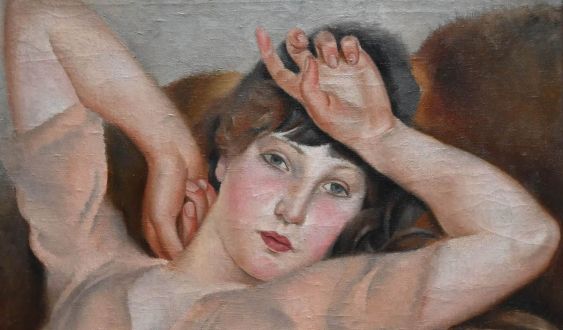
It was the year 1925 and Sala Parés, with its reopening, had to change direction. With the transfer from Joan Baptista Parés to the Maragall brothers, and after some years in which it had been losing popularity since 1914, the oldest exhibition hall in Spain and even one of the oldest in the world, had to modernize.
Founded in 1840 as a fine arts store, the hall on Petritxol street then opted for a line based on the perfect conjunction between the classicism of nineteenth-century figurative art and the new avant-gardes of the early century, such as New Objectivity, a movement that emerged in Germany in the late 1910s by Gustav Friedrich Hartlaub, as a response to dominant expressionism and with the intention of showing class struggle and European corruption with greater fidelity to reality. One of its most representative painters of this movement is Otto Dix, who fought and represented the horrors of the First World War and its consequences.
A century later, the new exhibition of this emblematic hall, Figurations between wars 1914-1945 (which can be visited until February 7), wants to precisely vindicate the participation and incidence of Sala Parés in modern Catalan art. It does so one hundred years after the period of the Maragall brothers at the helm of the hall, a period very linked to figuration in Catalonia, which in those days was already appreciated as entirely heterogeneous, complex and multiform.
In 1926, taking advantage of the lack of collective proposals, the Autumn Salons were inaugurated in its venue with a group of works that presented a renewed figuration that already proposed a dialogue between the new and the old. A visible step from the past to the future. In the words of journalist, poet, and cartoonist Josep Maria Junoy, when describing the new direction of the hall: "The beauty of the old and the new, tradition and modernity. Without modernity, tradition becomes a fossil. Without tradition, modernity would fly like smoke." Names like Emili Bosch Roger, Joaquim Sunyer, Joaquim Torres-García, Rafael Benet, Josep Mompou, Pablo Gargallo, and Salvador Dalí, stood out from a total of fifty artists, presenting that year's exhibition as the true and most significant manifestation of modern Catalan art. From young Dalí, it was exhibited Girl sewing and Figure on some rocks. With so little, the clear talent and artistic intentions of the Empordà genius were already glimpsed. The rest of the works, with a clear Noucentista tone, also included evolutionist strokes and artists from the Barcelona Courbet Group, among whom Josep Togores stands out.

"Catalan figurative painting had to overcome novecentismo and look towards the influences of Cézanne and towards Picasso's cubism"Above the aforementioned dialogue between future and past, and the attraction of new visitors, the venue intended, at the risk of seeming too ambitious, at the risk of seeming the defender of an ungraspable and amorphous idea,to bring together all the figurative currents of the country, which were not few, and he succeeded until the beginning of the Civil War in 1936.It was not an easy challenge: Catalan figurative painting had to overcome Noucentisme and look towards the influences of Cézanne and towards Picasso's cubism.This transition was aided by the strong connection with Paris of a series of painters, the foreigners who took refuge in Barcelona during the First World War, and the Catalan painters who were in Montparnasse, names like Manuel Humbert, Pruna, Togores, Celso Lagar or the painter Olga Scharoff. Links were established with Chagall, Modigliani, Apollinaire, Mason, Juan Gris, Max Jacob and, of course, with Pablo Picasso. The work of Josep Maria Togores (1893 – 1970) represents the line that the gallery defines and defends throughout its extensive history.Classicism and modernity in a set of complex and changing works, tense, but which, as a whole, enjoy full harmonyThe one from Cerdanyola, who dedicated himself to painting due to deafness caused by meningitis, took advantage of a scholarship from the Barcelona City Council to travel to Paris in 1907, where he met Cézanne. With a strong impressionistic tone, he was part of the Courbet Group. Also indebted to the tradition of Spanish realism, he slowly transitioned towards cubism, but from a very personal perspective, in which he also left space for surrealism. He arrived at this movement with Braque, Maillol, Jacob, and Picasso. He signed an exclusivity contract with the renowned art dealer Daniel-Henri Kahnweiler until 1931. A year later, he returned to Barcelona. He was represented by Francesc Cambó, and died in 1970, run over by a car in the middle of Paseo de Gracia.
"The figurative art between wars is expressed with a gaze into the void, an existential, moral void; embracing an evident hopelessness"Other painters like Torres – García turned their influence towards the avant-garde. Planells embraced the oneirism proposed by his friend Dalí; Óscar Domínguez painted disassembled and disassemblable women with a cubist aesthetic; and the work of the Russian-born painter, Olga Sacharoff, stands out for constituting another twist to Modigliani's portraits with a stylized style and inert eyes.


Add The New Barcelona Post as your preferred Google source for free
Stay informed with the latest news.