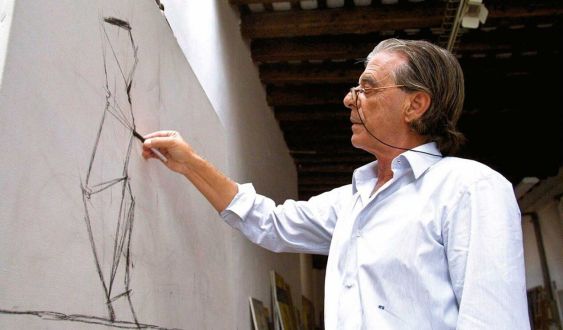
Ricardo Bofill, one of the most international Spanish architects, passed away this Friday in Barcelona at the age of 82. Born in the Catalan capital in 1939, Bofill leaves behind a wide and varied architectural production, characterized by his innovative vocation and a cosmopolitan vision. With projects still underway, such as the Royal Arts Complex, in Saudi Arabia, and the Chongquin airport, in China, he has created a thousand works in more than forty countries around the world, working mostly outside of Spain.
The son of an architect, Bofill was expelled from the Barcelona School of Architecture for his political activism and continued his career at the Geneva School of Architecture. When he returned to Spain, his degree was not recognized, but he was able to practice. His groundbreaking vision became evident very early on, with his Taller de Arquitectura (Architecture Workshop), founded in 1963 by a multidisciplinary team, from architects, engineers and urban planners to sociologists, writers, musicians, photographers and philosophers, which contributed to renewing the architecture and urban planning of the sixties and seventies.
The Taller de Arquitectura transformed into Bofill's architectural studio, where his two sons, Ricardo Emilio and Pablo, will now continue his work, already at the helm of the firm in recent years. As their father did, the team continues to be characterized by plurality and is currently made up of more than one hundred professionals of thirty different nationalities.
The Catalan headquarters of the Taller de Arquitectura, La Fábrica, in Sant Just Desvern, is one of the many works that Bofill leaves in Barcelona and its metropolitan area. In Sant Just there is also the revolutionary and at the same time controversial Walden 7, and in El Prat de Llobregat he signed the remodeling and expansion of Terminal 2 of the airport and the construction of Terminal 1. In Barcelona, he conceived the Teatre Nacional de Catalunya (TNC), the Institut Nacional d'Educació Física de Catalunya (INEFC) in the Olympic Ring, or, more recently, the W hotel.
Other buildings to which he contributed in the Catalan capital are the offices of the Parc Logístic de la Zona Franca, the Nexus II offices of the Universitat Politècnica de Catalunya (UPC), as well as the headquarters of Desigual, very close to the W hotel. He also left his mark on homes in the Front Marítim and on Nicaragua and Bach streets. In the rest of Spain, he created the Muralla Roja and the Xanadú, in Calpe; the Jardín del Túria and the Torre Ikon, in Valencia; the Torre Suecia, the Parque Lineal del Manzanares and the Palacio de Congresos, in Madrid; the Miguel Delibes Cultural Center, in Valladolid or terminal 2 of Malaga Airport.
Bofill, who defined himself as a nomad, went further and signed projects, especially in France, but also in the Netherlands, Luxembourg, Sweden, the Czech Republic, Poland, the United States, Lebanon, Morocco, Algeria, Japan, Russia, China, India and a long list. The Place du nombre d'or in Montpellier, Les Temples du Lac, the Colonnes Belvedere Saint Christophe and the Cartier headquarters in Paris, the Shiseido building and the Casa Oz in Tokyo, the Konstantinovsky Congress Center in Saint Petersburg, the Platinum tower of Vila Ananda in Beirut or the 77 West Wacker Drive skyscraper in Chicago are some examples of his extensive international work.
Add The New Barcelona Post as your preferred Google source for free
Stay informed with the latest news.
