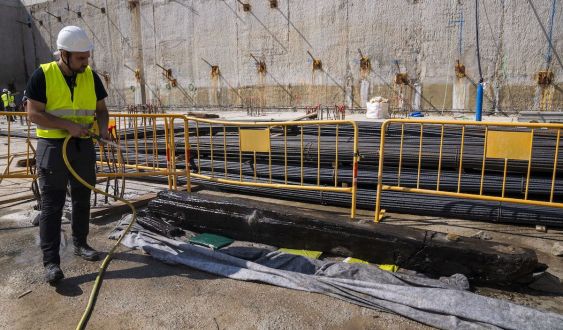
The subsoil of Barcelona continues to hide remains and traces of a city with thousands of years of history. On the plot where the future scientific research center of the Ciutadella del Coneixement will be located, archaeologists have made a new and surprising discovery, after the 15th-century vessel unearthed a few weeks ago and christened as Ciutadella I. Now, in this space, a fragment of a keel has appeared, the wooden piece that acts as the backbone of a ship by connecting the stern to the bow. A piece that has been found separated from the Ciutadella I ship, which is why archaeologists are working with the hypothesis that it could belong to a second medieval vessel, although it is not ruled out that it could be a dismembered part of the ship already found.
The keel, almost three and a half meters long and thirty centimeters wide, was found during the process of extracting the pieces of the medieval ship discovered in mid-April. The piece had become stuck to one of the pilots of the works, with the risk of fracturing if excavation continued without caution. At that moment, archaeologists proceeded to excavate it manually to successfully free it and, once secured, an excavator facilitated its definitive extraction. At one end of the keel, a joint can be observed, indicating that the piece fitted with a bow or stern wheel, a detail that suggests the fragment is an end of the keel and not a central element.
Although the fragment is in a good state of preservation, archaeologists will not be able to determine if it is a dismembered part of the medieval ship Ciutadella I or a second vessel until six months to a year from now, once a detailed study of the stratigraphy and analysis of the materials has been carried out. One of the most notable characteristics of this new piece, according to Santiago Palacios, the archaeologist leading the excavation, is the presence of a longitudinal groove cut into the upper part of the keel. This characteristic corresponds to the way large tonnage ships destined for commercial routes were built according to the Atlantic tradition, while the remains of the ship christened as Ciutadella I suggested it would be a Mediterranean type of vessel.
After this second discovery, the Servei d'Arqueologia de Barcelona, which leads the ship's conservation process with the company Arqueòlegs.cat, does not rule out the possibility of unearthing new fragments during the works of the Ciutadella del Coneixement, as they estimate that there is still 15% left to excavate of the 7,000 meters that the works occupy. In parallel to the archaeological excavation of the entire site, the archaeologists continue with the restoration work of the vessel found in mid-April.
Although the medieval ship's timbers are "quite consistent," according to restorer Delia Eguiluz, it is a delicate process, as wood, despite being a material used for shipbuilding throughout history, deteriorates rapidly when it comes into contact with air. For this reason, the pieces are extracted and immediately deposited in water pools set up around the excavation, which allow the fragments to be kept in a humid environment. In addition, a constant irrigation system ensures that the fragments of the ship that have not yet been extracted can be preserved in optimal conditions, as well as the newly found keel.
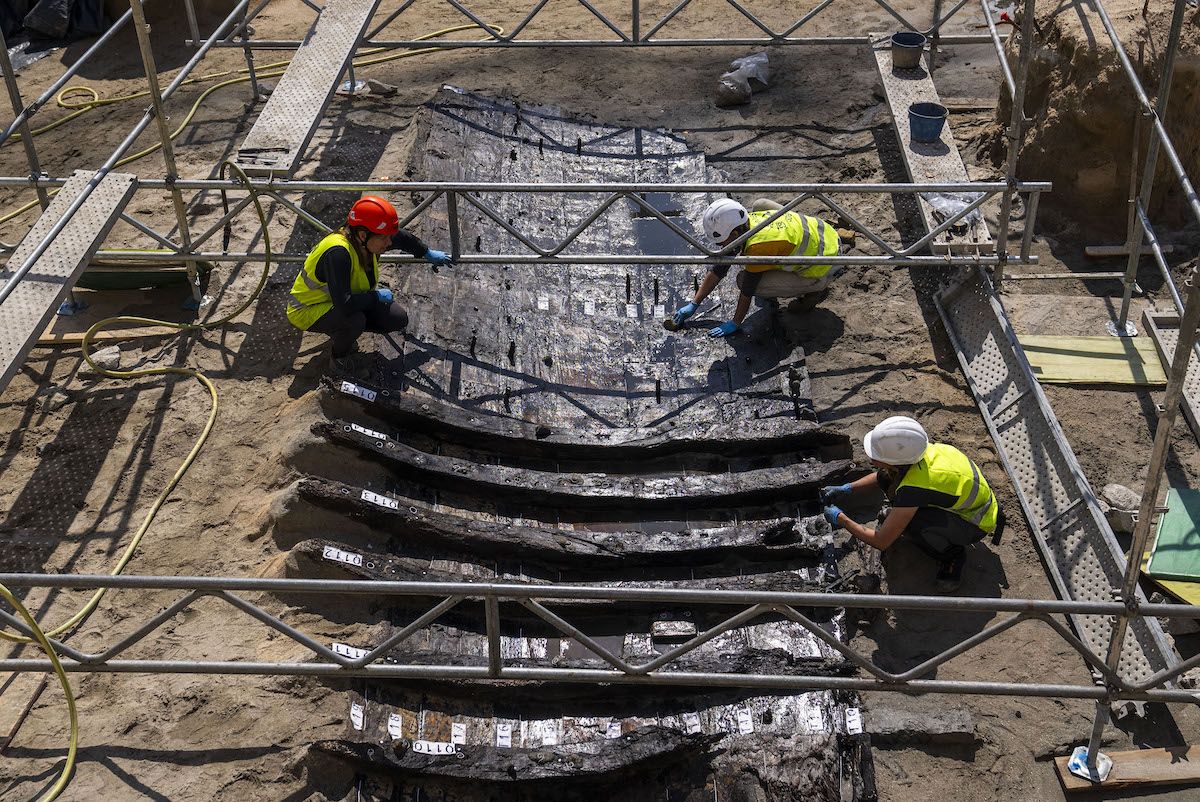
So far, the two vertical pieces that cross the ship have already been extracted, and the thirty horizontal fragments that make up the vessel are currently being removed. The team of archaeologists expects that the extraction of all the pieces can be completed within a maximum of fifteen days. Subsequently, the water pools will be transferred to the conservation center in the Zona Franca, where they will be deposited inside containers for the intensive cleaning of all the timbers.
However, it is estimated that the conservation process of the vessel will take about five years, as resin will also be applied to the pieces so that they can be preserved dry, and even be exhibited in a museum, like those of the medieval ship Barceloneta I, found in works near the França station and currently exhibited in the Barcelona History Museum. In order to study the vessel without directly manipulating its pieces, the Arqueòlegs.cat team has created a three-dimensional model of the ship, which allows it to be viewed from all angles with great precision, as well as digitally preserving the remains as they were found.
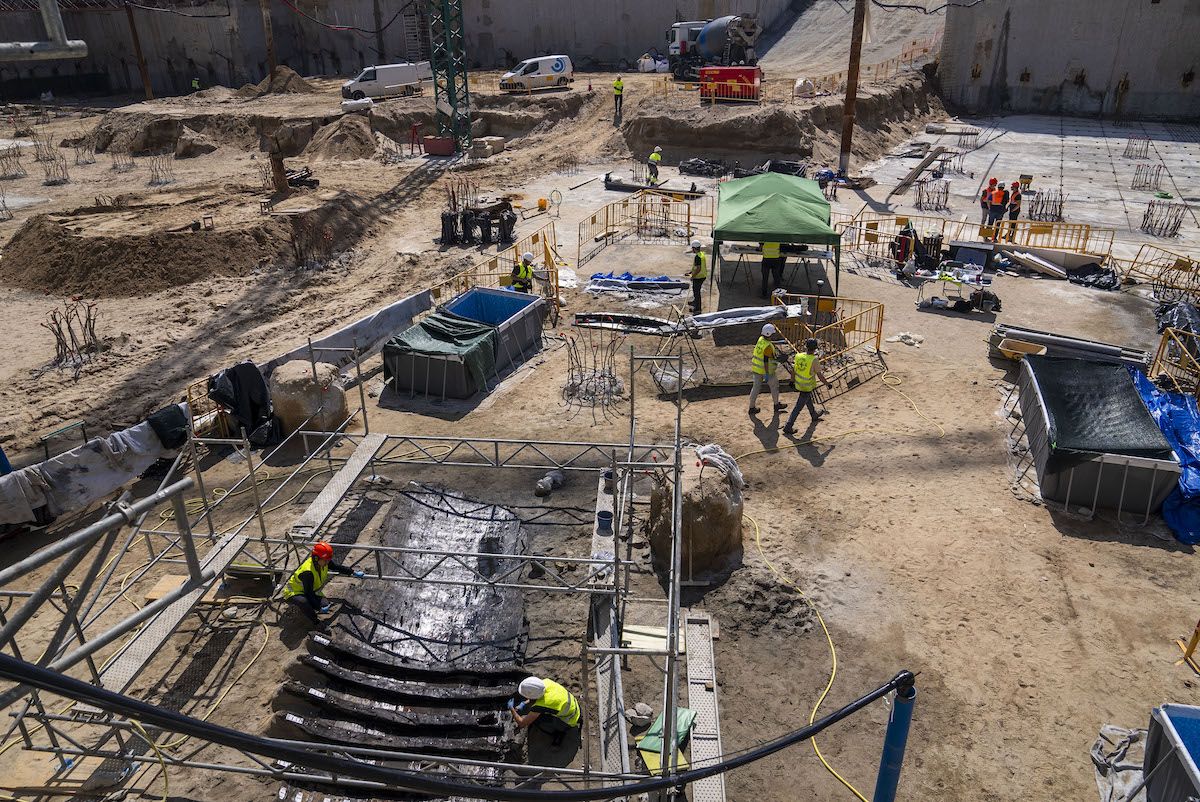
In this plot where the archaeological excavation is being carried out, five meters below sea level, the future underground car park of BSM will be located, a public company that already managed the old car park that for years had occupied this space, where the Mercat del Peix had historically been located. The archaeological excavations, however, do not have to delay the course of the works that are being carried out in this space, with the forecast of finishing them at the beginning of next year, so that the car park can become operational during the first quarter of 2026. Subsequently, the three buildings that will make up the cutting-edge research center will be erected, with professionals from the Barcelona Biomedical Research Park (PRBB), the Spanish National Research Council (CSIC), the Barcelona Institute of Science and Technology (BIST) and Pompeu Fabra University (UPF).
Add The New Barcelona Post as your preferred Google source for free
Stay informed with the latest news.
