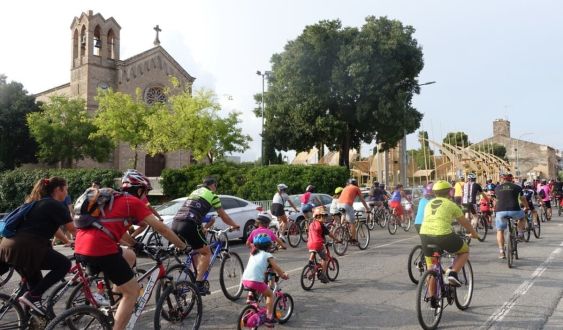
The use of private vehicles is one of the biggest contributors to pollution in our cities. The European Mobility Week (SEM), held from September 16 to 20, aims to reduce the circulation of polluting cars and motorcycles and promote more sustainable, safe, and healthy commutes, such as walking, cycling, using public transport, and electric vehicles.
The Department of the Vice-presidency and Digital Policies and Territory has as a priority objective the decarbonization of mobility, and works in favor of green, collective, and shared mobility. The policies are aimed at working for a sustainable, connected, and decarbonized territory.
This year, SEM's motto is Combine and move, thus emphasizing intermodal mobility, that is, the combination of more sustainable transports, to improve the environment and our health. For example, instead of taking a private vehicle to go to work, one can leave home by bicycle to the nearest station and there take the train or subway and walk to the workplace.
European Mobility Week is the European Commission's main awareness campaign on Sustainable Urban Mobility. It promotes a change of habits to encourage the use of public transport, improve the habitability of our cities, seek greener solutions to improve air quality and reduce pollution, in addition to combating climate change.
Figures continue to grow
The campaign, which celebrates its 20th anniversary this year, has gradually grown worldwide. In Europe, last year more than 53 participating countries joined in a total of 3,184 cities and towns, of which 231 were Catalan. This year, and one week before the registration closed, at least 237 municipalities in Catalonia had joined, so this figure will be higher.
Catalog of activities
To participate in SEM, municipalities must commit to organizing different activities between September 16 and 22 that serve to raise public awareness about sustainable mobility. The Generalitat has prepared a catalog of activities to help local councils, ranging from bike rides, workshops, exhibitions, or communication actions, among others.
Municipalities must also implement at least one permanent action throughout the year to encourage accessibility on urban roads and the reduction of traffic or improvements to infrastructure for bicycles and pedestrians. And, finally, municipalities must also celebrate Car-Free Day, preferably on September 22.
The 'Car-Free Day'
During this day, the passage of private vehicles is restricted in designated locations, and motorized traffic is closed for most of the day. In fact, only cyclists, public transport, and clean vehicles (LPG, CNG, electric, etc.) can circulate on the closed pedestrian streets. Car-Free Day serves to raise awareness among everyone about the negative effects of pollution in urban centers and the advantages for the environment and health of sustainable travel.
Regarding SEM activities, this year's planned events include scavenger hunts, transport races in Barcelona and Tarragona, bike rides in Baix Llobregat and Badalona, and a race in Vilafranca del Penedès, among others.
In parallel, and to encourage a change of mindset in municipalities, European Mobility Week features various sustainable urban mobility awards. These are the EUROPEANMOBILITYWEEK awards, the Sustainable Urban Mobility Planning (SUMP) award, and the EU Urban Road Safety award. Through these awards, the European Commission aims to recognize local authorities that have demonstrated excellence in the fields of awareness and planning for sustainable urban mobility and road safety.
Pollution, a health risk
Air pollution is the greatest environmental health risk in the European Union due to the high number of premature deaths it causes year after year. Poor air quality causes serious diseases such as heart disease and strokes, the most common causes of premature death from air pollution, followed by lung diseases and lung cancer, according to several scientific studies published for decades.
The main objectives of the European Mobility Week are, firstly, to stimulate citizen behavior, regarding vehicle use, compatible with sustainable urban development, in particular with the protection of air quality, the prevention of traffic accidents, reduction of greenhouse gas emissions and the rational consumption of energy resources. The second objective is to raise public awareness about the environmental impacts of transport and to inform them about its different modalities.
In this sense, and thirdly, to promote the use of sustainable means of transport and, in particular, public transport, bicycles, walking and electric vehicles. It also aims to promote a reunion of citizens with the city in a healthy and relaxed environment, in addition to reflecting on how the excessive use of motorized transport impacts our health.
Add The New Barcelona Post as your preferred Google source for free
Stay informed with the latest news.
