In October 1936, the Generalitat of the former Republic approved the decree that gave life to the Commissariat of Political Propaganda, a pioneering body in democratic Europe led by Jaume Miravitlles, who weeks later would also occupy the general secretariat of the Anti-Fascist Militias Committee. The core of the Republic was a matter of full-sail romantics. Men –despite the unprecedented advances in the deserving of women– who risked everything, even their lives. One of the examples that best illustrate this condition is the Popular Olympiad project, an alternative to the 1936 Olympic Games.
The venue for the '36 Games was disputed in '31 by Barcelona and Berlin, and finally it was the German capital that prevailed. But the political scenario of Germany in '31 had nothing to do with that of '36. After the Great War, the Weimar Republic, in the midst of an economic and moral crisis, was overthrown by National Socialism. A persistent and reactionary discourse that simplified and distorted reality, the popularization of slogans, shock forces in the streets, and a warlike aesthetic and behavior were the wings of an Adolf Hitler who, in March 1933, consolidated himself on the throne of barbarism. The unstoppable manifestation of Nazism was not spontaneous. Joseph Goebbels, a master of propaganda and not fond of improvisation, adapted architecture to mass culture. And although the new German context threatened to turn the Games into an act of clear glorification of fascism, the IOC ratified Berlin as the Olympic venue. The Catalan government, aware of the repercussions that the Hitlerian Games would have throughout the world, decided to set up an alternative with only 3 months' notice. The objective was a massive propaganda event in favor of solidarity among peoples, human dignity, and world peace. The Olympiad invited athletes who had been excluded from the Berlin Games for racial reasons. It received the support of the main European sports federations, the United States, and Canada. 6,000 participants registered and, when international media were already in Barcelona, on July 19, 1936, during the hours leading up to the inauguration, rumors of the military uprising forced the event to be canceled.The Nazi propaganda machine was not in favor of the encounter. They were wary of a more than probable defeat and the backlash for fascist postulates. But although Louis was the favorite, it was Schmeling who took the credit in a face-off that makes history. It was the first KO of Louis's career and the Nazi loudspeakers were quick to echo it. Schmeling received the honors of a hero of Hitler's regime.While Catalonia was preparing the Popular Olympiad in the spring of '36, New York was getting ready to host a boxing match at Yankee Stadium on June 19. It was not just any match. Max Schmeling, German, and Joe Louis, the most popular African-American talent of the moment, were facing each other. The Nazi propaganda machine was not in favor of the encounter. They were wary of a more than probable defeat and the backlash for fascist postulates. But although Louis was the favorite, it was Schmeling who took the credit in a face-off that made history. It was the first KO of Louis's career and Nazi loudspeakers were quick to echo it. Schmeling received the honors of a hero of Hitler's regime. Two years later, on June 22, '38, on the eve of World War II, the fight was reissued, and on that occasion, propaganda services focused on it thoroughly: on one side, President Roosevelt, and on the other, Adolf Hitler wanted to make public a meeting with their respective boxers, turning the duel into a clash of world powers: Louis would be the representative of democracy and Schmeling, the representative of fascism. The fight was resolved in just 2 minutes in favor of the African American, and this time it was the anti-fascist propaganda machine that did not miss the opportunity to transform what had actually been a simple victory in the ring into a forceful demonstration of strength.
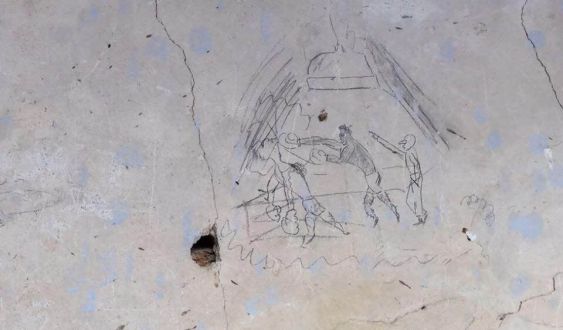
The reality was different. Schmeling never wanted to succumb to the Nazi regime and even stood up to it. Furthermore, over the years, the German and the African American built a deep friendship. Schmeling rescued Louis from economic debts and cocaine addiction on several occasions.The effect of propaganda spread rapidly like a balm, especially on the Republican front of the Civil War. As journalist Miquel Andreu points out (Som Garrigues), in the attic of an old building that served as a hospital in El Soleràs, a drawing has been found that refers to the fight between Louis and Schmeling and dates from the same summer of '38. But the fight had been adulterated by propaganda. The reality was different. Schmeling never wanted to succumb to the Nazi regime and even stood up to it. Furthermore, over the years, the German and the African American built a deep friendship. Schmeling rescued Louis from economic debts and cocaine addiction on several occasions. Both openly regretted the manipulation they were subjected to, and there are countless images and videos where they can be seen together sharing affection. Miravitlles, from the Propaganda Commissariat of the Generalitat, assured that the cause he defended was too just to be able to tell the truth. And it is probable that he had reasons. Propaganda does not heed reasons, it is emotional. And unfortunately, classifying it as a more or less just cause is not dictated by the message that is propagated but by the side of the scale that accumulates more followers. That is why propaganda is pernicious, because it takes advantage of the weak and grants them power. Power that is immediately returned to the spheres that directly or indirectly support the propaganda message. That is why in the 21st century there are still governments and political parties that allow the evangelization of the axioms of the far-right.
Add The New Barcelona Post as your preferred Google source for free
Stay informed with the latest news.