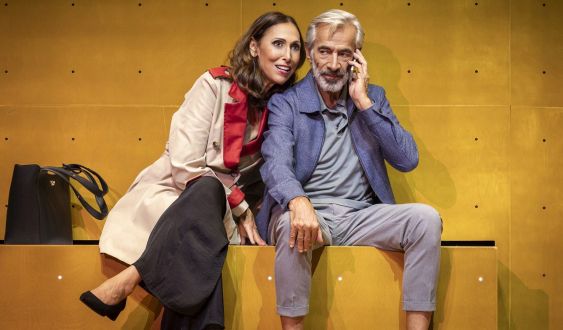
Mejor no decirlo (Better Not Say It) is directed by Claudio Tolcachir and is a comedy in which the audience becomes a witness to the life of a married couple. But what happens when they decide to say everything, absolutely everything?
Mejor no decirlo: scenes as a debate on current issues
Mejor no decirlo is not a conventional play; instead, we find ourselves before a succession of scenes where the big burning issues of today are raised: feminism, abortion, ecology, political ideology, or gender identity.
Due to this format, the pace of the proposal is quite dynamic: we move from scene to scene, witnessing the different ways of thinking of the two protagonists and attending an intellectual debate that, nowadays, abounds in our society. On one hand, we have the character of María Barranco, who embodies the most raw sincerity, without mincing words. On the other, Imanol Arias opts for a mediating and prudent attitude, almost tiptoeing through life so as not to hurt anyone.
The dictatorship of opinion
One of the most interesting points of Mejor no decirlo (and which, for me, should have had more prominence) is the question: Are we obliged to have a formed opinion on absolutely everything? The play raises the possibility of whether we can afford the luxury of not knowing what to think, but immediately returns to the main theme of the proposal: that of "false truths."
This is where the message becomes somewhat confusing. While he is portrayed as someone who must learn to be sincere, she is presented as the role model, even though her attitude of "blurting out the first thing that comes to her mind" does not take consequences into account. Perhaps there is a lack of a deeper reflection on the fact that truth, to be constructive, also needs respect and care. Her character remains a bit flat, without a clear narrative arc, as if her option were the "best" by default, a premise that somewhat contradicts the spirit of the synopsis.
Two "pros" on stage
As for the performances, the duel is served:
- Imanol Arias surprises with a very well-defined comedic flair and a very fresh naturalness.
- For her part, María Barranco went from less to more. Despite a somewhat more controlled and rigid start (surely due to opening night nerves), the actress ended up finding her place on stage.
Better not to say it is, ultimately, a work that fulfills its function of entertaining, but that does not break new ground or particularly surprise. It is a two-voice debate about how we live and how we look at ourselves, which touches on current issues according to gender or social class, but with a script that errs on the side of simplistic. A work to enjoy two great actors, but that stays on the surface of what could have been a much fiercer social critique.
Add The New Barcelona Post as your preferred Google source for free
Stay informed with the latest news.