[dropcap letter="E"]
It is difficult to imagine that small wooden, wire, and latex dolls can generate revulsion or connect with the fears that lie, buried, in the deepest part of the collective unconscious. But it happens. I invite you to watch Violeta or Les bessones del carrer Ponent. These are two of the best-known titles by the tandem Anna Solanas-Marc Riba, a pair of filmmakers who, since they met at ESCAC almost 20 years ago, have not stopped imagining, creating, writing, building, and modeling atmospheres that are already recognizable to those who have seen any of their works. We meet in their small workshop in Gracia, a basement full of tiny stacked sets, hours and hours of piled up artisanal work that has been alive in stories that have traveled the world. And their short films have been in more than 1,000 festivals and have won countless awards, although it is not about numbers that I come to talk to you about here.
Let's get to the important part: How is it possible to transmit such intense emotions through inanimate beings? How is it possible that their puppets generate more internal movement than many flesh-and-blood actors? "It's the magic of puppets," says Anna; "and the type of animation we do is not at all realistic, it's very sparse, it goes to the essential." She assures that they achieve this by having a story behind it that helps to understand the puppet's feeling and the sum of the smallest details: "Sometimes it's the position of the eyes with the pause, the gesture of the mouth…" Because the viewer can perfectly get lost in the reflections in Violeta's irises or in the decadent makeup of the characters from Cabaret Kadne.
"Really, working in animation you can do whatever you want, at a production level. You don't set barriers for yourself, because whatever you want can happen, you can create the type of character you want… that gives us great freedom," says Marc.Sexuality and childhood are two of their main themes. Also war and the destruction we are doing to Earth. The first two appear in The Twins of Ponent Street, in which two twin grandmothers united by a perverse relationship embody the very bogeyman, but even more terrifying – if possible – and in duplicate; two fictional characters inspired by a real one from Barcelona two centuries ago who kidnapped children in the Raval. The darkness that always emerges.
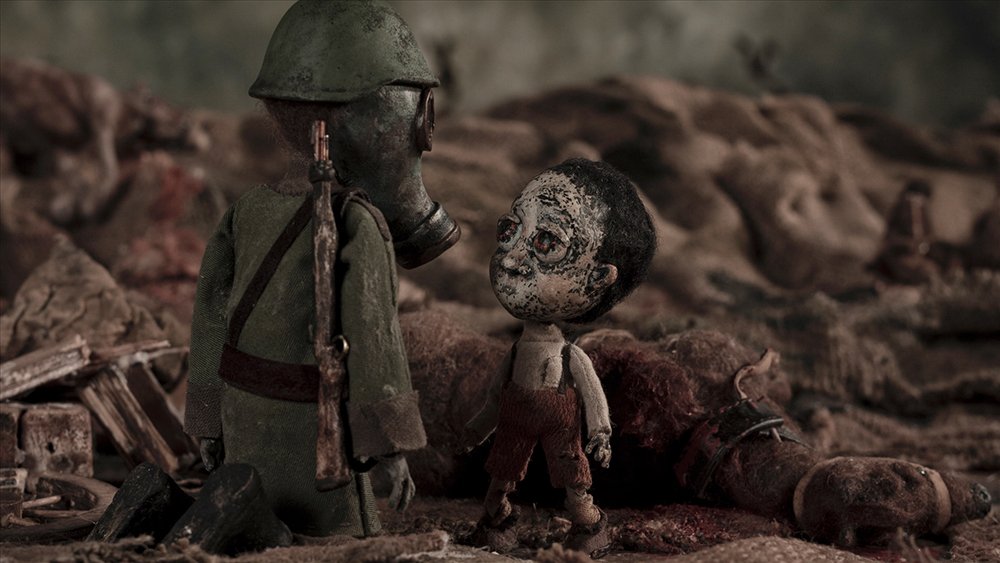
This darkness, always present, and a small child with a face full of marks star in Cavalls morts, or the war seen through the eyes of a child who, to save himself from the bombs, enters the guts of a dead horse in search of a heart that is no longer heard. Poetry in its purest state too. Symbolism. Meaning in motion. And it is that Anna Solanas and Marc Riba go so much to the essential and present reality in such a raw, so sparse, so naked way, that it would be unbearable to see their stories in live action. "Really working in animation you can do whatever you want, at a production level. You don't set barriers, because whatever you want can happen, you can create the type of character you want… that gives us great freedom," says Marc.
Freedom that can go so far as to hurt, like everything that is real. To which she adds: "We work with inanimate objects. That allows us to deal with very politically incorrect topics, and many times also mixing children, because it is a topic that obsesses us quite a bit, the fact of mixing childhood with cruelty; the technique itself has allowed us to do it and, despite dealing with very politically incorrect topics, we have always tried to do it in an elegant way." That's why, the two make a strange face when I ask them if they would ever shoot with flesh and blood actors. "No no, we would feel…", Anna begins; "…out of place, it's another field," Marc finishes.
"In the entire first part of the process, perhaps we are more filmmakers, for script, planning… but then it's different, then we are more sculptors…", says Anna.And why thestop motion"We are in love with the technique itself, with the artisanal fact, that the finishes are visible attracts us a lotMarc brings the dolls to life with his hands, which come from a flat design.In the entire first part of the process, perhaps we are more filmmakers, due to the script, planning... but then it's different, afterwards we are more sculptors...",says Anna. Sculptors who build between 6 and 10 seconds of footage per day, sculptors who invested four months just in the filming ofCanis, to which must be added as many more for pre-production. In fact, what takes the most work is the pre-shooting phase: building the story, the puppet, the set... Building with hands, shooting with hands, materializing the obscure in minuscule movements of eyelashes, eyes, and mouth. And reaching the viewer's gut to stir something that was dormant.
But not everything is dark in their work. As everything has its opposite pole, Anna and Marc have purely children's works, a more "white" cinema that they enjoy as much as the darker one, for which they are better known: "In fact, we are very childish in a radical sense, we really enjoy children's products, the whiter products, and that's why we sometimes do them too." And where does that overwhelming presence of childhood in all their cinema come from? "I get the feeling that we admire innocence" (Anna).
Add The New Barcelona Post as your preferred Google source for free
Stay informed with the latest news.