Football Club Barcelona announces that it will submit the approval of the shield change to the assembly of delegates. The proposal, which came out of nowhere, involves substantial changes: the acronyms disappear and the number of blaugrana stripes is reduced. A simplified shield, like the wrapper of a candy. The sports press close to the club defends the measure because "a powerful brand requires a clean, modern and impactful shield."
Times change and not all institutions or doctrines adapt to their speed. Companies know it and so do large sports corporations. It is taken for granted that in order not to lag behind progress, one must grow, adapt, let the market economy, which devours the past and excretes it in museums, where it does not bother, also rule there, in football.
Given that the main good that football offers is an intangible, its image is sold. Competition, then, is for visibility, for the colonization of televisions, computers and phones around the world. For all those people, Barça is not a club but a football team that sometimes wears a blaugrana shirt, but also wears a thousand other shirts.
Within the narrow limits granted by democracy at Can Barça, the member can now accept or reject the proposed change. What historical event justifies a new corporate image? What modification in the club's essences does the proposal respond to? What is wrong with the current shield?The team cannot be identified with colors it does not always wear, nor with players who are not eternal. On the jersey, various symbols vie for visibility: the sports brand logo, the current advertisement, sponsors, and the crest. The only symbol that has always remained and must continue to do so if the club wants to remain identical to itself, is the latter, the crest.
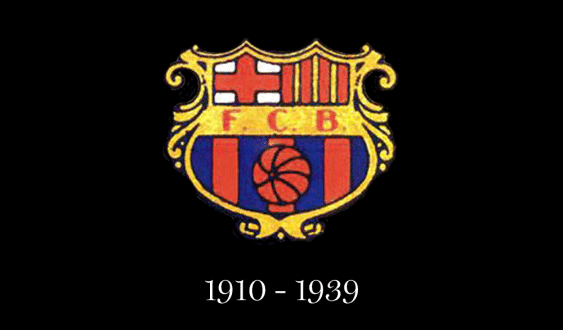
In this particular case, the pot-shaped emblem was adopted in 1910, after a competition open to members which was won by Santiago Femenia, who had played a match with Barça in 1906. Since then, it has only changed to adapt to the aesthetic tastes of the time or by legal imperative, when under the Franco regime the name was Hispanicized and the bars of the Catalan flag were reduced. The last modification was in 2002, during the great football slump with Gaspart as president. The one before that, in 1975.
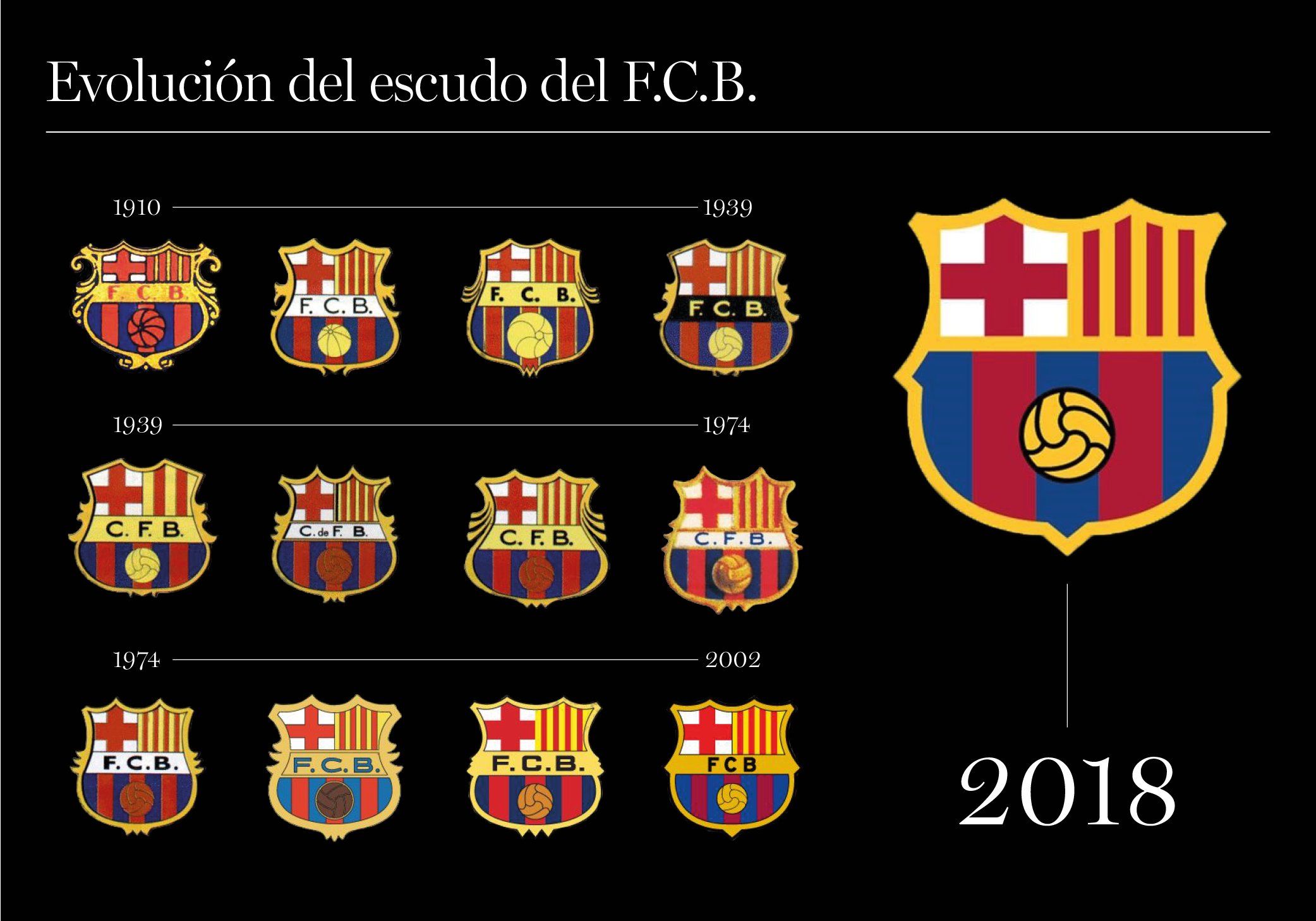
Within the narrow limits granted by democracy at Can Barça, members can now accept or reject the proposed change. What historical event justifies a new corporate image? What modification in the club's essence does the rebranding respond to? What is wrong with the current crest?
If we check the club's website, we see that, surprisingly, they already take it for granted: "Barça updates its crest," they title. Now it is "more homogeneous, more harmonious, and more luminous," qualities that are difficult to objectify. And they add that "it provides more reproducibility, especially in digital media, which are increasingly important." It seems to me that the members deserve a text that treats them as adults and not this text whose author sins either from ignorance or malice.
But let's not complicate things, it is enough to propose a new exegesis of the much-cited attribution to Barça of being something more than what it is, a club. That more than a club, today means that the club is (also) a brand. (Signe distintiu d'una empresa, d'una institució i especialment d'un producte o d'un servei, constituït habitualment per un logotip, un gràfic o la combinació d'ambdós, DIEC [Distinctive sign of a company, an institution and especially of a product or service, usually consisting of a logo, a graphic or a combination of both]). ). The brand is no longer the "distinctive or sign that the manufacturer puts on the products of its industry, and whose use belongs exclusively to it," as the Royal Academy says, but a metonymic transfer has occurred, so that the brand (the part) has replaced the club (the whole).
With this change, the board of directors tries to catch up with other European sports societies that have drastically changed their currencies. It believes that by suppressing the letters so that they do not cause strangeness to the oriental fan, it will increase its followers and, therefore, its profits. It is wrong. What Barça must sell (because it is about selling, to my regret) is the example of a tradition that does not bow to fashions and that does not confuse modernity with gullibility. Perhaps, to succeed without losing dignity, Barça only had to show itself as a club that loves the ball just as philosophers love knowledge. The marketing gentlemen, are they sure that salvation comes through homologation? With these ideas, there is a danger of going from being "more than a club" to being "just another club."
We will see if the delegate members, for once, make an effort. We will see if the delegate members, for once, make an effort.
Add The New Barcelona Post as your preferred Google source for free
Stay informed with the latest news.