[dropcap letter="T"]
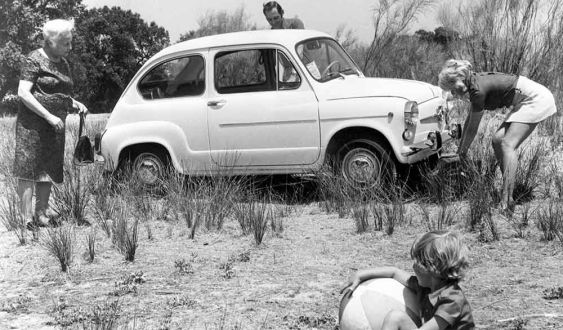
Everyone of a certain age has an anecdote related to a Seat 600. Whether it's the radiator smoking halfway up the Toses pass, or excursions to the beach with family, mother-in-law, and dog, crammed into that tiny cubicle, or that night you tried to "make love" inside the car, performing all sorts of contortions. The 600 is, without a doubt, the car with the most history in this country, more for what it socially represented than for its miserable performance: it had a displacement of 633 cc and barely reached 90 per hour.
Until Seat was founded in 1950, Spain was at the bottom of Europe's automotive industry, with 3 vehicles per 1,000 inhabitants and a car fleet with a pile of pre-war vehicles from small production companies like the Catalan Hispano Suiza or Abadal. But Francoism needed its mass automobile and, as José Feliu explains very well in the Illustrated Atlas of the Seat 600 (very interesting), the regime's authorities agreed with the Italian Fiat to install Seat in the Zona Franca: Barcelona would provide the labor and the Italians, the technology and designs, charging a 4% royalty on the price of the vehicle and stamping the unpleasant 'Fiat license' under each Seat emblem.
They started with the 1400, but it wasn't until 1957, with the low cost 600, that things exploded: autarky meant the 600 had no competition and for years it was THE CAR, the ultimate symbol of status, social ascent and, why not say it, liberation. There were some Deux Chevaux, some Simca 1000s, the "cuatro latas" or the Beetle, but none of them were competition for the 600.
When they finally handed you the keys, after two years on the waiting list and having paid part of the 65,000 pesetas it cost, you set off to travel the country. With the 600, the country began to be tinged with cars, going from the few thousands in 1957 to more than 1 million vehicles circulating in the late seventies. The problem is that the number of vehicles has not stopped multiplying since then, with the traffic jam and pollution problems that this entails: currently we have a fleet of 27 million vehicles for a population of 31 million adults, and today most cars circulate empty, with only the driver.
The 600 also made great contributions to the collective imagination: it boosted roadside commerce, encouraged the appearance of second homes in housing developments, and led to the birth of the essential figure of the Sunday tripper. Until then, excursions were made by bus or on foot, but from that moment on, any meadow or any shade under the pines was good for setting up the barbecue.
Many of the more than 800,000 people who owned a 600 now regret having sold it, exchanging it for a newer and more comfortable car. "If I had it now, how I'd show off!" Those who still own one form a small sect that meets at the mythical "600 friends' gatherings" sung by Manel, organized by clubs throughout the country and on websites like seiscientos.org. And if you want to drive one, I recommend keeping an eye on the initiatives of the Moritz brewery: they have a good stable of cars and often organize cultural activities that will allow you, even if only for a few minutes, to travel to the past behind the wheel of one of those endearing jalopies.
Add The New Barcelona Post as your preferred Google source for free
Stay informed with the latest news.