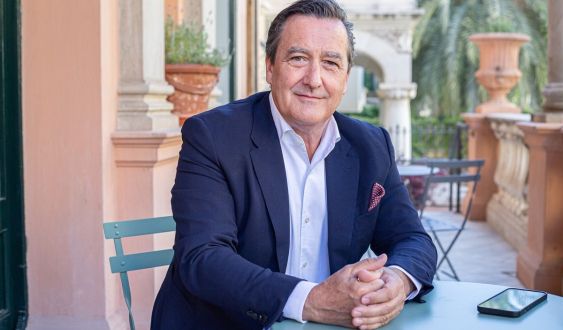
Mirko Scaletti is the president of the Casa degli Italiani, a historic entity in the city —with 160 years of presence in Barcelona— which will soon become a foundation.
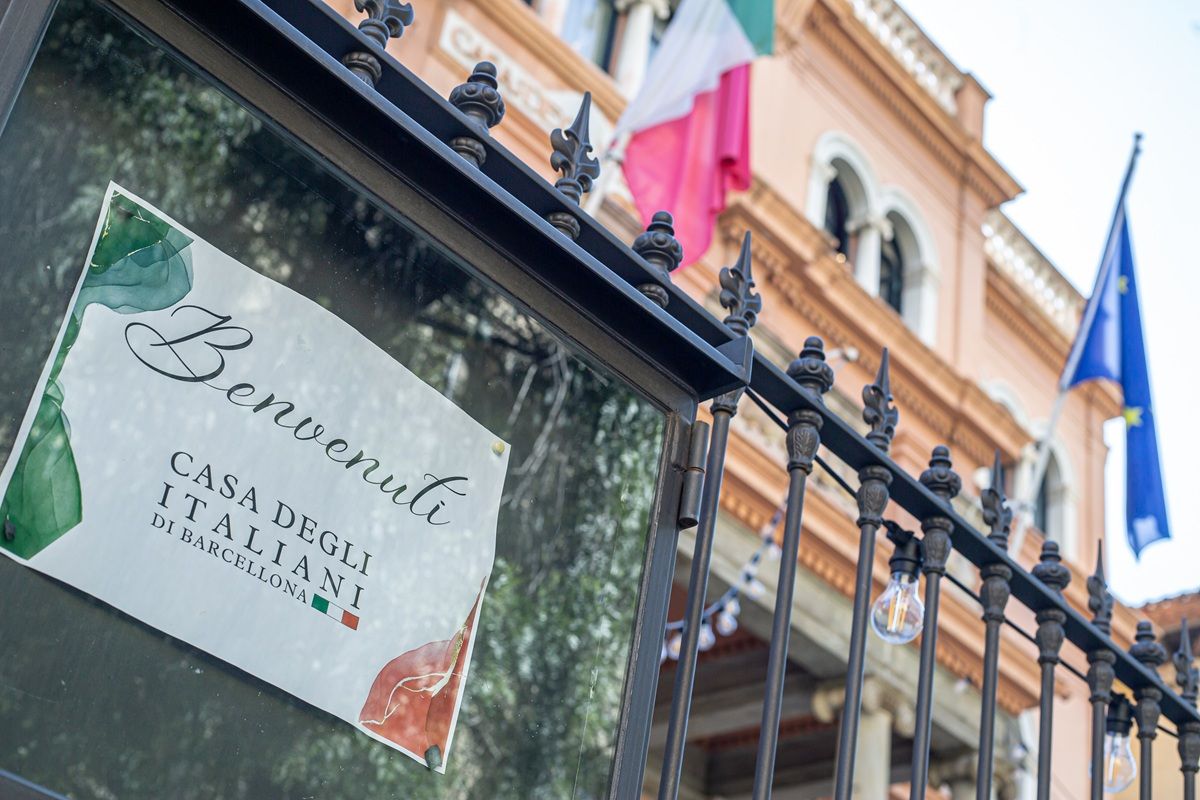
In its spectacular palace in Passatge Méndez Vigo, it carries out activities focused on the dissemination of Italian culture, the promotion of exchange between Barcelona and Italy, and acts as a "social club" for Italian residents. Scaletti, also director of Panasonic's West Cluster, highlights both the business and the social and cultural aspects of the association, and never misses an opportunity to emphasize the proximity between both cultures. With almost two centuries in the city, the entity has solid arguments to affirm this.
--- Who are you and what do you do in Barcelona?
--- That's a very good question. We are the legacy of a group of Italians who, almost 160 years ago, arrived in Barcelona. At that time, the Italian State promoted structures called "mutuo soccorso" societies, which had state support and offered assistance to Italians who emigrated. We are talking about the late 19th century. In the early 20th century, Catalonia had a very powerful industrial fabric, which facilitated their roots. If we look in perspective, examples such as Hispano Olivetti or Pirelli and Fiat with Seat are the most visible, as we came from Italy to help develop the industry.
--- But in the beginning, wasn't it more about textiles?
--- Yes, without a doubt Italy influenced the Catalan textile industry of the 20th century, which benefited from imports of yarns and fabrics from the bel paese, complementing its own production, especially in the cotton and wool sectors. Automotive was the most visible part already in the middle of the last century. But in the early 20th century, the textile industry was already very strong, and there were many Italians working here. Then came the banks; the Banco de Roma was one of the first Italian banks to establish itself in Catalonia, and later the entire industrial aspect was consolidated. There was also a great influence and exchange in the pharmaceutical sector. Many Italian industries have a very close relationship with the Catalan fabric. And that's how our history began.
--- I understand that even then it was unusual to create a headquarters of this type in a city that was not a state capital.
--- Exactly. But I believe that in this case, the relationships went beyond the condition of capital. The relationship with Spain in general has been very good, but the harmony with Catalonia was even greater, especially in the industrial field.
--- So, the first promoters came mainly from northern Italy?
--- Most of them, yes. We are talking about the industrial fabric of Turin, of the factories in the north. Then, with the agreement with SEAT, many professionals arrived to help develop more competitive models. It's more of a northern mentality, just as in Catalonia a certain difference is perceived with respect to the south of the State.
--- Here in Catalunya there is a feeling of great closeness to Italian culture. Like first cousins.
--- Totally. Because of the way of thinking, acting, even doing business. Catalonia has access to the sea, ports... It has always been more accessible. There was also an important railway connection with Italy, long before with other regions of the south.
— And now? Who are you today? How have you evolved?
--- Fundamentally, we went from being a mutual aid society to an association. Today we are totally independent: we do not depend on the State, we generate our own resources, everything is done by us and our partners.
— Are you one of the first foreign communities with a stable presence in Barcelona?
--- It's very curious that we established ourselves so early. I think our strength comes from there. The industrial relationship attracted people of a certain level, and that also generated a culture. Even the first hotels, some luxury hotels, in Barcelona were founded by Italian families. Today there are not many Italian hotels left, but the culture of the luxury hotel —like the Majestic— has Italian roots. We didn't just bring labor: we also brought business models.
— And what is the function of the mansion today?
--- We started in another location, but very soon we moved here. Our main function is to promote Italian culture. We are not in competition with the Italian Cultural Institute; each one has its mission. We want to be the home of all Italians. But there are no barriers: anyone interested in Italian culture can come.
— For what kind of activities?
--- Cultural events, presentations, meetings, business contacts... We promote Italian culture without encroaching on areas more proper to the Chamber of Commerce or the Consulate. Our advantage is precisely independence, which allows us to freely decide what we want to do: exhibitions, shows, activities...
"There are no barriers: anyone interested in Italian culture can come"— And will that cultural and social function become a foundation?
--- Yes, it is our future project. We will maintain the associative part, but evolving towards a new legal figure. Why? Because a foundation opens new doors for us. If we want to promote culture, the social part, we also need to position ourselves adequately in the institutional ecosystem. Being a foundation will give us more strength, more credibility, and more visibility.
— And a character more akin to the Catalan environment.
--- Exactly. One of the areas we want to strengthen —and which as an association has not been easy for us— is assistance. We want to help, not only in the short term the Italian citizen who arrives, but also others. And for that, we do need to take the step towards a foundation: to be better connected with the administrations and entities of the country.
— Too much bureaucracy?
--- Well, like everywhere. But we have noticed an improvement in recent years. The relationship with the public administration is now more fluid, more attentive. I hope it continues this way, even with political changes.
"If we want to promote culture, the social part, we also need to position ourselves adequately in the institutional ecosystem"— Why do I have to come to the Casa degli Italiani?
--- I don't like to "sell" what we do; it's more of a relationship of affection. Of love. It's not just about the specific event. For example, in July we will hold one of our summer aperitifs, which we really enjoy. But the important thing is the social aspect: integrating, sharing, discovering. If you are Italian, it's a bit like coming home. If you are not, but you are attracted to our culture, it's about discovering it from within. This is the house of Italy and your home.
— Is the audience more private or corporate?
--- It's for everyone. We don't put up barriers. As I told you, we want people to feel at home.
—160 years make for many stories.
--- I'll tell you a couple. One was the visit of Rita Levi-Montalcini, which was very important for us. Another very beautiful moment was Pavarotti's visit in '90, when he was performing at the Liceu. He signed our book of honor. Even King Vittorio Emanuele III came in person; and he awarded us the "Diploma di Benemerenza di primo grado" and the gold medal, which we keep in our vast archive. And lately, since we really like sports, I would highlight the aperitif we organized a few years ago during the Water Polo World Championship and the visit of the "Sette bello". I had never seen so many people in the passage. It was magnificent, as it surely was in '82 when Italy won the World Cup.
— You also bet big on gastronomy.
--- Yes, we are setting up a space dedicated to it. Cuisine is an essential part of Italian culture. There are many Italian restaurants, yes, but we want to go further: to position cuisine as culture. To understand the why of ingredients, recipes. To offer classes, masterclasses, or simply enjoy our gastronomic events at Casa degli Italiani.
— And now you are looking for more presence in Barcelona's social fabric.
--- Yes, that's an important change. For years we lived a bit like this passage: in the heart of Eixample, but somewhat hidden. Now the time has come to open up. We are in Barcelona, what more could you ask for? We want to integrate more. Because the social dimension also implies finding travel companions. Bigger things can be achieved if they are not done alone. To make ourselves known, but also to discover others. It is a fundamental step, both for the Casa degli Italiani association and for the future foundation.
— And how do you combine all this with your activity at Panasonic?
--- I take care of France, Belgium, Holland, Spain, Portugal... I'm quite spread out. The Casa degli Italiani is a totally voluntary activity. All of us on the board have our professional lives, which we balance with our private lives. I'm also part of the CEJE, the Japan-Spain Business Circle. And, if I have a little time, I escape to go fishing.
Add The New Barcelona Post as your preferred Google source for free
Stay informed with the latest news.
