
The first retrospective of the French painter Suzanne Valadon held in Spain has been in Barcelona, and there are reasons for it. First, of course, for her great contribution to the history of art of the late 19th and early 20th centuries, with her own gaze on the Paris of the belle époque, where she stood out with her portraits and female nudes for a complicit and non-eroticized treatment of female intimacy. A more than sufficient reason that the Museu Nacional d'Art de Catalunya (MNAC) has complemented in the exhibition Suzanne Valadon. A Modern Epic, which can be visited until early September, by presenting the relationships she forged with locals like Ramon Casas and Santiago Rusiñol, with whom she coincided in the city where everything happened and was the center of the world.
Suzanne Valadon was the artist behind Marie-Clémentine Valadon (1865 - 1938), a working-class woman who settled in Montmartre, very close to the Moulin Rouge, at a very young age. She arrived in Paris when she was five years old with her mother, after her father had abandoned them. She went to school for a few years and soon started working whatever job she could find, whether as a laundress, florist, dishwasher, nanny, or waitress. It is even said that she ventured into the circus world as an acrobat but abandoned it after suffering an accident.
It was then, at just fifteen years old, that she began to model for artists of the time. She started with Pierre Puvis de Chavannes, but also worked with Renoir, Matisse, and Toulouse-Lautrec, who suggested she adopt a pseudonym that referred to a biblical story that reminded him of her, Susanna and the Elders. It was a theme that had been portrayed by many painters, such as Artemisia Gentileschi, Rembrandt, Rubens, or Tintoretto, about a young woman surrounded by older men who wanted to take advantage of her.
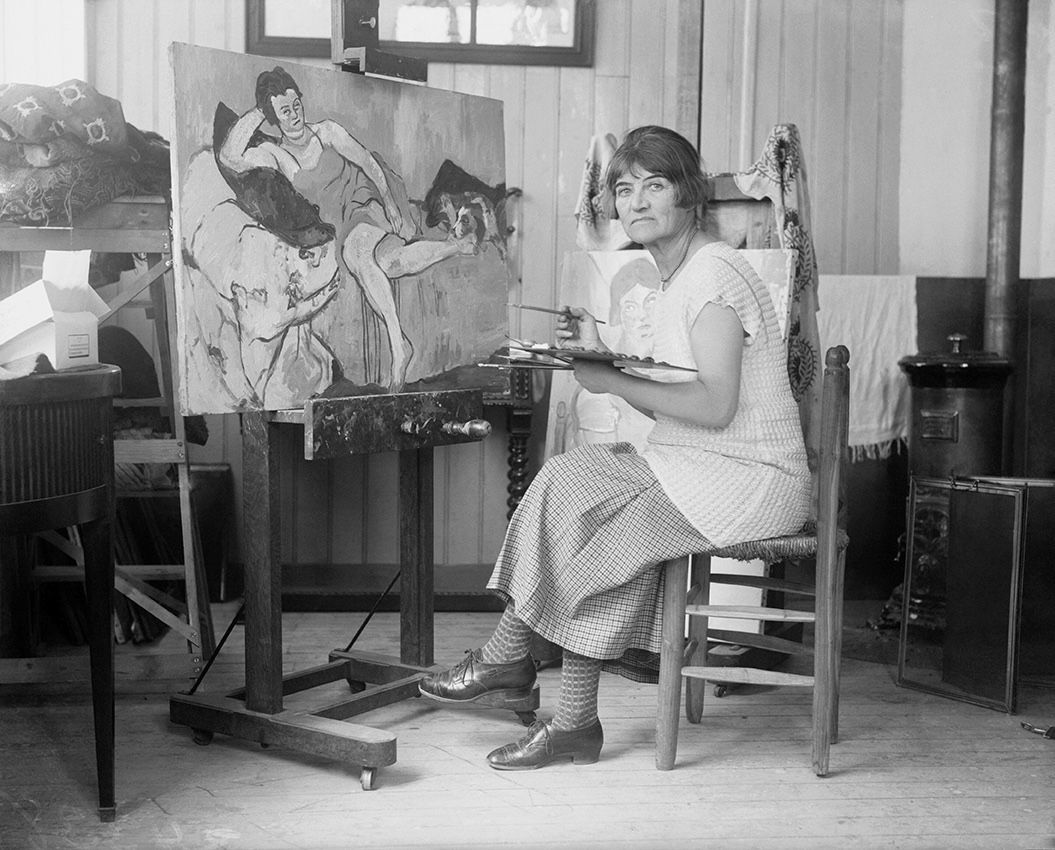
Self-taught, she learned from all the painters for whom she worked as a model, observing their techniques and tricks, entering their studios, with a special role from Degas, who believed in her talent and encouraged her to develop it, influencing her early drawings and engravings as seen in The Acrobat or The Wheel (1916), reminiscent of Degas' dancers, but already with the black outline and the vivid and altered colors that characterized the Post-Impressionist Valadon. Despite the support he gave her, even collecting her works, Degas called her Terrible Maria for her strong character, something for which Valadon must not have had many alternatives if she wanted to assert her work and leave behind her past as a model in a man's world, undoubtedly much more complicated than her.
The Montmartre-Barcelona connection
It was in those years of full immersion in the different artistic movements inhabiting Montmartre that she met the painter, art critic, and journalist Miquel Utrillo (Barcelona, 1862 - Sitges, 1934). Both very young, they maintained a stormy relationship, with the birth of a son whom the Catalan took time to accept as his own, Maurice Utrillo, who would also become a renowned painter. Various plastic testimonies of this relationship remain with the portraits they made of each other. The most popular is the one Utrillo made of Valadon in 1891, commonly known as The Seven Years' War, in reference to the time that passed between Maurice's birth and Utrillo's legal recognition.
Utrillo acted as a cicerone in Paris for artists like Casas and Rusiñol, introducing them to artistic circles he had known since 1880. Both painted Valadon's Montmartre, whom they also ended up meeting, as seen in some of Rusiñol's titles, The Smiling One (1894-1895), a portrait of the artist, or In Campaign (1891), with a couple in the middle of a date, Utrillo and Valadon. Joaquim Sunyer also crossed Valadon's path, with him painting the art critic Gustave Coquiot (1908) and her painting the art collector Mauricia Coquiot (1915), a couple who were very good friends with the painter.
Utrillo, Valadon's partner, acted as a cicerone in Paris for artists like Casas and Rusiñol, introducing them to the artistic circles he knewThe work about the idyll of a couple by Rusiñol, preserved in the MNAC, has another detail: Utrillo wears the clothes of the musician and composer Erik Satie, with whom he collaborated in the development of Chinese shadow shows. Satie accompanied them with his piano and Utrillo ended up becoming an expert in the field in venues such as Le Chat Noir.
It was he who exported them to Barcelona, where they arrived at Els Quatre Gats, as attested by the MNAC collection, with figures that were made by Casas and that represented figures such as Àngel Guimerà. The relationship between Utrillo and Satie broke when the musician began a relationship with Valadon, also captured in portraits that can be seen in the exhibition, such as Valadon's Portrait of Erik Satie (1892-1893), characterized by skin painted with green, another symbol of the Frenchwoman's paintings, always reinterpreting the classical uses of colors. Casas and Rusiñol also painted Satie before he became a famous internationally renowned composer.
A modern epic
Beyond the prologue with a Catalan connection, in the words of the exhibition curator and head of collections at the MNAC, Eduard Vallès, Valadon starred in a career of obstacles as a female artist, from a low class and stigmatized for having been a model, hence the title of the exhibition, Suzanne Valadon. A Modern Epic. She managed to leave it behind and consolidate her success, daring to recover her image, so overused by them, in the self-portraits she made in the last years of her life, such as Self-portrait in the mirror (1927) or Self-portrait with bare breasts (1931).
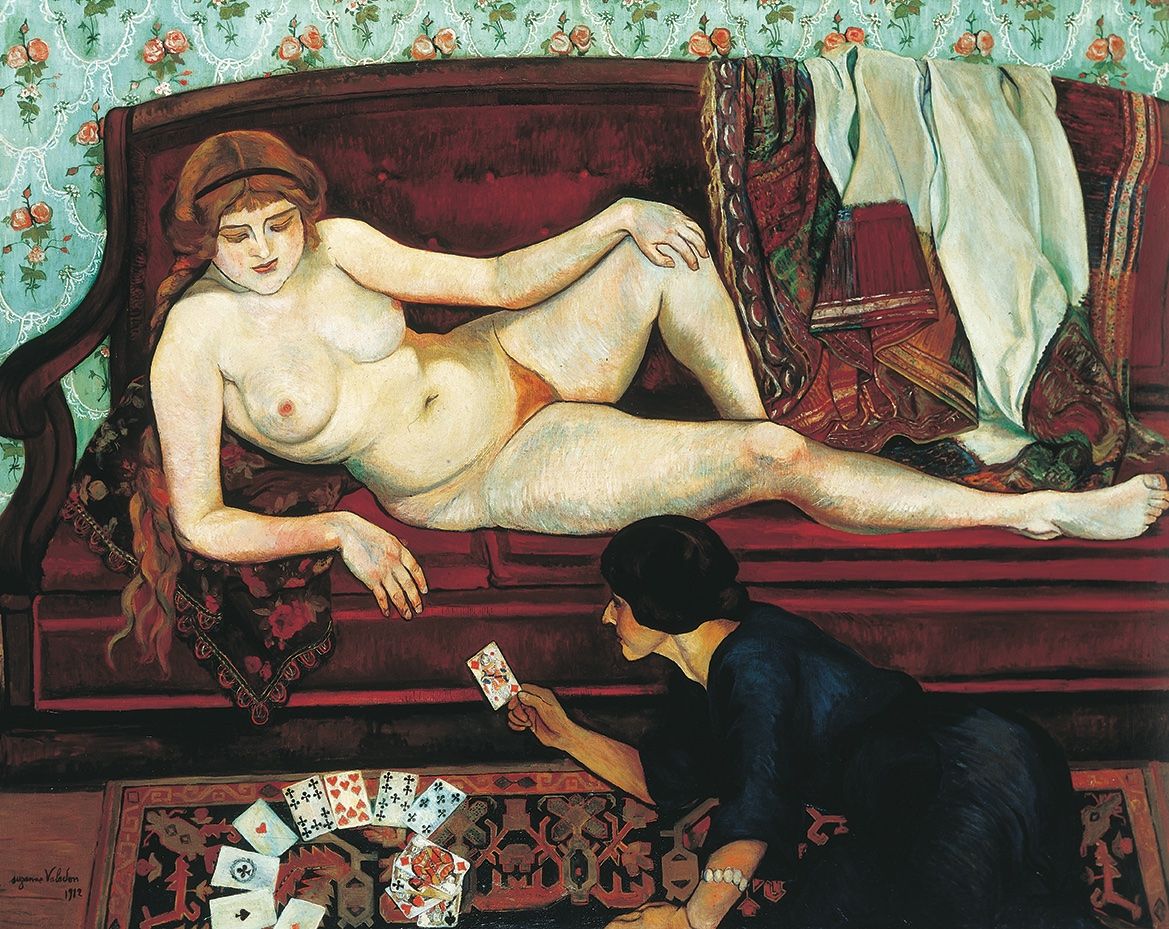
She was also brave in proposing everyday female nudes, rejecting the erotic gaze of those who preceded her, and also portrayed her. She even broke stereotypes with The Blue Room (1923), her first work acquired by the French State. There appears a modern model who defies aesthetic canons and is dressed, in addition to smoking and reading, a declaration of intentions that gets rid of Valadon's previous image. As if that were not enough, she is considered the first female painter in history to portray a male nude, with Summer or Adam and Eve (1909). The leaf covering his sex was not in her original proposal; she had to add it to be presented in society, although it was not necessary to do so in her case.
Valadon was brave in posing everyday female nudes, rejecting the erotic gaze of those who preceded her and also portrayed her.She died at 72, with a funeral attended by artists such as Pablo Picasso, Georges Braque, and André Derain. Despite the success she achieved in life, with a body of work consisting of almost 500 canvases and 300 works on paper, her fame faded for a time, becoming known only as the mother of Maurice Utrillo, until her figure was recovered and reclaimed.
One of the successes of the season at the MNAC, where the main international visitor is French, achieving something unusual like selling out catalogs and having to order a new reprint. More than 100 works review the trajectory of the Montmartre painter, including oil on canvas and cardboard, drawings, and engravings. The exhibition arrives in Barcelona after being shown at the Centre Pompidou-Metz and the Musée d'arts de Nantes, on each occasion with a different proposal, with 40 works only exhibited at the MNAC. It thus warms up for its arrival at the Pompidou in Paris next year.
Add The New Barcelona Post as your preferred Google source for free
Stay informed with the latest news.
