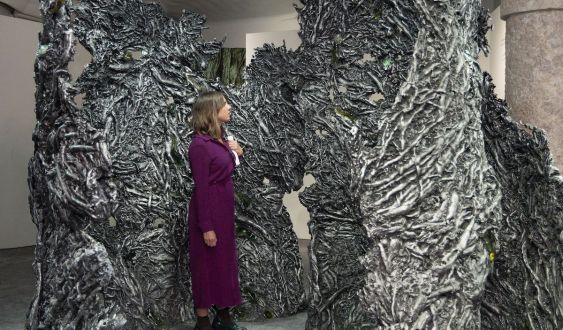
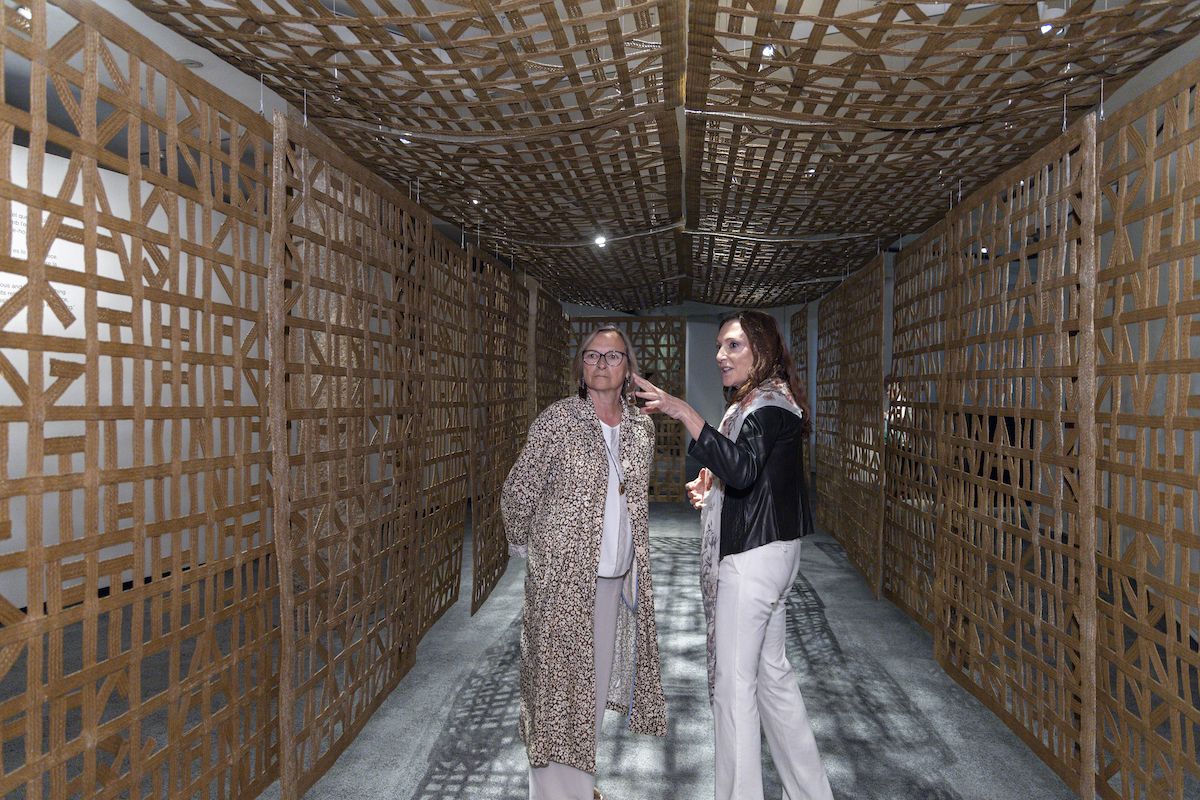
Cristina Iglesias is one of the most relevant (and sought-after) creators on the contemporary peninsular scene. These months, she fills the spaces of La Pedrera with structures that seem to have always been there, as if they had grown slowly among the undulating stones, the cracks in the walls, the solemnity of the columns and the air. Her materials, with a texture that oscillates between the mineral and the organic, invite one to look and to touch, but above all to traverse. Passatges is not an exhibition to contemplate, but to explore or inhabit: an experience that unfolds when the body moves, when the spectator allows themselves to be guided by intuition and becomes part of the work.
"My work stems from an exploration of the relationship between space, materiality, and perception," Iglesias writes in the catalog. This seemingly theoretical statement becomes a tangible promise when one delves into her numerous labyrinths: forms close and open, light falls like a breath on metal, water murmurs within subterranean cavities. Her sculptures (pavilions, lattices, walls traversed by texts) not only delimit a place but generate it. They redefine the boundary between the interior and the exterior, between the natural and the artificial, and turn the air into a living question.
Passatges proposes a journey that brazenly dialogues with Gaudí's architecture, to the point of almost questioning it. Her materials are darker, wetter, more geological; her iron is less decorative and more tectonic. If Gaudí sought the organic miracle of nature, Iglesias explores its memory: the recollection of what has eroded, of what remains underground. Her works evoke subterranean water, the roughness of the landscape, the matter that holds invisible stories.
One of the central pieces, Bosque interior (2025), transforms the main floor into an almost ritual space. Solid stone columns are arranged like ancestral trunks, and between them, shadow becomes matter. To the eye, it looks like an ancient temple; to the touch, a pulsating ruin. "It is each person's experience, with everything they perceive and project, that activates the work," says Iglesias. And it is true: the visitor, by walking, completes the meaning of the work and converts emptiness into presence. The chronicler has gotten lost once, and has hit a dead end, twice. Do not come to see static paintings: come prepared for everything to move around you.
At the entrance, another installation (a black and porous structure, almost a cage or a sanctuary) fragments the light and densifies the silence. "Sculpture can transform a place and offer new forms of interaction and reflection for those who pass through it," says the artist, and this phrase resonates as people stop, unsure whether they are inside or outside, spectator or protagonist.
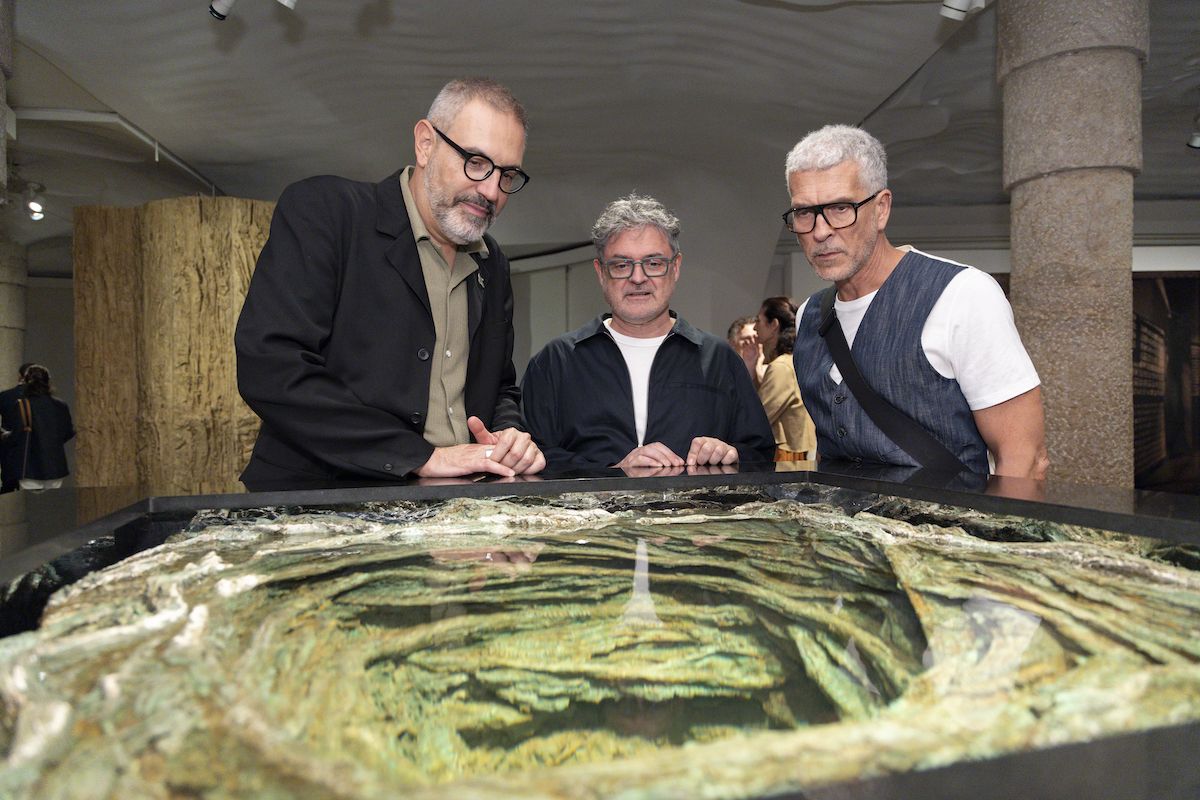
The exhibition culminates in the courtyard, where an octagonal sculpture of black stone (almost Kubrickian) contains a center of green, undulating water. It is as if La Pedrera had opened its heart and from it sprang a well of subterranean energy. This work summarizes Iglesias' entire universe: water as memory, stone as word, matter as language. In it, time seems to recede. Everything becomes primeval and, at the same time, strangely futuristic.
Finally, in addition to the physical pieces, an audiovisual is projected that documents the artist's creative process (from the studio to the final assembly) and allows one to delve into her way of looking at the world. Iglesias speaks with a Nordic calm, cold and tender at the same time, like patient subterranean magma.
Perhaps this is the merit of Passatges: when you leave and look at La Pedrera again, you cannot help but think that beneath the surface of everything (of a wall, of a body, of a city) there is always a new layer waiting to be crossed.
Add The New Barcelona Post as your preferred Google source for free
Stay informed with the latest news.