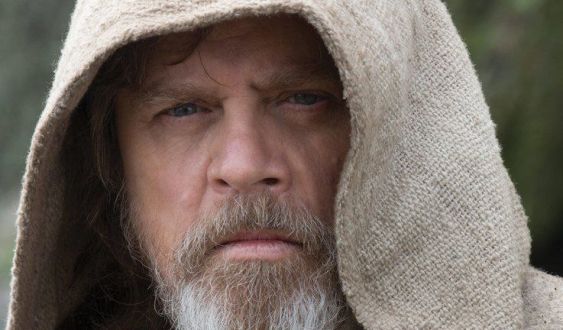
The other, the most distinct and hated, appears familiar, like a counter-image of oneself, realized through the emotional bond.The need to elucidate her family destiny is what also drives Rey, inThe Last Jedi, to a sinister cavity, in the depths of the sacred island. There she seeks answers, drawn by thematrix darknessof her vital question: can she know who she is, if she doesn't know who her parents are? In this telluric experience, which inevitably refers to that of young Skywalker, she does not find the solution, but rather a multiplication of her own image, reproduced in series, which leads her to a crystal that progressively fogs up, and behind which she hopes to see her parents. The viewer accompanies her anxiously, to discover the truth: what ends up being seen is her own face searching for itself, reflected in the gaze that longs for a reparation of the damage suffered."WHAT SHOULD I DO, TEACHER?" Hate and love, as driving feelings, are respectively claimed as more powerful throughout the saga, also in the battle waged by the Jedi knights against their own interests. Experiencing the rapture offuryin martial action leads to the dark side. Disinterest is required in the most instinctive of actions, self-preservation against the enemy. A supreme paradox that hooks the viewer. "If you strike me down with anger I will be with you always," Luke tells Kylo Ren. Something similar Obi-Wan had conveyed to Vader, before vanishing, inStar Wars (Episode I), renamedA New Hope"if you strike me down I shall become more powerful"Preventing the reactive form of nihilism is the underlying purpose of the warning Nietzsche poured intoThe Twilight of the Idolsit would be about tearing down thefallacious ideals-the hollow images, once revered- without anger or resentment, as if in play, so as not to be trapped in a relationship of domination, exercised, paradoxically, by that which one wants to eliminate. From a shamelessly Buddhist perspective, less aggressive in its approach, the Jedi is required as a moral imperative to practice detachment and full concentration in the moment, two of the least frequent attitudes in our time. It is probable that for this very reason they are so appreciated on screen, apprehended as characteristic of heroes, with the enabling of a space for the experience of a second reality that complements the one lived immediately.
The Jedi is required as a moral imperative to practice detachment and full concentration in the moment, two of the least frequent attitudes in our timeLet us remember how the enamored Anakin Skywalker, gripped by anguish (due to recurring admonitions that, in dreams, make him fear the death of his pregnant wife) had asked Yoda, as if he were an oracle: "What should I do?". The Jedi master's answer is as clear as it is difficult for the person involved to put into practice: "Practice letting go of everything you fear losing."Thatlet go, relative to what one most wants to possess, is unnatural, contrary to common sense; and can be compared to the movement of faith illustrated by Abraham, the patriarch of the Old Testament who agrees to offer his son Isaac as a sacrifice, after so many years (decades) waiting for him. SørenKierkegaardexplodedin extensothe biblical passage inFear and Tremblingto critically point out the inadequacy of rational thought when it comes to understanding and communicating the spiritual designs of man, in his relationship with the transcendent dimension. His preferred alternative -the conception of faith from the absurd, as a movement that cannot be theorized- finds a place in the radicality of a certain Lutheran worldview, which not only surreptitiously approaches the Nietzschean explosion, but also maintains a certain parallelism with the peaceful version of Buddhism. Rudolf Otto, in his essayOn zazen as an extreme form of the numinous irrational, refers to "shocking" statements from teachers, "like when they say thatthey don't want to know or hear anything about Buddhaor of Zen itself. When one becomes aware of all these things - he continues - it is because they are no longer possessed in an original and authentic way."THE END (BEYOND APPEARANCE)Let us return, in this final paragraph, to the beginning of the first part. To Yoda's paradoxical statement inThe Last Jedi(Episode VIII), which in times ofcoachingmassive perhaps -only "perhaps"- we are closer to understanding:"The most important teacher, failure is". The sentence is related to the problem also detected by Luke Skywalker, that kind of implicit deification in the fact of "being a legend," of being considered from myth and, in short, an excessively complacent self-image. That the Jedi discipline as a myth ends is the condition for, in a sensegatopardiano, its true reason for being is updated. Theambiguitydoes not cease inThe Last Jedia glimmer of hope is sensed in the corrupted Kylo Ren, just as Luke is confirmed fallible. The decision to destroy the temple and the sacred texts -shared by Yoda and Luke- seeks to resume a new lineage of heroes, while questioning the unconditional value of legend, and incidentally critically recalls the human (and yet irrational) need to believe.
That the Jedi discipline as a myth ends is the condition for, in a Leopardian sense, its true raison d'être to be updatedThat statement by Yoda, aligned with the crisis experienced by the still "young Skywalker" -as the venerable master refers to him- denounces the weakness of the feeling that accompanies victory. It adds to the critique of the dependency relationship generated by belief, as well as to the merely theoretical assimilation, and to the supposed possession of things or people. These forms of apprehension enable corruption, fertilize the dark path of the force. Also from another master, Mace Windu, young Anakin, had received -in vain- a very specific warning ("Be mindful of your feelings"), which invited him to recognize his internal conditioning, in order to transcend them and not be a victim of them. The thought of Buddhist reminiscences is not precisely secret in the Jedi discipline, and Rey's training inThe Last Jediemphasizes the correlation, never completely exclusive, of good and evil, which -let's remember- transcends the apparent Manichaeism of the narrative proposal. The "dark side" of the force does not possess an entity -it can well be understood in the negative, even with Saint Augustine, as corruption or absence of good-butneither is the positive side something that can be possessed, without further ado, and wielded in a privileged way by the mere fact ofto know oneselfJedi knight. Yoda, always endearing, represents the Zen master, and as such postulates detachment, the shedding of all interest and passion for the achievement of amindfulness, for concentration in the moment of life and the elimination of fear, which in turn dilutes the possibility of suffering. The term for this type of consciousness ismindfulness, linked to the practice of meditation, which we see Luke exploit to its ultimate consequences –spoiler alert!- and thanks to the magic of cinematic fiction at the very end ofThe Last JediThe power of the mind is used to confuse the enemy, recreating a false image of oneself at a distance, an (unreal) appearance that is forged from full concentration, apart from the ebb and flow of emotions. Lukeis and is not. It is the one that channels and condenses Kylo Ren's hatred, the thirst for affirmation through destruction, which is whyinevitablyit must cease to be.
Offering from another place a model of conduct with a happy ending - an ending that implies a rebirth, beyond time - the religious function of myth is certified.From a distance, Luke vanishes and leaves his clothing without carnal support, as Obi-Wan Kenobi had done. And, in the same way, the apparent annihilation under the effect of hatred eternalizes his spiritual reality, both for the enemy and for generations of disciples and admirers. Thereappearancestranslucent will be phantasmagorical and threatening for some, but beatific for others, basically for those who believe or want to believe from fiction, in this time of crisis. Luke will join Yoda, or Obi-Wan himself, as an immortal being who advises and guides the living. Offering from another place a model of conduct, with a happy ending -an ending that implies a rebirth, beyond time-, the religious function of the myth is certified.(End of the trilogy).
Add The New Barcelona Post as your preferred Google source for free
Stay informed with the latest news.
