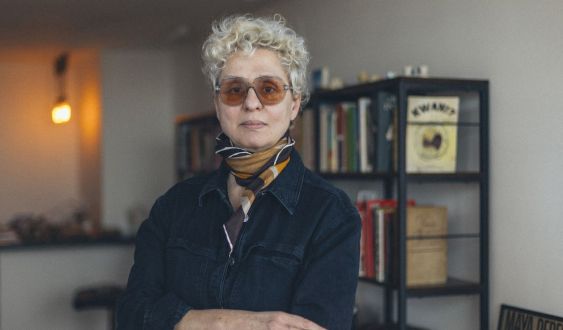
"I haven't lost an iota of curiosity, of the desire to listen and learn, to explore sounds and musical lexicons through which to understand the world and reflect on realities and experiences outside of power." The chords of Tangambara, by Ali Farka Touré, are heard from the Bar. Sitting on the terrace, a marijuana cigarette in hand, Sarah Ardite sips vermouth with a beer and roasted peanuts. "I understand and live music as the ontological expression of peoples, as the means to reach their truth," she adds.
Raised in a family with a rich sound heritage, Sarah learned the mysteries of flamenco palos from her grandfather and father, a love for classical music from her mother, and through her four siblings, Xavier, Joan, Eva, and Toni, she soaked up a thousand and one currents. "From blues and R&B, to rock, passing through jazz, folk, post-punk, and very important music like Cuban or Indian." At home, everyone played the piano in the living room –"I also studied violin, and my siblings other instruments"– and, in her case, the notes got into her soul and feet and since childhood she has not stopped dancing: "ballet, jazz, contemporary, Japanese dance, Senegalese sabar, sirtaki… I've danced everything," she laughs.
She studied Economics and did a master's in Political Science and, suddenly, her life took a turn when she went to live on the African continent. "There I worked as a consultant and, later, as vice president of a multinational. I moved by car from one place to another, through Portuguese-speaking countries, as well as South Africa, Zimbabwe, and Mauritius." That experience lasted ten years and exposed her to the thousand and one African sounds, "which can radically change from one village to another." An infinite heritage from which eternal loves emerged such as Oliver Mtukudzi, Ethiopian and South African jazz, Fela Kuti's afrobeat, Franco Luambo and Congolese music –"the real cradle of almost everything we listen to"–, Angolan music and an endless etcetera.
"I started working as a DJ in Cape Town and Luanda, getting to know and collaborating with musicians, artists, and collectives like Panafrican Space Station or Chimurenga, by Ntone Edjabe, with whom I discovered a lot of sounds in unforgettable listening sessions of the thousands of records he had at home," she recalls. Nothing would ever be the same again.
The shared journey
After a brief period in Dubai –"an aberrant and turbo-capitalist cardboard cutout where culturally there is nothing of interest"–, Sarah Ardite returned to Barcelona with the sound baggage treasured on the African continent. A cultural heritage that she has continued to expand "through the sounds of the Persian Gulf, those of the Maghreb and those of the so-called Middle East". But such an exciting journey cannot be a solitary one.Since her return to Barcelona, she has not stopped collaborating with radio stations, such as Gladys Palmera or Contrabanda FM; museums, such as the CCCB; events, such as the International African Film Festival; and libraries and cultural centers, such as Albareda, where she has activated the sessions Musicalment parlant, "talks with debate in which music is the means to make specific sociocultural contexts visible" or the cycles Àfrica és el ritme del món, "workshops articulated around specific aspects such as, for example, the role of music in decolonization struggles, or in Pan-Africanism."

Approaching the work of philosopher Marina Garcés and taking her master's degree was the final twist that would anticipate Sarah's current project, Músicas Sospechosas (Suspicious Musics), a platform born from the need to articulate a discourse "in which, more than an end in itself, music is a means to understand realities outside of power."
In addition to radio programs, articles and interviews published in headers such as Afribuku, Ramag or In'n'Out Jazz, the project also takes shape through a series of fanzines edited together with Anabel de la Paz and Ricardo Duque. The first, N'écoutez pas la musique des noirs, explores the sounds of Haiti "capable of surviving local necropolitics," is translated into five languages (including Haitian Creole) and provides, via QR, an extensive listening guide to delve into the music of the Caribbean country.

Where creative processes live and vibrate
Despite regretting seeing "how they have turned Barcelona into a cow that a few do not stop milking, leaving it without joy, without children, without young people, without spaces to create, dooming the common to its disappearance", Sarah still loves the city."I love pedaling it, cruising through the Raval, going into the underground bars where people smoke and things happen without permission." And she finishes her beer, before stating: "despite the aspects I detest, it is still the place where my creative processes come to life."
– Which, without a doubt, will help sweeten your creative processes is our gastronomic offer. Lunchtime is approaching and we have delicious tapas, dishes, and a menu.
Sarah Ardite does not miss an opportunity to make another claim, "for tapas made with good ingredients and reasonable prices, something increasingly rare in this city." And she smiles, shaking her head to the rhythm of Savane by Ali Farka Touré, asking for another beer, and knowing that this time she is in the right Bar.

Add The New Barcelona Post as your preferred Google source for free
Stay informed with the latest news.
