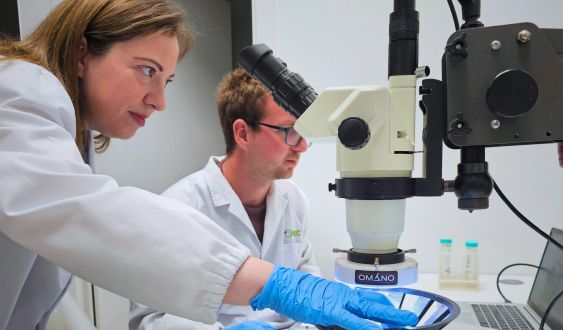
A new light-activated drug has succeeded in restoring functional vision in blind mice. It is the result of research led by the Institute of Bioengineering of Catalonia (IBEC), published in the Journal of the American Chemical Society, in which Rosalba Sortino is co-first author. The developed compounds replace the function of photoreceptors that are lost in diseases such as age-related macular degeneration or retinitis pigmentosa, making it possible for the retina to process light again. After treatment, the mice recovered their spontaneous preference for dark spaces, a behavior that directly depends on the ability to perceive light. The drugs, which can be administered both by intraocular injection and in the form of eye drops, open a new path for the development of treatments against blindness.
Postdoctoral researcher in the Nanoprobes and Nanoswitches Group at IBEC, Rosalba Sortino trained at the University of Palermo and has been working at the Barcelona center for more than seven years. She is co-first author of the study, along with Joaquín Martínez-Tambella, in research led by Pau Gorostiza, ICREA research professor at IBEC and head of the group. The research is part of Sortino's doctoral thesis, distinguished with the 2023-2024 Extraordinary Doctorate Award from the University of Barcelona. According to Sortino, the objective of the study was to recover vision by reproducing a mechanism as close as possible to that of a healthy retina, reactivating the retinal circuit at the point where photoreceptors usually act. The team is now working to evaluate the safety of the drug and optimize its formulation with a view to future clinical trials.
Add The New Barcelona Post as your preferred Google source for free
Stay informed with the latest news.