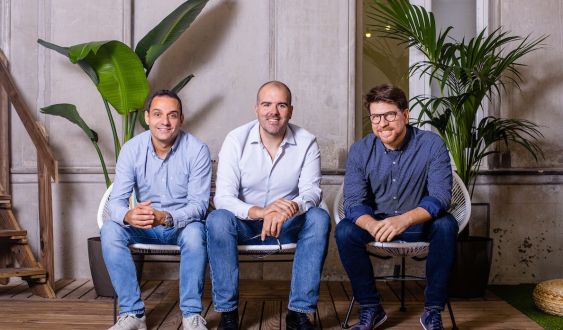
Minors have access to the Internet at increasingly younger ages. Currently, the average age at which children get their first mobile phone is around 12 years old. In 2010, with the arrival of the iPhone 4 and the proliferation of the first smartphones, the founders of Qustodio detected the potential and risks that these devices would have for children, and decided to create a parental control tool. Now, after almost 15 years, the application has seven million user families from 180 countries.
"The Internet is a hostile world for children and, with this application, we want to offer peace of mind to parents, while generating a healthy and safe digital environment for minors," summarizes Emily Lawrenson, Qustodio's communication manager. "Just as we try to adapt our home to be safe for children, we should also adapt the digital world to be healthy for them," she argues.
With this purpose, Eduardo Cruz, Josep Gaspar, and Josh Gabel, three computer scientists expert in cybersecurity, launched Qustodio in 2012 in Barcelona, with a name derived from the Latin word custodia, which could be translated as surveillance. The tool, which offers annual subscriptions of 43 or 75 euros and is available in eight languages, allows monitoring the minor's activity ---for example, their browsing history or the videos they have watched---, locating them in real time, and setting usage limits for their devices, among other options.
The first prototype they created was designed to be used on computers, specifically on Windows devices. In its first two years of activity, Qustodio closed two funding rounds that managed to raise two and a half million dollars from the American investment fund 8W Ventures and the Spanish Kibo Ventures.
"Just as technologies are changing, our tool is too, and it is constantly being updated," Lawrenson argues. For example, the tool has incorporated artificial intelligence algorithms to detect if conversations held by minors include threats or violence, or refer to topics such as depression or suicide. In the event that the system detects a possible danger, it automatically sends a message to the parent's device, exposing what alerts have been detected, without the need for parents to have access to all messages, thus protecting the minor's privacy.
In 2022, the Australian technology company Qoria, which collaborates with schools to protect children in the digital environment, acquired all shares and subsidiaries of Qustodio for a value of 52 million dollars. "With this merger, we achieve comprehensive protection, from school to homes," says Lawrenson. Qoria closed 2024 with a turnover of more than 101 million dollars, 23% more than in the previous period, an increase that is due, in part, to the purchase of Qustodio or Educator Impact, as it has facilitated expansion into new markets. Currently, Qustodio has two headquarters, one in Barcelona and the other in North America, and in the Catalan capital alone, more than 80 people work.

"Even for me, as an adult, going online generates stress and anxiety," acknowledges Lawrenson, who emphasizes that the risks are even greater for children. "At these ages, children's brains are not prepared to have mature conversations and detect the dangers that exist in the digital world," she explains. Qustodio identifies that some of the most worrying problems of Internet use in minors are cyberbullying, access to pornography, or the addiction that certain applications can create. In addition, they point out that these dangers can be found even in applications that at first glance seem innocent, such as mini-games like Roblox, since their chats are sometimes used for cyberbullying.
To start using Qustodio, the application must be installed on both the minor's device and the parent's device. For this reason, the cybersecurity company insists that the installation of the tool must be preceded by a conversation and prior consent from the minor. "It is not enough to install it, because then the minor will interpret it as coercion and a prohibition; instead, there must be pedagogy and a conversation with children about the importance of digital well-being; only then will parents and children become aware of it," concludes Lawrenson.
Add The New Barcelona Post as your preferred Google source for free
Stay informed with the latest news.
