Barcelona has already started the countdown to Christmas. The first signs arrived in the form of the lights that have been hanging from the city's streets for days —although we will have to wait until next Thursday, November 26, to see them lit—. Now, the preparations are also moving to the heart of the Catalan capital. Plaça Sant Jaume is preparing to become a large Christmas postcard, one of those that used to be sent to wish happy holidays and that, over the years, have disappeared from mailboxes.
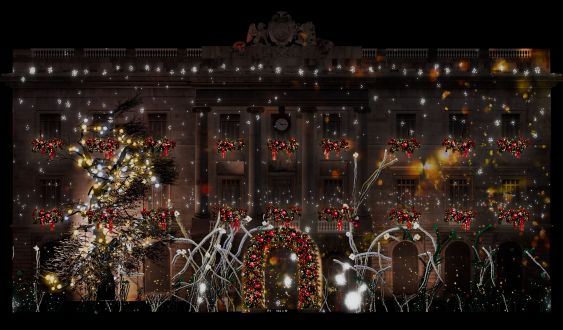
The proposal, however, adapts this tradition to new times: this time, the greeting will be projected in digital format onto the facades of the Barcelona City Council and the Palau de la Generalitat, with a mapping created by the digital artist Alba G. Corral based on programming code. The intervention will turn the two buildings into the two halves of the same Christmas diptych, as if it were a postcard opening between the two palaces. The show, with flowers, leaves, branches, and organic shapes that grow and unfold throughout the projection, is jointly promoted by the two institutions for the third consecutive year and has a budget of 315,000 euros.
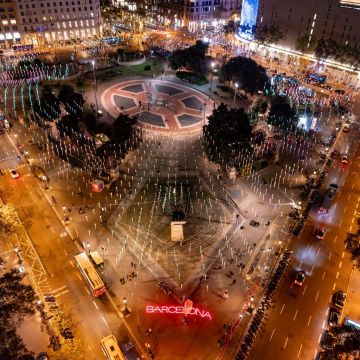
It will be on Thursday, November 26, when this postcard will be projected for the first time, just after the switch-on of Barcelona's Christmas lights, which will have its central event on Passeig de Gràcia, but will also extend to the different neighborhoods of the city. This date should also foreseeably mark the switch-on of the lights in Plaça Catalunya, an installation that has been surrounded by uncertainty in recent weeks due to the presence of the encampment in defense of the right to housing, which had occupied the square since the end of September.
The Deputy Mayor for Culture and Creative Industries, Xavier Marcè, has assured that, "if nothing strange prevents it," both the planned author lights and the Christmas Festival —which is usually held in this space— can be installed in the square. The council, however, is still working to make it possible, and the unknown is whether the installations will be ready in time for the general lighting switch-on.
The forecast to install lighting in Plaça Catalunya comes after the council evicted the encampment on the morning of November 16. An action that the mayor of Barcelona, Jaume Collboni, defended to guarantee "normality, coexistence, security, and health" in the city center. Now, with the Christmas future of Plaça Catalunya on track, the unknown moves to Plaça de Sant Jaume, where part of the protest for the right to housing has moved.

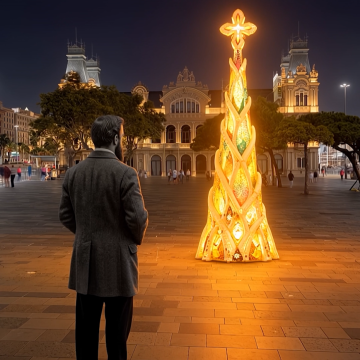
In fact, six activists have started a hunger strike to demand negotiations with the administrations, a protest that raises the question of whether the Christmas tree can be installed in the corner of the square where it is usually located and where the activists are now. Despite everything, Marcà has assured that the council maintains the intention of installing the tree there, although it will be studied depending on the evolution of the protest.
A brush made of algorithms
Beyond the unknown about the tree, Plaça de Sant Jaume will also be the scene of one of the main novelties of the Christmas festivities in the Catalan capital: a mapping that will transform the facades of the City Council and the Palau de la Generalitat into a large Christmas postcard. The inspiration, explains artist Alba G. Corral, comes from 20th-century postcards, illustrated even by artists such as Joan Miró or Salvador Dalí, and full of elements and symbols that are part of the universal Christmas imaginary. From this reference and the landscape of the Mediterranean winter, Corral has created a visual proposal where leaves, branches, and flowers, both digital and physical, will unfold.
The intervention is part of the change in the square's approach that the two institutions promoted three years ago to overcome the debate surrounding the nativity scene. Since then, the nativity scenes have been installed inside the two buildings —that of the City Council and that of the Palau de la Generalitat—, while the facades and the outdoor space are reserved for shared artistic proposals.
Thus, this year's proposed projections will premiere on November 26, just after the Christmas lights are turned on. The next day, November 27, at 8 p.m., the square will become the stage for an inaugural performance that will combine Corral's digital drawing with live music by Icelandic cellist and composer Björt Rùnars, based in Barcelona. On this occasion, the proposal will not be static, but will be created and transformed live in front of the public, inspired by the sounds of Björt Rùnars, as if an invisible hand were drawing them thanks to a "brush created with programming code," Corral explained. Trained in computer engineering, she works with generative systems that allow her to create visual forms from code. A practice that, as she wanted to emphasize, should not be confused with generative artificial intelligence. "My practice is drawing with programming code," she explained.
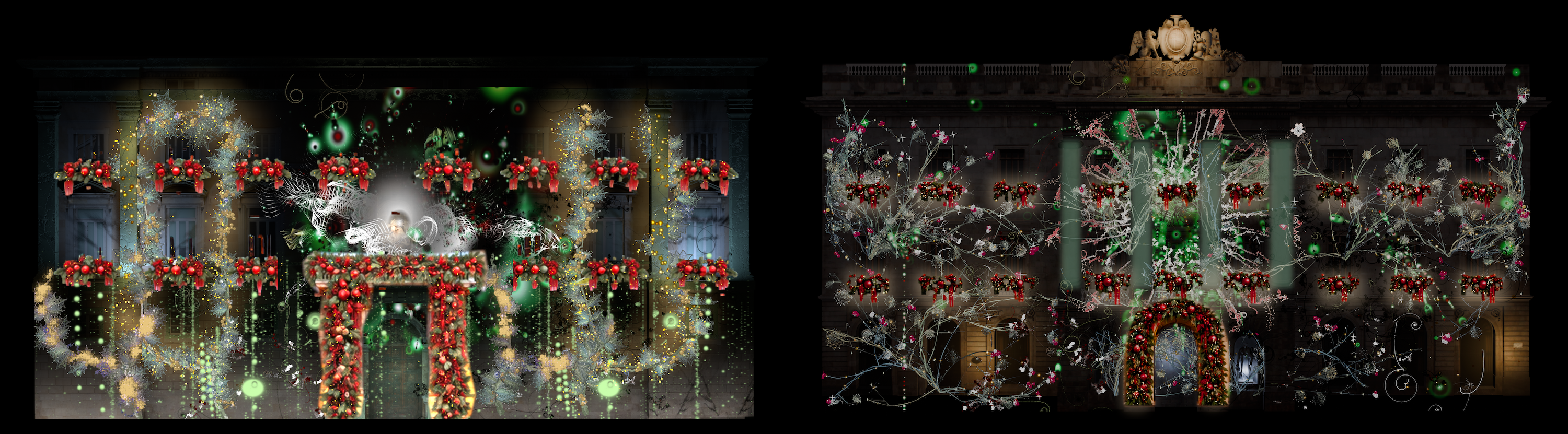
After this inauguration, the mapping can be seen until January 5, from Monday to Thursday, from 6:30 p.m. to 10 p.m., and on Fridays, Saturdays, holidays and holiday eves, until 11 p.m. Every day there will be three sessions that will also be accompanied by music, at 6:30 p.m., 7:30 p.m. and 8:30 p.m., while the rest of the passes will be projected without music —to respect the neighbors' rest— and continuously. The installation will not operate on November 30, December 1, 3 and 10, nor during Christmas Eve, New Year's Eve and Three Kings' Day.
Add The New Barcelona Post as your preferred Google source for free
Stay informed with the latest news.