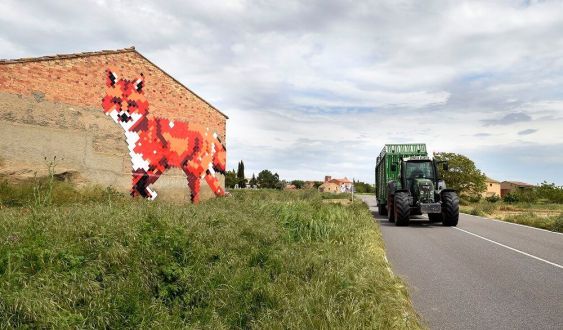
Penelles, in La Noguera, does not reach five hundred inhabitants, but it has become a neuralgic center of street art with international reach. Or rural art, which is how Mar López Pinto and Jordi Solsona, two Barcelona freelancers with roots in the town, who are the architects of this project that has changed the image of the entire village, call it. "We wanted to bring this type of art, which is normally found in large cities, to more rural areas to, in this way, boost the economy of our small municipality." And boy, have they done it.
Every first weekend of May for the past three years, the Gar Gar Festival has been held in the town, the mural and rural art gathering that has revolutionized this municipality, which already has more than fifty facades decorated with the most innovative urban art. This year, 25 artists from all over the world participated, leaving their mark on the houses of the local inhabitants and filling with visitors a town that until now had no tourist attractions worth mentioning.
One of the pioneers and already a friend of Penelles is the French visual artist Zeso, who spent a decade painting in New York. He is one of the most influential graffiti artists in global muralism and decorated a wall in the municipality in the first year of the festival. This year, he inaugurated the exhibition hall parallel to the event with the exhibition "New York Penelles." What do New York and Penelles have in common? "They have nothing in common, they are two opposite extremes. Well, only the graffiti on the walls," replies Zeso, smiling, who spent four months as the first "artist in residence" in the town this winter. "I stayed here and created an installation that allows inhabitants to interact with the artwork," he explains.
Zeso is the author of one of the murals in the town center, where an urban revision of Alice in Wonderland appears. However, in three years, more than fifty walls in the town already feature the work of national and international artists such as Taker One, Mina Hamada & Zosen, TV Boy, JFAR, and many others. A wide variety of styles can be seen, from realism to still life, abstract or geometric, but all drawings are linked to rural and natural themes. "We have been surprised that several international artists, who usually never participate in festivals, have wanted to come expressly to Penelles because they were excited to leave their work in a town that is already talked about in international street art circuits," explains Mar, curator of the event.
This year, participants were chosen from among 280 applications from graffiti artists from all over the world who presented "high-level proposals," a fact that made selection difficult, a selection that also takes into account emerging artists from the territory such as Swen Art and Llukutter. "Most of those chosen do it for the love of art, as they only receive money for the material they have to use," Mar continues. Only those considered "headliners" of each edition are paid for transport and accommodation at the festival.
"For us, it is also very interesting that the inhabitants of Penelles welcome artists into their homes and exchange feelings and experiences," says Jordi. And that impacts their ability to enjoy street art. "It's very curious to see how people from outside, when they don't understand what you're painting, ask you about it and question it." In contrast, the people of Penelles walk, look, grasp the ideas and are no longer surprised by the result," assures artist Vorja Sánchez, who this year painted a wall next to the church, inspired by organic forms he found around the town and with chromatic tones that follow those of the temple.
Five years ago, no one would have thought that in the middle of Noguera, Urgell, and Pla d'Urgell, a rural redoubt would be found, converted into the municipality with the most graffiti per capita in the State. It's one mural for every seven inhabitants, not everyone can say that.The town has enthusiastically embraced the project, and one of the few conditions it imposes on participants is that their creations portray the agricultural and rural world. "We also recommend that they do not address political or religious themes because we want them to be drawings respectful of the neighbors who have to live with them every day," explains the town's mayor, Eloi Bergós.
Five years ago, no one would have thought that in the middle of Noguera, Urgell, and Pla d'Urgell, a rural stronghold would be found, converted into the municipality with the most graffiti per capita in the State. It's one mural for every seven inhabitants; not everyone can say that. Now, after three editions of the Gar Gar Festival, strolling through its narrow streets has become a visit to an open-air urban art museum, where any corner or facade can surprise with a spray-painted drawing by the dozens of graffiti artists who have left their mark in Penelles.
Furthermore, little by little, this festival is becoming an essential meeting point for the urban art world. Artists share hours and days of work, which allows them to get to know each other and share experiences. "I come from Hungary, and it's very good for me to participate in Gar Gar because that way I can learn about the work being done here, share works, and promote my art," explains Taker One, the author of the wolf mural that presides over one of the town's facades. This type of festival "is more typical of big cities like New York, Philadelphia, London...", explains this artist, thus giving the key to Gar Gar's success: being able to decontextualize this intrinsically urban art to make it fit into a small town in Noguera.
Add The New Barcelona Post as your preferred Google source for free
Stay informed with the latest news.