The most important philosopher of modernity had no children. Immanuel Kant, the thinker who never left Königsberg, consecrated his life to study and to the writing of his critical project. To such an extent did he lead an ordered life, to such an extent were his habits and routines inflexible, that his fellow citizens could set their clocks by seeing him walk past their houses. It is said that only once did he miss his appointment with punctuality, one afternoon when he stayed reading longer than usual the works of his admired Jean-Jacques Rousseau, of whom he also kept a portrait in his study. The Franco-Swiss thinker, author of various works on education, on the other hand, did have children, and in considerable number. He abandoned all of them in an institution for their upbringing, who knows if still affected by his own childhood traumas or, rather, by that of not contravening theory with practice, to spare himself the pain of being conditioned (that is, limited) in the legitimate exercise of his freedoms.
«Jean-Jacques Rousseau, author of various works on education, had a considerable number of children. He abandoned all of them in an institution for their upbringing».
The incompatibility of intellectual life with family is one of those philosophical commonplaces that can be found at the very origins of public thinking, already in the semi-mythical figure of a Socrates always anxious to be outside the home that Xantippe ruled with an iron hand, to converse with whomever on those dusty roads. A commonplace whose parodic update we can read in the opuscule titled The Sexual Life of Kant, signed with the pseudonym of Jean-Baptiste Botul. Much more sincere and reliable, at least a priori, purports to be the biographical representation of Rousseau. Already in the first pages of his Confessions he proudly warned of the pioneering nature of his enterprise, a warning that seeks to win over the reader through a fabulous pretext (the sincerity of his showing, as Paul de Man has pointed out) ultimately impossible to corroborate: «I, who am going to strip myself bare like no one before, in return ask for an extra dose of understanding, given the exposure that this entails».
«Speaking of acts of faith, that the celebration of Father's Day coincides with Saint Joseph's Day is a powerful irony, full of meaning».
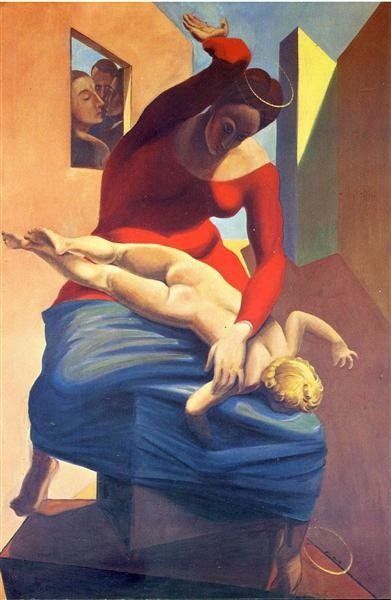
On the contrary, that functions as an archetype that allows illustrating the experience that marvels/disquiets successive generations of creatures once they become creators, remote parents of the child-god (not in vain Freud used the expression «His Majesty the Baby»); that is, when they begin to live firsthand the mystery of the incarnation and the consequent recognition in the otherness, sometimes unfathomable, that are children. No less disturbing, though correlative, is the non-recognition of oneself in sameness, which eventually takes place in front of a mirror. In our times of productive efficiency, many parents try to justify their deplorable physical appearance and explain the reason for their diminished cognitive faculties based on contrasted arguments: lack of sleep, the absence of truly restorative rest, or the always surprising recurrence of the unforeseen, which plunges cosmic order into perfect chaos. And not infrequently do they receive the well-known pat on the back from the still-not-parents, with a sentence that can in no way go viral, nor be successfully retweeted: «I imagine (from your face and scarce mental agility) that being a father is hard… but, "it surely pays off"».
"In the joke, the truth is already contained, grotesquely deformed or free of makeup. The question is to identify at what point what is visualized is real or surreal."
A series of advertisements, on the occasion of this memorable day, celebrate the paradox (which Kant obviously did not come to consider in his study of the paralogisms of human reason) consisting of giving life to another and, as a consequence, ceasing to have a life of one's own. They show the classic outdated father, who is relentlessly ignored by one or more teenagers. And, yet, the individual is at the end of the advertisement already "compensated," because he holds a coupon; a supposed ticket to his happiness, which is to make him forget all grievances. The scene combines real, even frequent, situations with another highly improbable one... but which softens the drama. The aftertaste of caricature is present in the television promotion, funny insofar as it conveys a symptomatic quota of reality. For in the joke, the truth is already contained, grotesquely deformed or free of makeup. The question is to identify at what point what is visualized is real or surreal. And we do not say this still thinking of Max Ernst, nor of any of the artists who wanted to transcend the customs of the unconscious, through the liberation of a more real ("surreal") reality.
"We have also looked with true passion at a woman who is no longer ours, intuiting with new happiness that, in fact, that is so, because she has never truly belonged to us."
Situations that will seem exaggerated, and for some viewers will sound like a caricature. We, parents, know that everything is much more complex and simpler than what one is warned about, half in jest, half seriously. Some of us have corrected texts on Kierkegaard and Luther with a baby in our arms. We have been tempted to seat the few-year-old offspring on the university classroom podium, having nowhere to leave him, even with a slight fever. And we have also looked with true passion at a woman who is no longer ours, intuiting with a new happiness that, in fact, that is so, because she has never truly belonged to us. Because it is not possible to possess what one loves most, what one owes oneself to. And that the true magic, as parents, lies in assuming the porosity of the line that separates the unthinkable and the marvelous.
Add The New Barcelona Post as your preferred Google source for free
Stay informed with the latest news.
