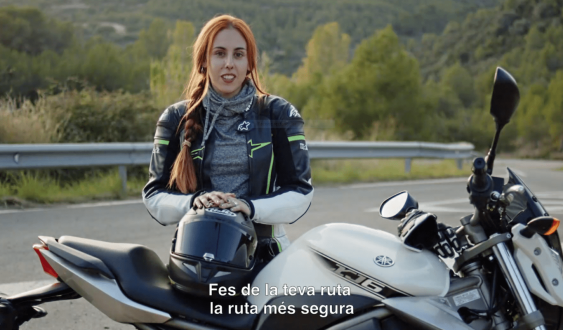
Zaira Gimenez is 25 years old and, although she has only been riding a motorcycle for three years, she assures that her passion for these two-wheeled vehicles comes from her family and is in her DNA: "Almost my entire family rides, they have transmitted to me the love for motorcycles, but also to have a high perception of risk. On a motorcycle, you are the chassis; if something happens to you, it's you against the asphalt." Zaira also drives a car and warns: "When you're on a motorcycle, you must have a thousand eyes; unconsciously, when you're in a car, it's different, more relaxed in attention, and this is a mistake. We must respect and take care of each other."
Accidents on our roads have been decreasing in recent years, except among motorcyclists. People who ride motorcycles represent one out of every three fatalities on the interurban road network. This vulnerability that they must face daily on the road is also suffered by their families. Zaira explains that when she decided to ride a motorcycle, her father, especially, did not take it too well, and although he has now accepted it and they ride as a family, he continues to suffer: "My parents' suffering is not because of my driving; it's more about what others might do to you; it's not about me, it's about others."
Regarding this fragility of the motorcycling community towards other road users, Zaira assures that the basic measures needed on a motorcycle to avoid accidents are "safe distance, being alert, and looking very carefully when overtaking." For her, a good motorcyclist "is one who knows how to differentiate the road from a circuit." She considers herself a prudent driver and emphasizes: "You have to ride a motorcycle with your head and think about the people around you."
Zaira is one of the protagonists of the new awareness campaign by the Servei Català de Trànsit (SCT) specifically aimed at people who ride motorcycles, The safest route. It is important to wear appropriate protective gear, perform good vehicle maintenance, and practice calm and preventive driving. In this regard, Zaira emphasizes that "nerves and haste are not good travel companions for anyone." Precisely, the campaign insists on the importance of the community's involvement in its own safety: Make your route the safest route.
The gender perspective in traffic and road safety policies
Statistical data shows us that women violate traffic rules less and also have fewer traffic accidents. Currently, in Catalonia, men represent 57% of people with a driver's license and women, 43%, but men are present in 80% of fatal accidents on the roads.
This is a reality that must be taken into account and, in this sense, the Departament d'Interior and the Servei Català de Trànsit have already begun to get to work with the application of a gender perspective in the field of road safety and training and educational actions through the 2021-2023 Road Safety Plan.
With the presence of women's testimonies in the new road awareness campaign for motorcyclists La ruta més segura (The safest route), in addition to reinforcing the breaking of gender stereotypes, women are positioned as the main transmitters of road safety messages. Road safety values have no gender, but it is necessary to feminize behaviors on the road because they are proving to be safer.
Add The New Barcelona Post as your preferred Google source for free
Stay informed with the latest news.
