
I read that a Harvard study confirms that ChatGPT already thinks like an average American. The first doubt arises: how does an average American think? The truth is I don't know, but I do think I know how a lifelong Catalan journalist writes. The Col·legi de Periodistes has just awarded him the Ofici de Periodista 2025 prize for his commitment to rigorous and independent journalism. I can't get his speech out of my head: "It is difficult to practice the profession without informational tension. Journalism requires time and space. If you want to prosper in life, you always have to learn and go with someone who knows more than you." In three words: people, time, and space.
Speaking of masters of the trade, Ramon Besa remembers journalists Antonio Franco, Agustí Fancelli, and Fermí Puig. Of the first, he highlights his commitment to nurturing directors and newspaper editors and his ability to relate to political and business power. Finding the exact word, being curious and losing fear, and no socializing of error. From the second, he understood the need to create sections and to make a newspaper, he learned to approach culture and to find his own limits. From the third, he valued the healthy exercise of polemicizing and earning the reader's respect, taking care of one's ego, and only giving an opinion when necessary.
By the way, Ramon Besa is member number 88,057 and assures that he only wanted to be a journalist to see the world and meet people, not to be known or awarded. They say that those who do not want power are often those who wield it best, and that those who do not seek recognition are those who should be most recognized. To serve and not to serve oneself. "Although journalism requires time and space, one thing is to be fast, and a very different thing is to rush, which is not the same... The day the profession has expired, that it no longer responds to the essence for which it was conceived, as they say will happen with paper, you let me know and I will come, but then I will come as a listener. And if necessary, if someone convinces me, if someone tells me how to master information the way those who are no longer here did, that day I will applaud more than ever," Besa reflects at the goalmouth and amidst applause.
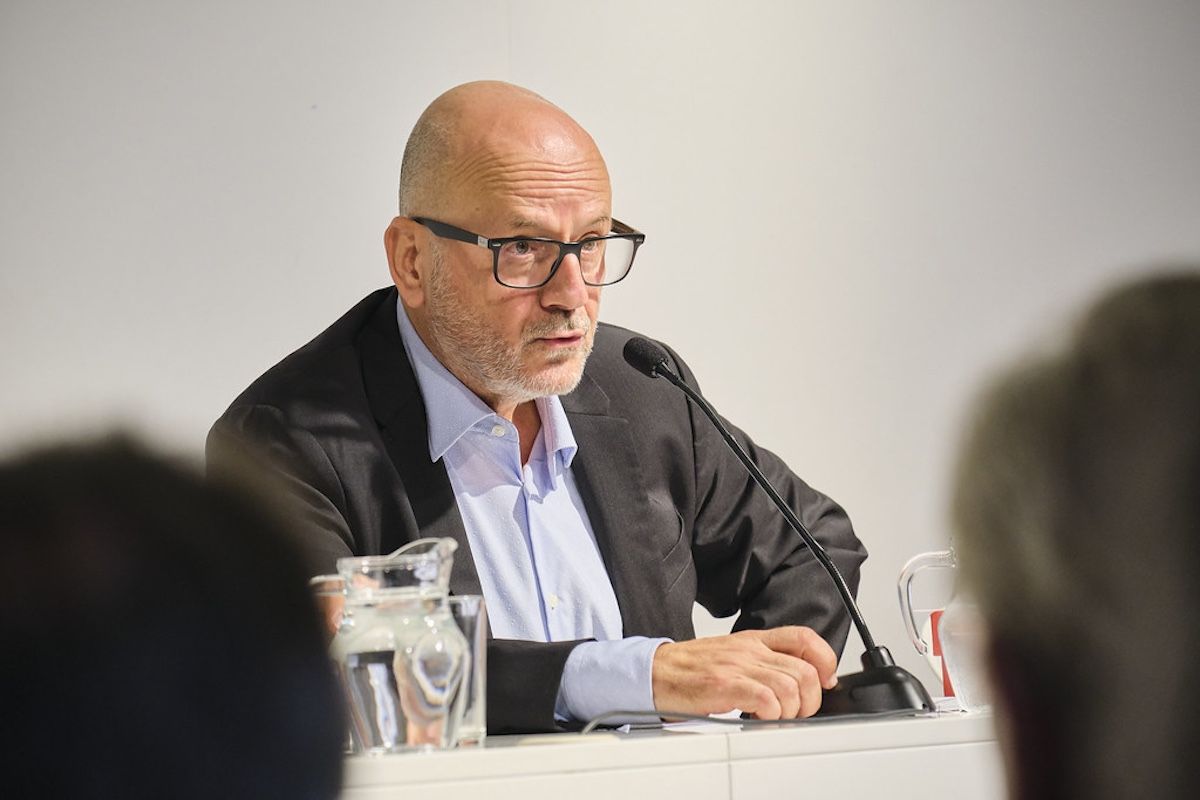
We ended up like the best football matches. That is, with the chronicle that breaks the clock and is written from added time to the initial whistle. Jordi Basté does the honors of presenting the honoree with a new ode to the profession: "Ramon's chronicle is the moral chronicle of the country and a form of everyday philosophy. Journalism, like life, is not understanding what happens, but why it happens. Journalism that thinks before speaking and above all that listens. Journalism is a service and a way of being and the profession is not a career, but a vocation." As in the best parties, a long list of journalists or writers accompany Ramon Besa, such as Mònica Terribas, Santiago Segurola, Sergi Pàmies, Joan Maria Morros, Francesc Marc Álvaro, Olga Viza, Martí Anglada, Frederic Porta, Xavi Torres, Emilio Pérez de Rosas or Daniel Vázquez Sallés, among many others.
I leave Rambla Catalunya still remembering the Harvard study, but above all the why of our profession that asks, listens and writes. Definitely, it is too good to have "unreachable references."
Add The New Barcelona Post as your preferred Google source for free
Stay informed with the latest news.