[dropcap letter="M"]
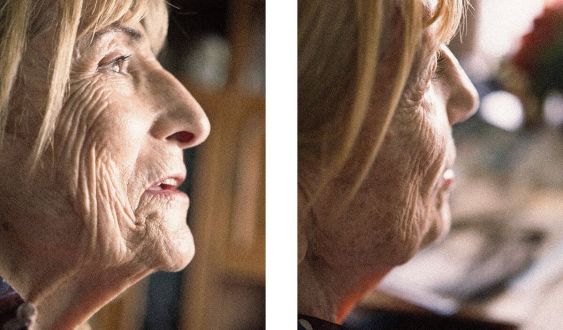
ari Carmen married Pepe 58 years ago and for more than two years she has visited him every day in a residence. Because, for more than two years, Pepe has had Alzheimer's. "He and I were one unit," says Mari Carmen. "You imagine that you will end your life with the person with whom you have built it and then it turns out that a day comes when your partner becomes a being who neither feels nor suffers."
Every four seconds a new case of dementia is diagnosed in the world and in Spain one in ten people over 65 years old has Alzheimer's. Their caregivers have to be attentive to the patient 24 hours a day. That's why Mari Carmen spends every afternoon at her husband's residence. She shaves him daily and gives him the snack she brings. "The food is good, but I bring him jelly and vanilla cookies that he can eat, because he is diabetic."
Pepe's illness began in 2003. "He was doing strange things," says Mari Carmen. The doctor made them buy some notebooks with rehabilitation, memory and attention exercises, and told them to come back after three months. But Pepe did not want to do them, nor did he want to return to his appointment with the doctor.
The disease continued to advance until, at the end of 2010, the situation was unsustainable. Mari Carmen says that her husband had become a mischievous little boy. "It was very hard. It's something that cannot be explained. To think that what made me fall in love with him was his bravery!" Now she says she cannot find that lively, intelligent and courageous Pepe anywhere.
For this woman, Alzheimer's is "a continuous sadness, a continuous being attentive." Mari Carmen controls her husband's sugar. She takes him to the ophthalmologist and the dentist. She gives him food. Every afternoon she brings him the watch and sunglasses that he likes so much. She puts cologne on him, because "he is very vain." And she buys him good creams that "are not covered by insurance." In reality, her dream, if she could afford it economically, is to take him home to be able to have dinner together, holding hands. "It's not a crazy love," says Mari Carmen. It's more the spirit of protection that comes out of her seeing him so defenseless. "The sorrow I have is that of loving him so much."
Last September 21 was World Alzheimer's Day. In Spain, there are about 800,000 people diagnosed with dementia and, with life expectancy increasing, this figure could triple by 2050, reaching epidemic proportions. As stories like Mari Carmen's make clear, it is a very demanding disease for family members. Therefore, the psychological support given to all of them by entities such as the Pasqual Maragall Foundation is essential.
This foundation, together with Obra Social "la Caixa", launched, on World Alzheimer's Day, an awareness campaign that, after passing through Barcelona the previous year, covered one hundred plaques on ten streets in Madrid's Ópera neighborhood in white.
The campaign, called "Blank Streets", lasted until last September 24 and, in addition to explaining what this disease means for those who suffer from it, wanted to emphasize the importance of investing in research, to be able to understand how Alzheimer's works and thus be able to prevent and diagnose it in time. Perhaps this way we can ensure that fewer people go blank, and that more couples, like Mari Carmen and Pepe, can end their lives together being who they were when they met.
Text: Laura Calçada Photography: Javier O. San Martín
You can read more stories like these in ALMA, the social social network, a digital space dedicated to the social sphere that provides a new perspective on the present and future of society, from an optimistic and diverse voice, and from all the initiatives promoted by Obra Social "la Caixa".
Add The New Barcelona Post as your preferred Google source for free
Stay informed with the latest news.