[dropcap letter="L"]
Music therapy as such is a relatively recent discipline, but there is evidence, since ancient Egypt, of the search for benefits for physical, mental, and emotional health through the production of sounds. In fact, none other than Pythagoras related musical harmony to that of the body, and Aristotle even assigned a mood to each harmonic mode. Currently, music therapy aims to promote self-knowledge and personal expression to satisfy basic needs such as self-esteem and relationships with others.
Carlos Vázquez is responsible for the technical volunteering office and manages the "la Caixa" Volunteers program in Tenerife. He explains that the initiative arose from the musicians themselves and that the volunteers enthusiastically embraced the project, in which educators are also involved. "The project is aimed at a very broad audience, from children with functional disabilities to women at risk of social exclusion. Last month, women from the world of prostitution came, who had been victims of human trafficking, who lived in shelters… women who have had a very hard life and who were going to an auditorium for the first time." The simple access to other facets of life, related to beauty and culture, would already justify an activity like this, but the contribution is much greater and reaches a transcendence difficult to gauge.
One of the volunteers, young Maribel, emphasizes that "for children with Asperger's or autism, music allows them to connect with their emotions, something fundamental for them." Giving shape to our emotions is the first step to knowing them and, therefore, knowing ourselves better. But music is also an unparalleled tool for coming into contact with others and with the world, a world that for many of these groups too often presents a hostile face. Educator Laura Costa confirms this: "Children open up more to express what they feel and learn that we all share the same feelings. It helps them to know their own emotions and to identify them, to communicate, to open up to others and to express feelings of sadness or frustration."
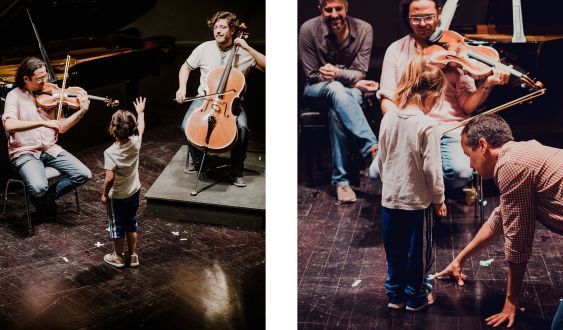
Guacimara Alonso, assistant production manager of the auditorium, highlights the diversity of responses expressed by the children, as well as their eagerness to participate: "In November, when groups with children suffering from Asperger's and autism came, it was very curious to see their reactions, because they were very different. The famous fourth wall of the stage was broken and more than one wanted to conduct the orchestra". The important thing to correctly delimit the activities, for Guacimara, is that the degree of disability is relatively similar among the children, and she also highlights the value of opening new experiences to them: "You have to take into account that there are children with disabilities who are never taken to the cinema because if they get bored or something bothers them, they can get up or start talking."
For Cristóbal Barrios, clarinetist of the Quantum Ensemble, "the experience is always wonderful." Faced with the excessive ceremony and seriousness of the usual classical music audience, the musicians appreciate the spontaneity of groups that are not subject to usual behavioral norms. "The feeling we musicians have is that we should be grateful that they treat us with so much affection," says Cristóbal. "Normally there is a barrier between the classical musician and the audience, and we appreciate that there isn't one here and that different things can happen. For example, the other day, a 4-year-old girl wanted to conduct the group. We gave her some guidelines and it was a lot of fun. In the end, all the children wanted to do it!"
In addition to bringing these groups closer to music and instruments with which they do not usually relate, the activity can even awaken vocations. This is the case of little JM, a 10-year-old girl who is a fan of urban music and who was listening to chamber music for the first time in her life. The impact must have been strong because now the little girl doesn't want to rap, she doesn't want to dance reggaeton, she doesn't even want to play the electric guitar, but... she is considering learning to play the viola.
Text: Raúl M. Torres Photography: Rubén Plasencia
You can read more stories like these in ALMA, the social social network, a digital space dedicated to the social sphere that provides a new perspective on the present and future of society, based on an optimistic and diverse voice, and all the initiatives promoted by the "la Caixa" Social Project.
Add The New Barcelona Post as your preferred Google source for free
Stay informed with the latest news.