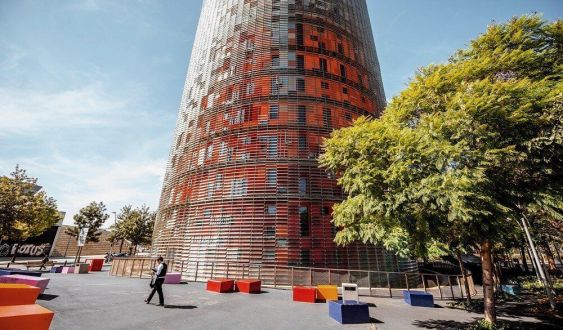
The Glòries tower, formerly the Agbar tower, will not be the headquarters of the European Medicines Agency but it will be the home of a strategic data review and fake news detection center for Facebook. The news was confirmed these days. The Austrian multinational Competence Call Center (CCC) has rented, for the moment, eight of the building's floors to house a unit that will work exclusively for Mark Zuckerberg's multinational and will employ some 500 people. This is the same number of workers that CCC has at its subsidiary in Germany, in Essen, which is also focused on detecting harmful content on the social network. In any case, the heads of the Austrian firm do not rule out that their need for space and workers in Barcelona will grow even further.
Facebook, or CCC, is one of the latest to bet on settling in Barcelona, but the list of multinationals that have recently chosen to have a presence in the Catalan capital is extensive. Not even the complicated political scenario seems to have slowed down movements that are concentrated mainly in three strategic sectors for the city's economy: technology, logistics, and industry.
TECHNOLOGICAL SECTOR
Barcelona has been a prominent center for the entire entrepreneurial ecosystem in this sector of activity for years, as we explained in a previous post. All this awakening has generated an ecosystem of companies, and above all of talent, that make the Catalan capital an ideal place to locate technological projects. The announcement of CCC has captured the attention of all media because it means the indirect landing of Facebook in Barcelona, but it has not been the only big announcement in the sector in recent days. Also recently, the German Lidl has announced that it will install a center of excellence in the former BBVA building in Plaza Cataluña to serve customers and manage its digital business. It will employ 250 people. Another technological multinational that has announced its arrival is the Argentine Satellogic, specialized in high-resolution imaging microsatellite technology, and which has announced that it will locate its European headquarters in the Catalan capital (in the 22@ district). In a statement, the company explains that the reasons for choosing Barcelona are mainly due to the significant concentration of specialized and multicultural talent it offers.
This multiculturalism is precisely the factor sought by the dozens of companies specialized in customer service that have chosen to have large operational centers in Barcelona. In fact, the Austrian CCC falls into this category of highly specialized and value-added call centers, but the list includes other large firms such as Zurich, Nestlé, Cisco, Roche, or Visa that have also located international centers for customer service in the city. Barcelona allows them to have access to workers from all over the world with university education and with a very competitive salary environment in relation to other major European capitals.
But if there is one sector that has also earned its role as king in the technological field in Barcelona, it is video games. Precisely last January, the British King, developer of well-known games such as Candy Crush or Farm Heroes, announced that it was expanding its presence in the city and moving to a 9,000 square meter building in 22@. The firm has seen in Barcelona the necessary potential to establish its hub for Southern Europe. It is not the only one. The Singaporean IGG, the second largest developer of games for mobile devices of the Asian giant, has also landed in Barcelona with the aim of having its operational center in Europe here. While the company has already started the hiring processes, it is also closely watching the local sector for a possible acquisition. It will have plenty to choose from, as video game developers are one of the most prominent segments in Barcelona's entrepreneurial explosion. Some of the projects that have emerged here have ended up being the object of desire for leading multinationals. One only has to think of the example of Social Point, founded in Barcelona in 2008 by two young entrepreneurs, and bought by the American Take-Two (creator of the game Grand Theft Auto) for 233 million euros. In addition, the Catalan capital has pioneering university programs in the country in this discipline at both Pompeu Fabra University and the Polytechnic University of Catalonia, as well as an incubator specialized in the sector (GameBCN, by Simon Lee). Attractions that also added up for the North American Scopely, which in September announced that it could invest in Barcelona to locate its first headquarters outside the US.
LOGISTICS
Another technology giant, the American online commerce platform Amazon, is responsible for Barcelona having consolidated itself as a strategic point for logistics in Southern Europe. The company led by Jeff Bezos announced multi-million dollar investments in Catalonia to turn it into one of its logistics centers in Europe. The last step was announced last November, with the opening of a 30,000 square meter warehouse in Martorelles. It was the company's fifth investment in Catalonia. Among them, 200 million euros for the launch of a large logistics center in El Prat del Llobregat, which will employ 1,500 workers. Amazon has also allocated part of these movements to service activities for its customers and has become one of the main international investors in Catalonia in recent years.
Barcelona's strategic position, next to the French border by highway and with a very competitive connection through its port and airport, have positioned the city as one of the most desired locations by e-commerce firms. And the commitment of the sector giant, Amazon, to this territory is acting as a true draw for new investors.
Another multinational that has opted for Catalonia in its logistics strategy is the French Decathlon. It's not even two years since a 40,000 square meter warehouse was inaugurated in Sant Esteve Sesrovires, adding to the one the sports equipment company already had in El Prat del Llobregat, in the ZAL (Logistics Activities Zone). In this space next to the Port of Barcelona, the American FedEx also announced at the end of last year the opening of a new ground operations center that will employ 280 people and that should serve, explained the multinational then, to "open" a door with Europe.
Last year, the logistics activities zone of the Port of Barcelona also saw the inauguration of a warehouse for Carrefour. The French distribution firm now has an 18,200 square meter space dedicated to cold operations, for products that require freezing or refrigeration.
INDUSTRIAL
Although technology and the logistics sector have taken the lead in recent years, we must not overlook more properly industrial activity as another pole of attraction for new Investments.
The Swiss multinational Nestlé is one of the most active in recent times, with announcements of more or less constant injections into its Nescafé plant in Girona. For their part, Enerkem and Suez have just announced a millionaire investment of 250 million euros for the construction of a new plant in El Morell (Tarragona), which will be a pioneer in the State in waste transformation and which plans to employ close to a thousand people. The Tarragona area, where the bulk of the State's chemical activity is concentrated, is one of the poles of attraction for new projects and also for investments that consolidate those already in place. For example, the chemical company Covestro (a subsidiary of Bayer) announced a few months ago the injection of 200 million euros to expand its Tarragona factory.
The automotive sector is another that generates the most expectation. While the Volkswagen group has made a constant investment commitment to the Seat plant in Martorell, the four-wheel sector is crossing its fingers to attract new manufacturing projects, either from a Chinese brand or from the American Tesla, which is looking for a location in Europe to build its second gigafactory. The list of newcomers does not seem to have an end.
Add The New Barcelona Post as your preferred Google source for free
Stay informed with the latest news.