[dropcap letter="D"]
ough or cream. We are not talking about cakes or star ingredients of a menu, but about some types of erasers that have made a company famous whose brand name reminds us of the city of Milan. We are talking about MILAN. A company that, despite what its name might suggest, is located very close, in the heart of Empordà.
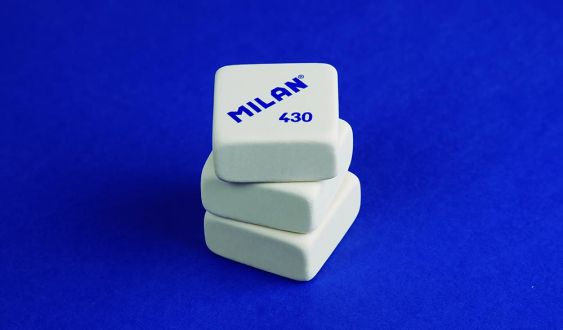
Although with the rise of computing we write less and less by hand, the brand of erasers and stationery items enjoys enviable health. The mythical classic MILAN 430 eraser - which we have all used more than once in its white, pink or green variant - turned one hundred years old this 2018 and continues to be the company's best-selling model, of which they produce 20 million a year that are sold in more than 110 countries, including Mexico, Vietnam, Japan, Chile, Russia, the United States, Madagascar or Mongolia; an international journey that began with the first exports of the product in the fifties.
"An eraser, well preserved, can last up to twenty years," explains David Marcó, general director of the MILAN group. The key, in part, is that since its inception, the MILAN 430 eraser has been made with soft synthetic rubber. Its effectiveness in erasing, however, depends on other external factors, such as the type of lead to be erased (soft leads such as 2B or B are always easier to erase), the pressure of writing, or the quality of the paper.
On the other hand, MILAN also has other successful items produced in Mont-ras (Baix Empordà). Among these products are the MILAN nata 624 - the first eraser made in Europe from plastic resin and covered with pink cellophane - or one of the recent successes: the eraser-sharpener for pencils. We also find the Master Gum 1420, capable of erasing graphite by simple adsorption with the contact of the eraser, and the classic eraser called Gigante, for industrial use, continues to be manufactured.
Currently, the company distributes and markets more than 3,000 product references and accessories for school use and has registered more than seventy proprietary designs developed by its R&D department.
The business initiative emerged during the First World War, when the great-grandfather of the current managing generation, Santiago Marcó y Pomar, son of teacher parents and educated by his uncle, master Avel·lí Serra, after working in the cork industry, dedicated himself to commercializing accessories and spare parts for this industry.EASTERN EUROPE, A STRATEGIC MARKET
As of November 1989, exports to Eastern European countries could begin, and in 2005 the company created the MILAN POLSKA subsidiary. "The decision was made due to the great potential we saw in the area, and Poland has been established as a strategic point of operations for the Eastern European area," explains David Marcó. In this way, the company continues its international expansion.
With a turnover from a wide variety of items that in 2017 amounted to some 27 million euros, the eraser market represents around 20%. Proof of this is that the Baix Empordà company manufactures up to 200 different models of erasers and 2,500 tons of rubber leave the Mont-ras factory annually. 75% of the erasers, moreover, are exported. A complete success. But, like all successes, they want to be imitated, and as new developments emerge, copies and counterfeits also arise. Like the oval-shaped "cat's tongue" erasers, of which MILAN was the first world manufacturer around 1950 and, currently, its shape continues to be imitated by other manufacturers.
HISTORY LINKED TO THE TERRITORY
MILAN is currently managed by the fourth generation, and today the brand is marketed by Facts SA, also from Mont-ras.
The business initiative arose during the First World War, when the great-grandfather of the current managing generation, Santiago Marcó y Pomar, son of teacher parents and educated by his uncle, the teacher Avel·lí Serra, after working in the cork industry, dedicated himself to marketing accessories and spare parts for this industry. Thus, he met the English chemist Mr. Ralph Somers in Palamós, who gave him some formulas to produce ink, sealing wax, glue and erasers. Manufacturing these items began the industrial initiative.
Santiago Marcó's initial workshop, in 1918, was located in the town of Palafrugell, and it was not until the second generation, with Josep Marcó Dachs at the helm, that they settled in Mont-ras, the neighboring town, where they could have more space for the factory (the business had already consolidated) and more possibilities for expansion in a suitable industrial area. "Currently, to be able to grow, we must find engineers, mechanics and computer scientists who adapt to the sector, which is increasingly technified," explain the company.
Since the invention and commercialization in 1770 of what is considered the first eraser by Edward Nairme -made of natural rubber- the sector has evolved, but its improvement is still an indispensable task. MILAN follows suit.
Add The New Barcelona Post as your preferred Google source for free
Stay informed with the latest news.