The nature of work evolves as the social use of the internet does; especially, positions related to Marketing and communication, which have found in the digital realm a clear field to grow and branch out. At least, this is the labor trend summarized in the study 'Top 25 Digital Professions 2018' prepared by the business school Inesdi, from Barcelona.
"Lately we have 20% of offers that we cannot fill, as there is not enough talent prepared for the demanded specialties: the position that is most difficult for us to fill is that of digital analyst"The study uses 313 offers published in the Inesdi job board –and managed by Indigital Advanced–, to draw a labor map within the digital environment, define which profiles are most demanded by companies in the last 12 months and, incidentally, illustrate students in the complex art of finding professional opportunities. The challenge is not easy, but there are still virgin labor fields and others happily fertile.
As Joana Sánchez, president of Inesdi, explains, among the former, data analysis stands out: "Lately we have 20% of offers that we cannot fill, as there is not enough talent prepared for the demanded specialties. The position that costs us the most is that of digital analyst; we have very few people prepared there – also as a country – and many times we need to look for them outside our borders."
On the other hand, among the positions that are filled, that of Digital Marketing Manager strongly stands out: "It is by far the most demanded by companies offering in our job board," says Joana Sánchez. "Any business is impacted by its customers, and these have now modified their consumption and relationship habits. While before you sought business with traditional media, now you need to attract consumers online. That is the reason why the figure of the Digital Marketing Manager has grown so much," Sánchez reflects.
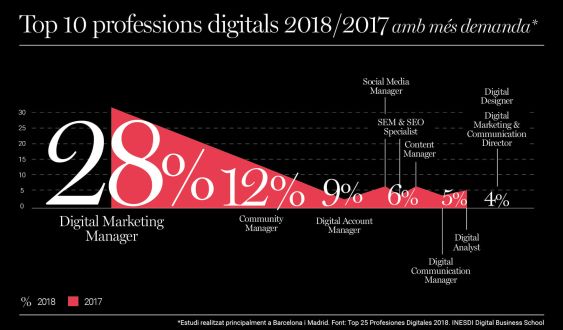
"In recent years we have seen a high specialization of professions related to the digital field. For example, 6 years ago the Community Manager was asked to do everything, but now a position like the Social Media Manager has appeared who designs the strategic part while the Community Manager takes care of the more operational part"The Marketing Manager position accounts for 28% of offers, 16 points ahead of the next one. Its function involves designing the company's digital strategy, choosing where investments are made in both advertising and the 2.0 ecosystem –should a website be created? is an app needed?– and detecting consumption trends in the internet era, a consumption heavily conditioned by the fragmented public. In commercial terms, users are bundles of dispersed and interpretable data. Categorizable.
That dispersion invites to serve the product in a segmented/personalized way, which modifies and broadens the labor market. Joana Sánchez tells it: "In recent years we have seen a high specialization of professions related to the digital field. For example, 6 years ago the figure of the Community Manager was asked for everything, but now a position like the Social Media Manager has appeared who designs the strategic part while the Community Manager takes care of the more operational part".
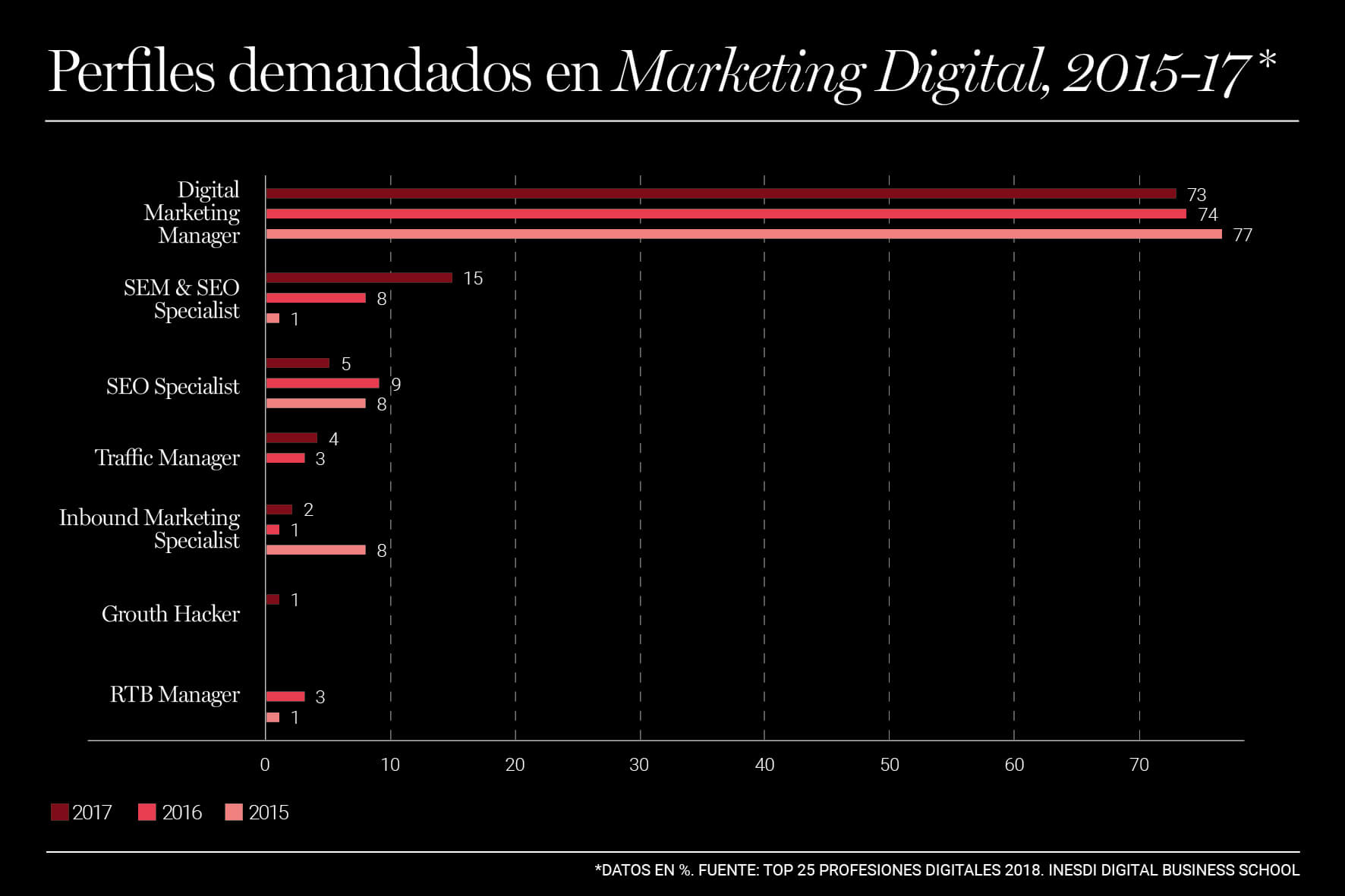
The director of Inesdi values this specialization as a trend within Digital Marketing, but not the only one: "I would say that in all Marketing strategies, advertising is falling and in return the figure of the Growth Hacker is gaining weight, a position that holds knowledge of natural positioning and technology. Currently, attraction is worked on more than digital advertising. Likewise, I would say that in cases where advertising is still explored, audiovisual has entered as a very clear trend".
In this context, the rise of attraction Marketing has given flight to professions very focused on content, such as the Community Manager, who ranks below the position of Digital Marketing manager in the list prepared by the Inesdi business school. A few points below appear those of Digital Account Manager (9%), Social Media Manager (6%), Sem & SEO Specialist (6%) and Content Manager (6%), a job often filled by recycled journalists. It is no coincidence: it happens that some certainly unstable professions – such as that of a journalist – have found in Marketing a foothold to cling to to stay afloat. Does this mean that the world we live in is being marketized?
Joana Sánchez replies: "I don't think so, in any case it is being digitized, because almost everything we do goes through the internet. Silvia Leal, doctor in Sociology, says that in 2020 we will talk more with chatbots than with our partners. The digital world has imposed itself for better or worse, it has favored the emergence of new labor and social opportunities, but it has also dehumanized relationships a bit. The more technology surrounds us, the more humanization there must be, and in this sense it is interesting that humanistic professions are incorporated into the digital world".
One door through which non-commercial professions can enter is Human Resources. Certain profiles such as Employer Branding or Recruitment Researcher, clearly influenced by Psychology or Sociology, have a significant scope of action on the internet. The negative? Companies are starting to entrust recruitment positions to robots: "Unilever already does it, it has a totally digital recruitment system that relies on artificial intelligence to select its future employees," explains Sánchez.
The massive Facebook leak and the Cambridge Analytica case have fueled the debate on the protection of our digital identity, often auctioned off – with automated consent – in the great bazaar of the internet. But how does the need for protection combine with the unstoppable rise of Marketing?It is one of the current fears, that dystopia according to which robots will take over human jobs. Although there are clues to think that this scenario is not entirely illusory, the director of Inesdi has reasons to face it with optimism: "From now until 2020, 40% of a company's tasks will be automated. Jobs will disappear, of course, but we will need others in their place. An example: a couple of weeks ago, the first staff-less bookstore opened in Beijing, operated only by robots. There are no humans attending, but there are many people behind the artificial intelligence developing it, analyzing data, doing digital marketing. Evidently, certain jobs will become robotized, however, we will need other professions that are behind the machines," Sánchez predicts.
There is a second misgiving linked to the profusion of digital systems, and it has to do with the misuse of personal data. The massive Facebook leak and the Cambridge Analytica case have fueled the debate on the protection of our digital identity, often auctioned off –with automated consent– in the great bazaar of the internet. But how does the need for protection combine with the unstoppable rise of Marketing? Difficult: "One of the positions that is growing the most is that of cybersecurity expert, how we protect our data from attacks perpetrated by hackers. This contrasts with the need to be able to see and interpret that data, so in a school like Inesdi, with postgraduate degrees in Cybersecurity and Marketing, we live in a permanent duality," laments Joana Sánchez.
In summary, the labor market in the digital environment lives in a permanent tension that has not been resolved, among other things, because it is not convenient. Invisible data is useless in commercial terms, but total –and surreptitious– exposure dissuades most users from participating in the digital circuit. In the end, a kind of lucrative chaos prevails, resulting in a series of novel and very specific positions, functions that, as we said at the beginning, offer clear opportunities in a frequently obstructed labor landscape.
Add The New Barcelona Post as your preferred Google source for free
Stay informed with the latest news.