[dropcap letter="P"]
laya de la Barceloneta, eight thirty in the evening. It's summer, the sun doesn't want to leave and the sand is still full of bathers, mostly Mediterranean tourists, the most lingering ones. The caravan of street vendors of fans, beer-water-coca-cola, mojitos and massages, makes its last rounds, while in the water, three wild ones fool around with jet skis.
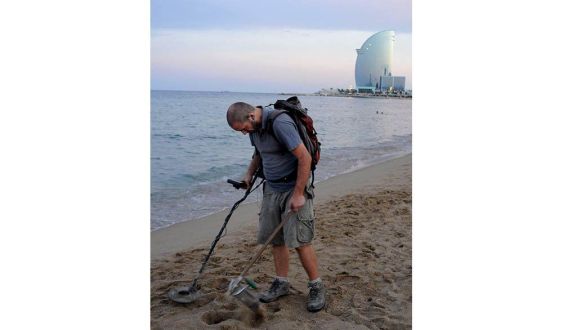
As every day at this time, Andrés begins to work: he takes out the metal detector and starts scanning the sand, dodging the groups of young people who are having their last one. He wears headphones connected to the device, so we don't hear the bip-bip-bip-bip! that indicates a find. He has it all figured out: with one hand he holds the detector, and with the other he wields a stick attached to a kind of perforated pot – an IKEA cutlery drainer – that allows him to dig the sand without bending down and sift it until the treasure appears. In the time we chat, he will find a euro coin, three pieces of unusable metal – possibly can remains – and a thick, pointed nail, which he will quickly put in a bag to throw away when he finishes.
He tells me that he is actually a cook, that two years ago he started scanning the beach and has become fond of it. That this doesn't provide much, but it's a fun outdoor hobby. He says he has found everything, from people who have lost their keys – he has a full jar at home – to coins from all countries: the last one, from Japan, he gave to his daughter, a manga fan. He has also found needles, syringes and, among the rarities, bullet casings and metal condom boxes. And from time to time, some jewelry. He says that each metal sounds different, and on May 1st, when Barceloneta was not yet the hotbed it is now, he noticed a celestial sound through the headphones. It turned out to be a double-turn gold ring: at first he thought it would be a trinket, but it turned out to be 7 grams of gold, a resounding bonus. But well, he usually doesn't make more than 4 or 5 euros an hour, and he couldn't live on that. The one who does live on that, he tells me, is the Russian who sweeps Sant Sebastià beach, a few meters away.
I find him tracking the sand among the small colony of resistant nudists. He is well equipped, with a Coronel Tapioca vest full of compartments: a pocket for coins, another for jewelry, etcetera. He tells me his name is Alex and that he was born in deep Russia, when I ask him the exact place he says "bah, you won't remember either". He says he lives off this, that he comes from L'Hospitalet every day and spends about 12 hours running the machine –playing the snake, he says– to get about 30-40 euros daily. That there are 4 or 5 doing it in all of Barcelona, and they already have the beaches divided up. He assures me that the best area is this one and that of the Vila Olímpica nightclubs, because at night the sand is full of couples groping each other and they literally lose everything. I ask about his detector, which seems better than the cook's. He says it cost him 1,500 euros and that it could find metals underwater and everything. Of course, when I ask him what is the most valuable thing he has ever found, he mysteriously falls silent and ends the conversation.
Later, doing research, I will discover why: the law is not entirely clear with finds on the beach, and in some cases the police have prosecuted for "misappropriation" the detectors who resell the loot.
Featured image: Man searches for silver and gold objects with a metal detector on Barceloneta beach. Photo by fototext / Alamy Stock Photo
Add The New Barcelona Post as your preferred Google source for free
Stay informed with the latest news.