Literature on track: Samanta Schweblin wins the first Aena Award

Samansa Schweblin
Samansa Schweblin
(Journalist, legal-aeronautical consultant and writer)
april 13, 2026 - 15:33
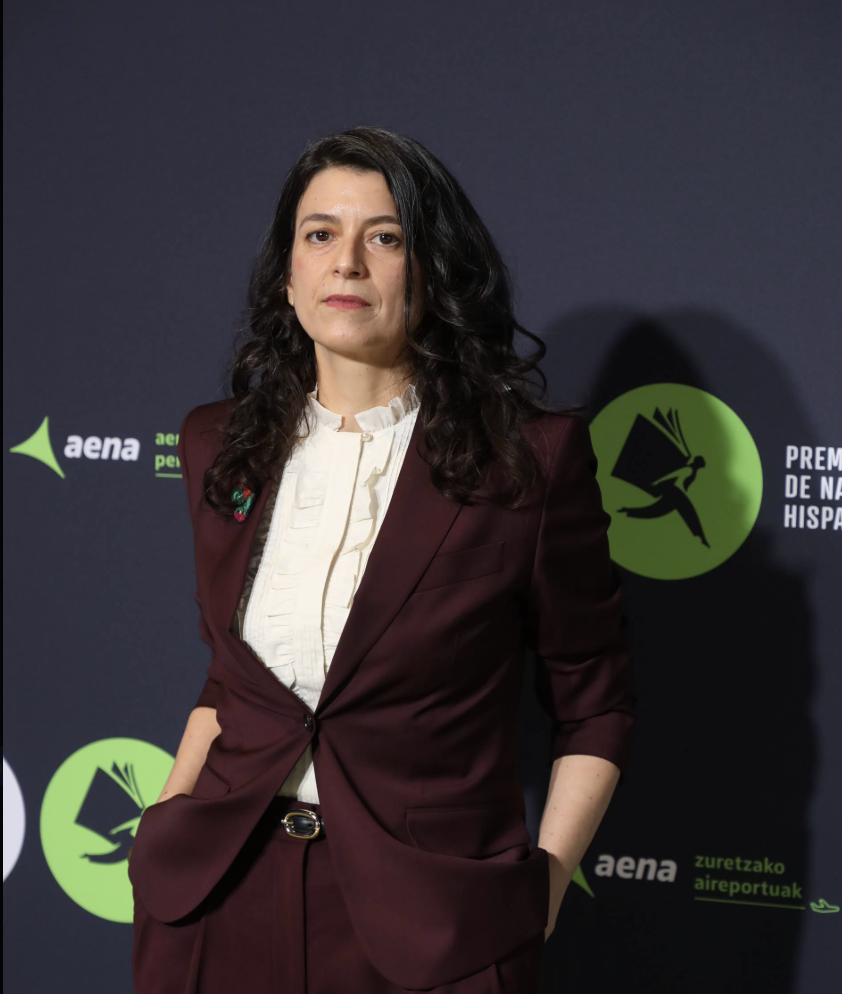
After ten at night, under the vaults of the Drassanes Reials of the Maritime Museum, Samanta Schweblin gets up from her table with the face of someone who had just gotten off a Russian roulette… but in a positive way. El buen mal (Seix Barral), his book of short stories about family solitudes and everyday monsters, had just won the I Aena Hispano-American Narrative Prize and, incidentally, the most talked-about million euros in recent Spanish literature. Rosa Montero, president of the jury, opens the envelope and the room responds as expected in these cases: with a long, almost liberating applause. The rest of the finalists have seen their mathematical 20% chance of winning disappear. Vila-Matas, Giralt Torrente, Fernández and Abad Faciolince remained seated at their tables, although they automatically also won 30,000 euros, the prize awarded to the four who were left at the gates. The 48-year-old Argentine writer has unreservedly admitted: "I am in shock." And immediately she found the tone: "Those of us who write short stories run a bit lame… today this award takes its first step by rewarding the exception." Then, paraphrasing the poet Wisława Szymborska, she concluded with an idea that lingered in the air, where she recalled how strange it is to celebrate literature while the world is out of balance and with many wars: "Worse than starting to read and write at a time like this would be not starting to read and write at a time like this."
Schweblin: "Instead of looking for more stories, I read the same three books over and over again. I went a little crazy."
The winner recalled her summer at 12 years old: her mother gave her an anthology of Kafka and her grandfather The Martian Chronicles, by Bradbury and Cortázar: "Instead of looking for more stories, I read the same three books over and over again. I went a little crazy. I loved that moment." Wednesday night accompanies. And the place, too. The Drassanes Reials have something that prevents one from getting used to them: they always impress. There, Aena has decided to further deploy its cultural commitment. Its president, Maurici Lucena, has said it bluntly: the intention is for the award to stay in Barcelona and have continuity. He has also defended the role of corporate patronage with a simple idea: "in imperfect societies, it makes sense for companies to contribute, even if it is not their main activity," he said. Also recalling the public part of the airport operator (the state holds 51% of the shares), he recalled that as a great reader, the Minister of Transport Óscar Puente, asked that the criterion for awarding the prize be solely literary and that there could not be the slightest suspicion of anything else when delivering it.
"80% of literary production in Spanish is published in Barcelona"
President Salvador Illa has closed the gala with a more emotional tone: "In difficult times we cannot do things against culture, because it is what we are. Bombs always end up disappearing and then it comes to light that books are another kind of foundation." He also recalled a fact that explains many things: 80% of Spanish literary production is published in Barcelona.
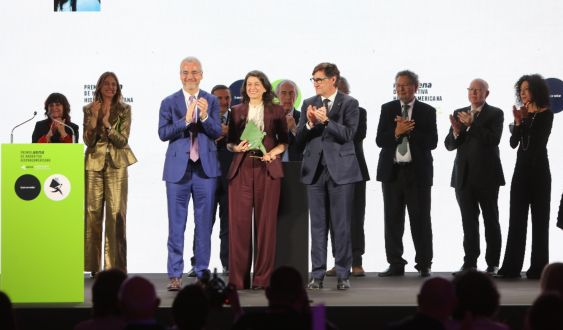
The president of Aena, Maurici Lucena, and the executive vice-president, Javier Marín, accompanied by the president of Catalonia, Salvador Illa, and different authorities.
One of the successes of the night was the set design, signed by art director Vanesa de la Haza and produced by La Tropa. The Andalusian, experienced in the world of cinema, created five scenarios distributed throughout the room, each dedicated to a finalist work. An agile proposal of five moments that present the finalist books. There has been a monologue by actress Nieves Soria giving voice to grandmother Josefina from Los ilusionistas, by Marcos Giralt Torrente. Piano music has played with the piece that Álex Gassent specifically created inspired by Schweblin's El buen mal; playwright and actress Lola Blasco has embodied Ryo in Canon de Cámara Oscura, the work by Enrique Vila-Matas; there has been live drawing by Patricio Hidalgo to remember Marciano, by Nona Fernández; and the choreography by Alina Sokulska has been danced, bringing to the stage the pain of war in Ahora y en la hora, the text by Héctor Abad Faciolince. Each of these moments was a presentation of a book that made one want to keep exploring. There was a desire to keep learning about the stories, because nothing has been prolonged more than necessary. Everything has flowed with a naturalness uncommon in this type of event. The presenters, Josep Cuní and Martina Klein, have worked in that balance between professionalism and closeness. And the tables, baptized with names of Aena network airports (Barajas, El Prat, Almeria, Vigo, Palma…), have added a nod that connected the world of aviation with that of books.
Samanta Schweblin © AENA
In the room, diverse profiles have mingled: politics, business, culture, law, and media. Barcelona, Spain, and Latin America, under the same roof. And, as befits a weekday night, everything ended at a reasonable hour. There is a detail that well explains the ambition of the project: in addition to the million for the winner and 30,000 euros for each finalist, Aena will buy copies of the five works worth more than another million euros. It will distribute them among its more than 11,000 employees and donate them to libraries and cultural institutions in the places where it operates. In Spain alone, it has 46 airports and two heliports. Although Aena already has an aeronautical cultural center next to the corporate terminal of Barcelona-El Prat airport, the symbolic weight of this first edition called for a setting like Drassanes. It had it. It was, in essence, a good night for an Argentine author and also for Barcelona. A night of literature, well-structured and without fanfare in the city of books. Just the kind of story that fits the spirit of our beloved The New Barcelona Post. From now on, when someone says "Aena," they might not only think of runways and terminals but also of books. In a cultural project that, added to its support for the Liceu, the Teatro Real, or the Taller de Músics with its scholarships, is beginning to take recognizable shape. Lucena summarized it in an aspiration for the award that premiered yesterday: "may this prize become something similar to the Booker or the Goncourt." For now, the first step has already been taken. And it sounds (or reads) good.

Add The New Barcelona Post as your preferred Google source for free

Stay informed with the latest news.
Activate now

About the author

Javier Ortega Figueiral

Journalist, legal-aeronautical consultant and writer

View biography