I disagree with the Castle housing a casino, but those are just unfounded wishes: the maintenance of the heritage and the festival must be financed from somewhere. The Easter edition of the Festival, on Passion Day, has been a kind of covert inauguration: like a secret, a mystery, a vigil of the true meaning of all this. We already know that silence is not the absence of sound, but few contemporary composers understand it as well as Bernat Vivancos. In this choral work of liturgical, mystical, and earthly roots all at once, it doesn't seem like we are witnessing so much a composition as an experience of spiritual immersion. A rite. A slow fall into the depth of the sacred.
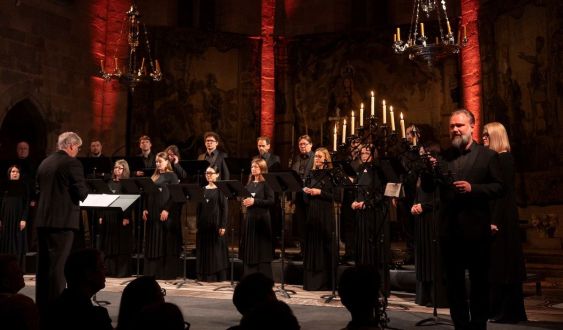
In the chapel of Carme, enveloped by the gloom of the stone (lightly illuminated with blood) and the nine candles of the candelabrum that were extinguished as each responsory ended, the pieces that make up this new great work by the Barcelona composer unfolded the three central days of the Paschal Triduum: Holy Thursday, Good Friday, and Holy Saturday. Three days of mourning, rupture, and waiting, musically reflected with austere elegance and contained tension. There was no explicit scenography or dramaturgy, but there was an internal theatricality in each pause, in each choral inhalation, in each word pronounced in Latin as if it were the first time it was spoken.
Vivancos, who as a child participated as a choirboy of Montserrat in recordings of Tomás Luis de Victoria's responsories, had dreamed of writing his own version. And he has done so from the artistic maturity of a creator who has nourished himself with Gregorian chant, monastic mysticism, Western modality, and Nordic spectral sound learned in Oslo. The result is a monument of harmonic homogeneity, which rises not by its grandiloquence, but by its purity. "If I didn't believe, I would never have considered writing a work like this," says Vivancos, noting that his spirituality is more essential than confessional.
The interpretation was performed by the Latvian Radio Choir, an elite ensemble directed by Sigvards Kļava making its debut at the festival. It is difficult to do justice to the timbral perfection (captured from the first note) of this choir: they sigh the chords, they breathe them in resonance, they carry them in their blood. With almost surgical precision and dynamic plasticity that oscillated between murmur and exclamation, they made every movement of the program shine, from the first Amicus meus to the last Sepulto Domino, passing through the chilling rawness of Tenebrae factae sun or the melodic abyss of Caligaverunt oculi mei.
The Catalan translations of the biblical texts, at the bottom of the program, helped the viewer delve into the poetic and theological charge of words that cry out, that question, that lament. "Oh, you who pass by the way, look and see if there is any sorrow like mine," reads one of the passages. It was not only the voice of Christ: it was that of any human being traversing the night.
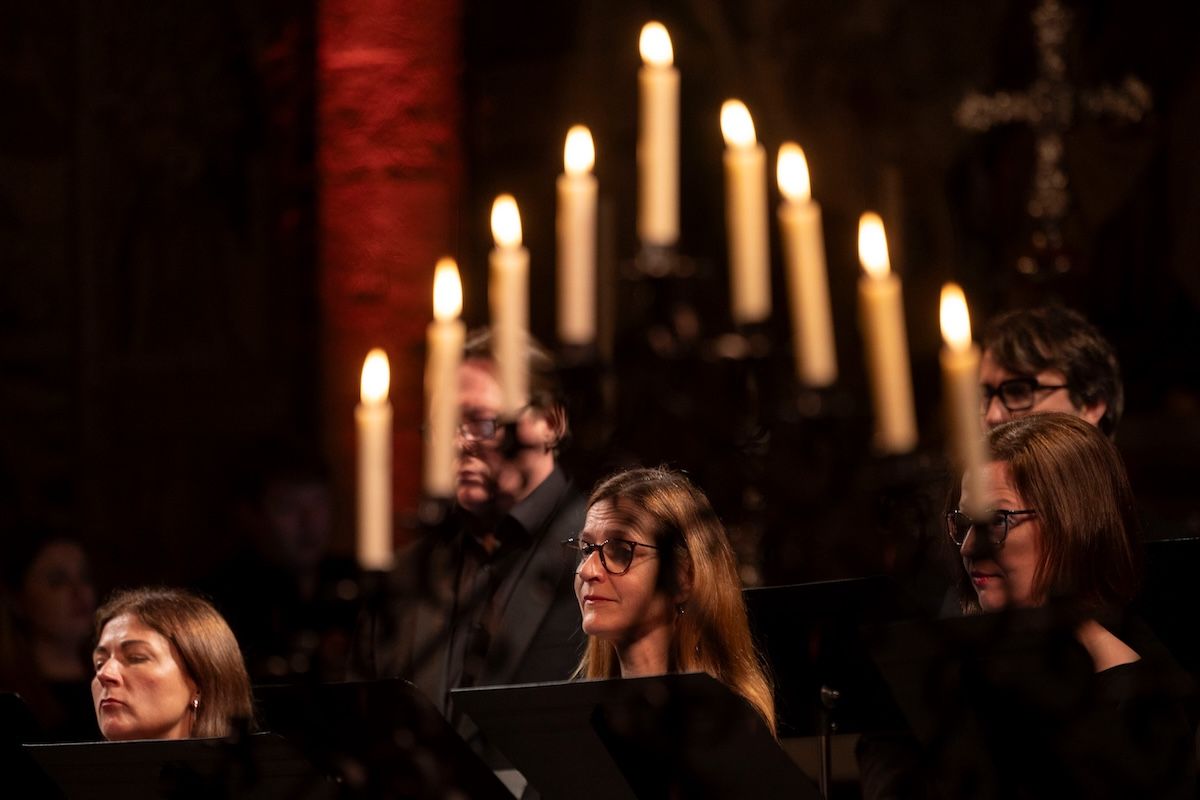
This concert was not just a musical event: it was an act of aesthetic faith. A celebration of that space where music ceases to be entertainment and becomes liturgy. The hall, in sepulchral silence, received the last note as one welcomes a revelation. And only after the final, resounding, naked, accusing absolute darkness, a long applause like a responsory that is never quite enough but is felt in the heights.
Vivancos has written a sonorous silence, a spiritual architecture made of echo and absence. Perelada, with the good work of Oriol Aguilà, has known how to welcome it as it deserves: with respect, with emotion and with a peace that promises us a luminous end to the story just before we eat the mona.
Add The New Barcelona Post as your preferred Google source for free
Stay informed with the latest news.
