
Karl Ove Knausgård (Oslo, 1968) returns with The Morning Star (Anagrama), an extensive novel in which different characters face something unexpected and almost supernatural: the appearance of an enormous red star in the sky of a hot August. After My Struggle and the Seasons Quartet, the Norwegian writer faces a new cycle, this time, "inscribed in what could be called fiction, fiction, whatever that may be," explains Anagrama's editorial director, Silvia Sesé, "with a captivating and fascinating first novel."
"When you write about yourself, you have obligations to yourself and the people around you. There are many things you cannot write about. Fiction is different, you have more freedom, but it is much more difficult: you have to invent everything," explains Karl Ove Knausgård. "It's more fun because it's more like what I feel when I read," says an author who wanted to recapture in this novel the sensations he had as a young man when he discovered science fiction through Ursula K. Le Guin. "That's when I realized I wanted to be a writer," he confesses.
Furthermore, he assures that he will not return to autofiction after the overwhelming success of My Struggle, a prose experiment, as he defines it, in which he only had the premise of being sincere, but which attracted a lot of attention and even led journalists to the doors of the homes of friends who appeared in the novels. "If I had known what would happen, I wouldn't have done it," he admits.
Having overcome the autobiographical literary episode, The Morning Star is built around "a central element that disorients the characters," each one contributing different reactions, from indifference to the deepest introspection, with their stories intertwining, even giving each other spoilers. "The characters see the same thing, but experience it differently," he emphasizes. It is not surprising that this novel was being written when the pandemic broke out, which has not disrupted the plot, but has influenced the atmosphere.
"We believe we know everything," warns Knausgård, testing that dogma by making a star appear that is not known whether it is God, evil, or nature, but which is accompanied by sudden strange behaviors in animals, from crabs invading roads and ladybugs overpopulating terraces to deer approaching humans. "We have turned our backs on nature," he laments, this being the central idea of a novel that did not want to speak directly about climate change, although its threat is felt as if a great star suddenly appeared above us: "The climate crisis is the most relevant issue we face. But if I had written about it, I know about the subject, you do too, we all know about it, but we do nothing." The writer did not want to show what he thinks about global warming, only to propose a fiction, because, as he argues, "being a writer is not being a prophet, my opinions are worth no more than those of others."
In this Norway that The Morning Star imagines, religion is constantly present, whether from the point of view of the pastor Kathrine or from that of a university professor like Arne. Biblical stories are reproduced literally and alluded to, with Egil representing a modern Abraham, in his struggle between his freedom and the duty to be a father. It even includes the story of a religion dedicated to the devil that existed in Knausgård's home country in the 90s, which burned churches and committed crimes, reflected through young musicians who have been savagely murdered.
Philosophical reflections are also present, intruding into a narrative of the everyday characterized by being unsparingly prolific, with almost 800 pages that, despite the quantity, are read mechanically, with great ease. The writer Karl Ove Knausgård stretches fiction, including everything from song lyrics to poems and, of course, fragments of the Bible. As a culmination, the novel closes with an essay written by one of its characters, in which the narrative is eventually returned to, leaving one wanting to continue reading the next title in the new saga.
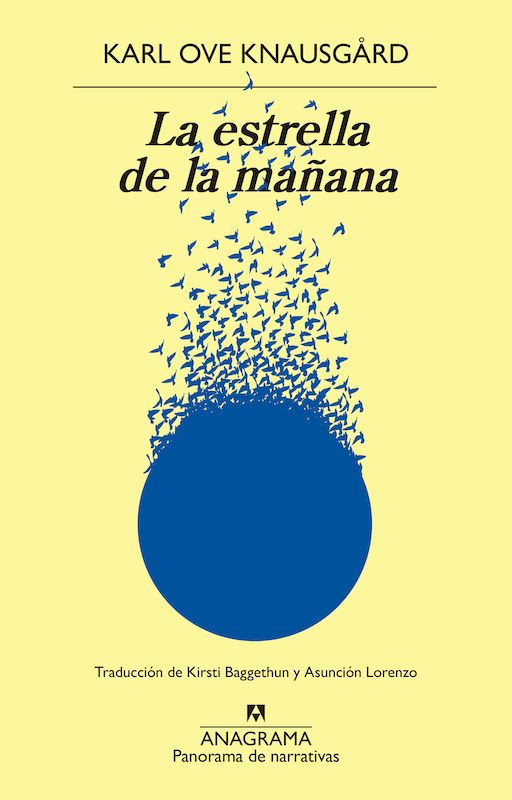
According to its author, in the next book there will be forests. Karl Ove Knausgård foresees that the saga, always with the mistreatment of nature in the background, will consist of six volumes, although that number has varied: "At first it was going to be one. Then, three, and later, five. But there will be six." The first three are already written and published in Norway, and now they are starting to arrive in Spain. Some details already known about the books to come are that the one he is writing now, the fourth, is set in London in 1986, after he moved to the British capital a few years ago, and the next one, in Russia. "I needed to get away from Norway, but I always end up being a little bit myself in London or Russia," he points out.
A creative frenzy that does not stop, based on writing and writing, doing 20 pages a day and focusing only on what is on the paper. "If you start thinking about how people are going to react, you can't write," he argues, recalling how before My Struggle he had only published two books and, afterwards, 15 have come. "For years I had a block and I ended up with 800 pages of beginnings that I discarded," he confesses, "what I want to do is write and publish, I write one book and then another." "For me, the important thing is to create. If I could paint, I would paint, but I am good with words and I am a writer," he adds.
Add The New Barcelona Post as your preferred Google source for free
Stay informed with the latest news.
