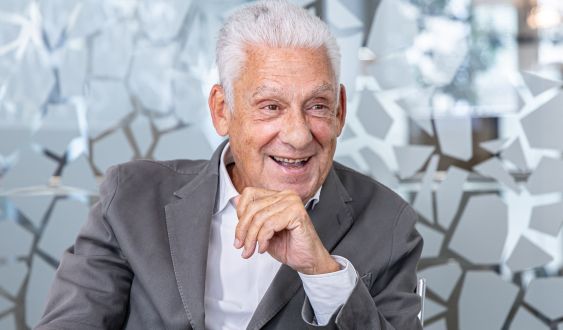
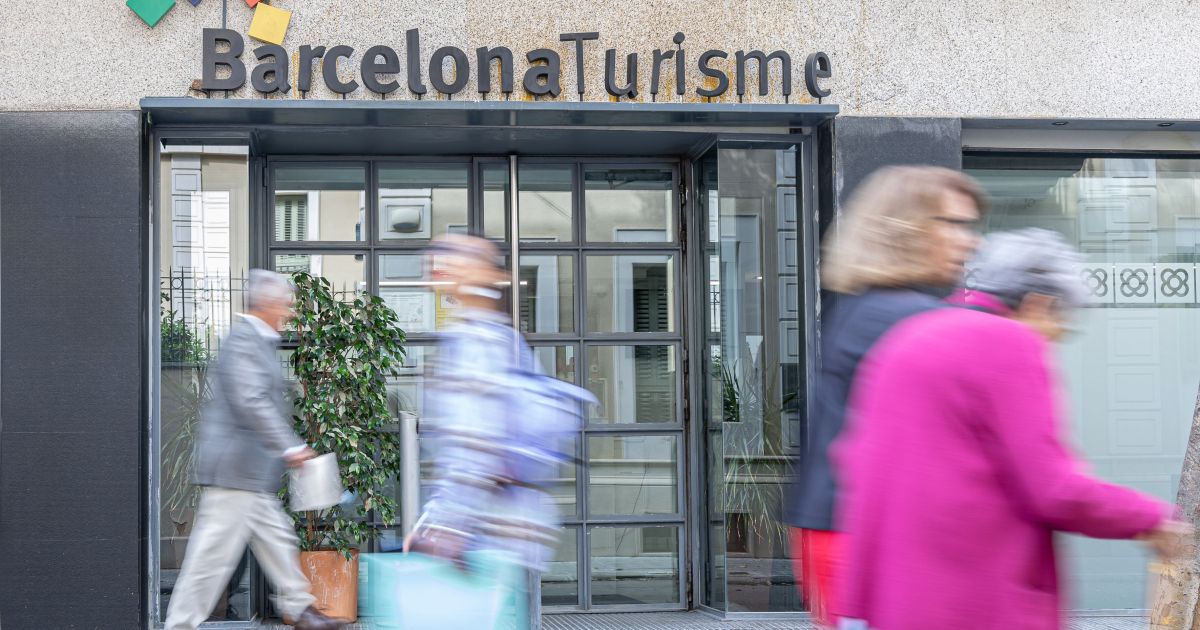
Jordi Clos (Barcelona, 1950) is one of the figures who best explain Barcelona's transformation in recent decades. Hotelier, president of Turisme de Barcelona and founder of Derby Hotels Collection, Clos actively participated in the construction of pre-Olympic Barcelona, which decided to open up to the world through tourism, congresses and culture. Patron and passionate about Egyptology —he is also the promoter of the Egyptian Museum of Barcelona—, he defends that tourism has been key to the city's international projection and economic progress. He is also one of those Barcelonians who love Barcelona almost as their own work. Perhaps that is why, when we ask him if the city could live without tourism, it is clear that the answer, in part, also speaks of himself.
— Could Barcelona live without tourism?
— To answer, we have to go back to the history of Barcelona. Barcelona, before the Olympic Games and even before, was a semi-industrial city. It was not like Bilbao, but it was a city where its economic power came from industry and from the industrial Poblenou. And in a very visionary way, Pasqual Maragall intuited that the future of cities would not involve depending economically only on industry. And he began to design and structure a change to transform that industrial Barcelona into something more.
— Diversify.
— And secure a future. Detroit is a very clear example. Detroit was a great automobile city, a gigantic industry; but when the automobile falls, they have no alternative, and what happens? It becomes a deserted city.
— And what was the alternative?
— We —and I say we because I participated very directly in this structural change— decided to bet on tourism, understanding, moreover, that you cannot destroy an economic model without creating another.
And we had the intuition that we had a city with a lot of future, even though at that time it still did not have a hotel structure, it was not open to the sea as it is now, it lacked a powerful fair to bet on MICE…
— When you speak in plural, who is that "we"?
— A series of people and entities that clearly bet on what Barcelona is today. There was the Hotel Guild, there was what used to be the Municipal Tourism Board —which is today's Turisme de Barcelona—, there was a series of congress and fair managers (infinitely smaller than they are now) and a series of sectors that clearly saw that the future involved having an open, creative and connected city.
It must be taken into account that at that time, and I am talking about the late eighties, Barcelona was already the most contemporary, most modern, most advanced in design city in southern Europe.
"Barcelona had four million overnight stays; today it has twenty."
— What were some of the first steps?
— Something unusual that had never been done in Barcelona, and even less so in Spain: we promoted a plan for the construction of the necessary hotels, with the support of the City Council on municipal land. Because if we wanted to be there, we had to exist. And that's how important hotels like the Hotel Plaza in Plaza España were born.
We are talking about a Barcelona that had 4 million annual overnight stays and now has 20 million. We are talking about a Barcelona where hotels closed on weekends because they were empty.
— Some people look with a certain nostalgia at that transformative stage of Barcelona... is that also your case?
— Picasso, in one of his history books, explains that when he saw and drew a painting or made a sculpture, he lived it with brutal intensity, he got up at midnight, went back to it, dreamed about it... but when he had done a thousand, the thousandth one was already part of his context, it was already sleeping.
The same thing happened here. We lived it that way when we created what was the first tourist association in Barcelona and we did a project, for example, with the 36 best hotels in Barcelona, to promote weekend tourism in the city.

We even carried out extraordinary campaigns like "Picasso Azul". We brought all of Picasso's blue paintings and held an international exhibition that we advertised throughout Europe and filled the hotels that were closing.
We believed in it. Nostalgia is what it is, and we really are what we are because we bet on it and wanted to be it.
"When you don't have it you want it, and when you have it you despise it."
— I was asking you about nostalgia because there are some who, from that nostalgia, harshly criticize the present, as if there were a lack of cohesion or strength.
— When you don't have it, you want it, and when you have it, you despise it.
— It's part of the human condition, then. For those who only see the negative externality, what do we owe to tourism?
— Without tourism, museums would be less than half of what they are now. We wouldn't be able to be so well connected with 60 or 70 direct destinations from Barcelona. We wouldn't have all those international congresses and meetings that come from around the world. Do you think companies like AstraZeneca would have come to Barcelona without this international connectivity and without the city's global positioning? Impossible. Or that we would have this high-level dining, or the shops on Passeig de Gràcia or Fira de Barcelona? All of that is part of the same ecosystem.
— I'll turn the question around: what sectors would suffer if we reduced tourism?
— Practically all sectors: commerce, restaurants, culture, air connectivity, fairs, congresses... Tourism represents around 13% of the economy and generates about 160,000 jobs. And I'm not just talking about hotels: it also affects pharmaceuticals, research, restaurants, luxury…
— The city of Barcelona received 16 million tourists in 2025, and it's 26 million if we count the Barcelona region itself. Have we reached a ceiling? Where is the limit?
— I believe we have already set the ceiling. Both the sector and the City Council have understood that the city has a certain capacity and that now the priority is to manage it well.
— How does that translate?
— With concrete measures. The PEUAT limited hotel growth. Port cruises went from seven to five. We have also changed the promotion strategy: we want less quantity and more quality. In recent years, we have slightly lowered occupancy, but we have increased the average price. That means we are changing the visitor profile.
"Barcelona competes with many cities to attract large international congresses, and that is no coincidence."
— What visitor profile is being targeted?
— Cultural tourism and especially MICE tourism: congresses, fairs, conventions. It is a visitor who brings a lot of added value, spends more and has less impact on public space.
— And how do you find this visitor?
— Barcelona competes with many cities to attract large international congresses, and that is no coincidence. There is a very powerful strategy from the Convention Bureau and a very close collaboration with the City Council.
— What role does the tourist tax play in this management?
— It has a dual role. On the one hand, it serves as a certain limit for some tourists. We are the second most expensive city in Europe in terms of tourist tax, and that surely affects the visitor's profile. But above all, with the tourist tax we can give things back to civil society. It serves, for example, to put air conditioning in Barcelona's nursery schools. Or for example, recently the City Council has created a fund to build 4,000 social housing units that come from the contribution of this tax.
"The Sagrada Família is the Taj Mahal of Barcelona."
— How can this sector recover its reputation?
— With management —which is being done— and with narrative, which is also being done. Turisme de Barcelona, and with the unanimous agreement of the City Council, we have created a reputation strategy to explain the added values that this tourism represents for the city and what would be the consequence of not having it. We can be very proud of what we have. We are not aware, for example, that we have the Taj Mahal of Barcelona, the Sagrada Família. It's like someone who has a Louvre. These are unique things in the world.
— Barcelona lives a very critical narrative with tourism: is it a consequence of a reality or of orchestrated discourses?
— I believe that from a cigarette butt that possibly had fire, a great fire was created. At a certain moment, it was politically interesting to increase and grow this situation. Because this tourismophobia that was created here has never existed in Madrid, nor in Malaga, nor in Seville, nor in London, nor in Paris. But here it was politically interesting to promote and increase it. And then what happens is that when this ignites, it is very difficult to put it out afterwards.
— Or even if you put it out, the ashes remain.
— Yes, and you have to keep cleaning them.
— Finish the sentence for me and, with this, we close Tourism Week: "Without tourism, Barcelona today would not be…"
— Without tourism, Barcelona today would not be the great city it is.
Add The New Barcelona Post as your preferred Google source for free
Stay informed with the latest news.