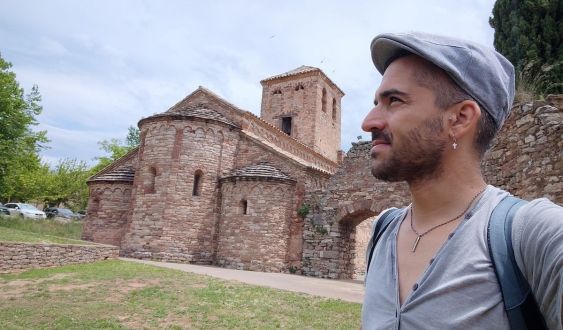
He still remembers the impact of the Sagrada Família or the statue of Columbus when, as a child, his father would come from Sant Boi to the city with him and his brothers to go to the cinema. He opens his eyes wide, visualizing those shapes and colors that left him mesmerized, that stayed with him, mentally following the lines and forms of an infinite Gaudí that continues to enchant him.
Joan Pau Inarejos sips a drink of Moritz. The notes of the Beatles' I've just seen a face —a passion shared by all members of a family as numerous as it is joyfully diverse— crackle in the evening atmosphere of the Bar. He smiles at the imminence of a good conversation: an art he likes to nourish with a broad culture, a good dose of irony, and an extensive and precise lexicon. An exchange where everyone learns and has fun.
"I studied journalism almost by exclusion of other disciplines more linked to art, although with less job prospects. But I also did it guided by my love for explaining and disseminating what I like." Even as a child, he surprised his school teachers with his informative art essays. "Of course, I have never claimed to be an academic," clarifies someone who understands the exchange of knowledge as an act of enjoyment.
That's why, in addition to his work in radio, television, and digital media, this journalist, announcer, scriptwriter, and art popularizer added, in 2023, the @romàniccatalà account: a space through which he carries out an invaluable work of disseminating an art form as deeply rooted in our history as it is unknown to the general public. "Even when, at the beginning of the last century, the bourgeoisie brought Romanesque pieces recovered from the rural environment to Barcelona, they did not know how to appreciate them. And that was a Catholic bourgeoisie! But their tastes and background were more linked to Central European Gothic imagery, and they did not fully understand the colors and forms of that art so much our own. It was an impact, at the same level as what the innovation of Modernism meant, in another register."
To help remedy the widespread ignorance about Romanesque art, the parishioner uses a multitude of resources: from memes, to anecdotes and analysis, always with a playful tone capable of pleasing experts and laypeople alike. Something that allows him to reach very diverse people "and feed my anthropological gossip, based on my interest in listening to what people from different backgrounds and environments say and, above all, how they say it."
The spirit of Montanelli
In the 1950s, the Italian journalist and intellectual Indro Montanelli wrote two series of articles for La Domenica del Corriere about the History of Classical Greece and the History of Rome. Due to the lighthearted and informative tone of those texts, various academics attacked him, accusing him of trivializing history. But today, three-quarters of a century later, those articles, which became books, are reference vehicles for approaching the history of these two civilizations, learning their essential aspects.
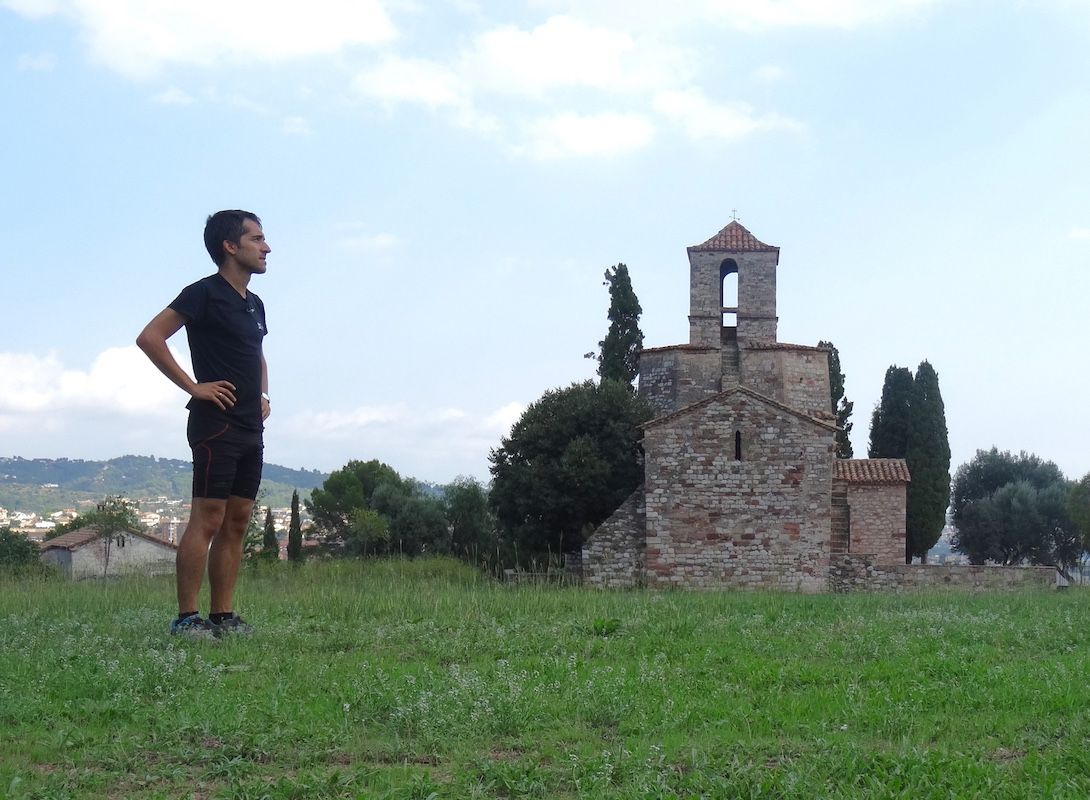
It is inevitable to think of Montanelli when reading Amb ulls de Romànic (Rosa dels Vents), the recently published book with which Joan Pau Inarejos explains the history and keys of Catalan Romanesque art, with a breadth of literary resources that make its reading the most enjoyable way to delve into a current that has its roots in the depths of our rural Middle Ages. A work that breathes and transmits, on every page, the author's passion for the subject.
"I have no vocation for adventure or an epic sense of life. I am happier reading and writing among books. And also with my family, who raised me with much love and who is my great vital reference point: a small society with many different colors," explains the person who has also developed a strong religious spirit over the years. "As a believer, I regret seeing how religion is very much alive in society, but totally deculturalized and often devoid of a humanist and dialogue-based approach without which, for me, no faith makes sense."
Capital of medieval art
In addition to his work as a journalist and popularizer, the parishioner collaborates with the MNAC, of which he praises the medieval art collection that, as could not be otherwise, he knows inside out. "Barcelona is the capital of medieval art. Here we have the best Romanesque art gallery in the world," he observes, saddened by the fact that this heritage is ignored by the majority of the population, who thus lose an important connection with their history, with their past.
"This is a fantastic city –he continues– and, although it is inevitable, as a Barcelonian, to feel a certain love-hate relationship with it, I cannot understand that exacerbated self-hatred of many people here. Their way of detesting their city." He finishes his beer. "I have been lucky enough to travel to many European cities, and like this one, for better or worse, there is none," he adds.
— Much of that self-hatred would be cured by trying the cuisine of this Bar, it's already dinner time and here we have everything, and very delicious.
Joan Pau Inarejos does not hesitate for a moment. "Well, some tapas sound good," he says. And with that, he orders another Moritz while the chords of In my life by his beloved Fab Four sweeten this interlude, before the conversation continues, delving into the night.
Add The New Barcelona Post as your preferred Google source for free
Stay informed with the latest news.
