“Back then, in Argentina, you could be arrested simply for how you looked. In fact, it was after a friend of mine was thrown in jail that I decided to board a ship bound for Europe. Shortly afterwards, I arrived in Paris with a hundred and fifty dollars in my pocket and an address a French backpacker had given me in Buenos Aires.”
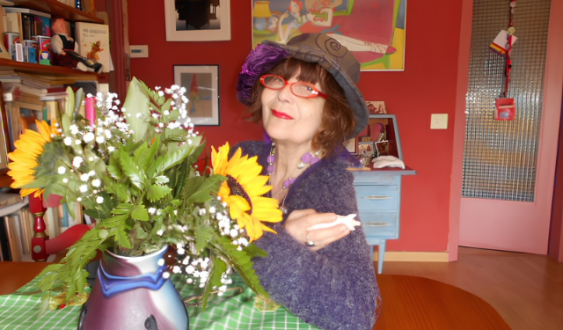
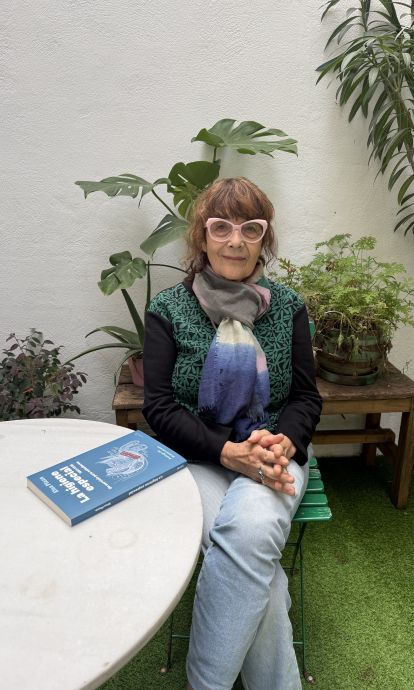
Elsa Plaza unhurriedly sips an afternoon black tea with lemon and sugar while recalling that 1975 when her life changed. She was twenty-five, hungry for freedom and brimming with proletarian pride. “I wasn't an activist as such, though I had close ties to the Federación Obrera de Constructores Navales, the historic Argentine anarcho-syndicalist shipyard union.” She left just in time to escape Videla's bloody dictatorship.
In the background, the steady tempo of Procol Harum's A Whiter Shade of Pale lends the Bar a solemn atmosphere. “I stayed in Paris for two years, after which I came to Barcelona, where, despite never losing my accent, I never once felt like a foreigner.” She learned Catalan and quickly became part of the feminist circles of a city freshly emerged from one regime and not yet tamed by the next.

La Coordinadora Feminista on Carrer de Casp, LaSal on Carrer de la Riereta, artist Mari Chordà, the Associació Catalana de la Dona, the first major International Women's Day march... Elsa was right there in the thick of it all, witnessing it first-hand while working as an illustrator for local magazines and for the very first Feminist Diary ever published in Spain, brought out by LaSal Edicions.
The capacity of different lived experiences to move us aesthetically as a prelude to artistic creation.
“Writing really began when, after finishing my Fine Arts degree, I wrote my thesis, Acerca del tiempo y la memoria, moving towards an aesthetics of inclusion. That prompted me to write a series of articles linking the capacity of different lived experiences to move us aesthetically as a prelude to artistic creation.” Niche, cerebral material “that wasn't going to draw many readers,” she laughs. So one fine day she decided to write for the sheer fun of it, and out came her debut novel, Rojiza penumbra – “starring my male alter ego in that mid-seventies Paris” – published in 2006. From then on, as the saying goes, the best was yet to come.
Enjoying the cycle
As much as – or even more than – writing itself, Elsa Plaza takes particular delight in the entire research process. Her stint at the Archive of the Crown of Aragon as an archivist led her to write El cielo bajo los pies, a work of literary fiction centred on the figure of Enriqueta Martí, about whom shortly afterwards – “faced with the overwhelming volume of material I had gathered” – she published the landmark non-fiction study Desmontando el caso de la vampira del Raval. “Diving into the archives gives me immense pleasure, because you know you will almost never find what you set out looking for, yet you stumble across all manner of surprises!”
She has alternated between fiction and non-fiction – often blending the two – relishing that cycle between archival research and the sheer pleasure of writing.
Throughout her career, the writer and researcher has alternated between fiction and non-fiction – often blending the two – relishing that cycle between archival research and the sheer pleasure of writing. Out of that process have emerged works of fiction including El magnetismo del viento nocturno, Jacqueline o el eco del tiempo, and Un tango para Emmy Langer, alongside striking non-fiction titles like La calle olvidada, La vieja cárcel de la calle Amalia, and the newly published Higiene especial, un servicio para caballeros (AlRevés) – a meticulous study starting from the lives of two women, María Tabuenca and Felicia Navarro, to reconstruct the entire machinery that, under the pretext of safeguarding public health, exploited thousands of women across countless Barcelona brothels between the 19th and 20th centuries. It is a rigorous work exposing the mechanisms governing this institutionalised subjugation of women – telling Big History through small stories, much like her beloved Natalia Ginzburg, of whom she is clearly a gifted disciple.
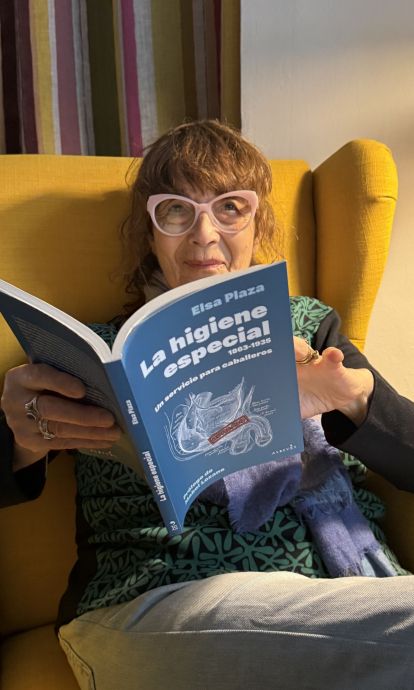
“Right now I am presenting this book while looking for a publisher for my next one, already finished, which is titled La luz en la ventana and reflects on history as the sum of documented facts and subjective memories, set in Northern Patagonia, where my mother's family comes from,” she announces. Added to that is a series of talks on Ginzburg, which she is currently finalising, and spending time with her children and grandchildren – “my greatest pride, because above all they are decent, good-hearted people.”
Her demand is clear: “that Barcelona be returned to Barcelonans.”
Two-sided activism
“The story of my relationship with this city is one of two-sided activism: as a local resident and as a researcher and populariser of history.” In both capacities, her demand is clear: “that Barcelona be returned to Barcelonans. That is what I love most about this city – its people, my people, my friends.” Reclaiming the notion of urban heritage as a defence of neighbourhood life is, for her, the antidote needed to halt the process whereby “Barcelona has ended up turning into a theme park,” she declares, finishing off her black tea.
– What forges unbeatable neighbourhood bonds is good food around the table. Dinner time is approaching, and you might fancy trying something from our delicious menu…
Elsa Plaza accepts without hesitation, as her beloved Beatles play in the background (A Day in the Life, to be precise) and the regulars in the Bar begin to liven up. “A tapa of Spanish omelette and, to go with it, a small glass of cava,” she orders.
– With or without?
The writer smiles. “With onion, of course.”
Of course.
Add The New Barcelona Post as your preferred Google source for free
Stay informed with the latest news.